What a Room Looks Like
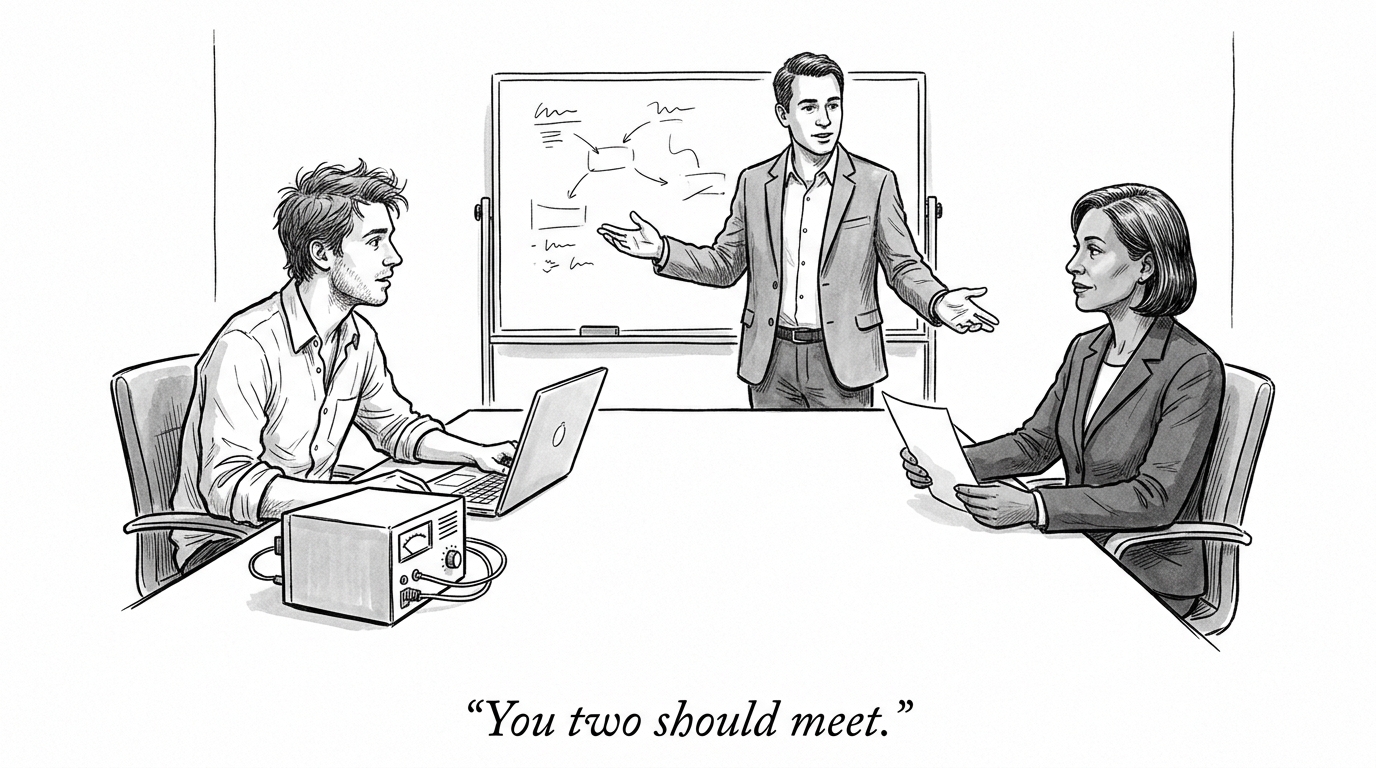
Most of the companies In-Q-Tel funded had never thought of the government as a customer. The work was building a room where they could meet one.
The room
In-Q-Tel is a strategic investor outside government, set up to find commercial technology for the intelligence community. It invests for a customer's need first, not for a fund's return. Its counterpart inside the CIA was the In-Q-Tel Interface Center, the QIC. The CIA's own archived page describes it as the center that links In-Q-Tel to the Agency, developing the problem set for In-Q-Tel and managing the Agency's relationship with it.[1][2] The QIC sat in the CIA's Directorate of Science and Technology, and the Agency's page on it appears under that directorate.
That is the structure, and it is a room with two doors. On one side were people inside the government with a need. On the other were companies that were building something useful and had no reason to think the government was a place to sell it. The room was where the two could find each other.
Finding the match
I was on the In-Q-Tel side for 13 years. Being inside was finding the match. Most of my work was finding a customer at the QIC, someone with a need, and then finding a company that met it.
The QIC developed the problem set, and the problem set told us what the government needed. That was where the search started. Then I looked for the company that met it.
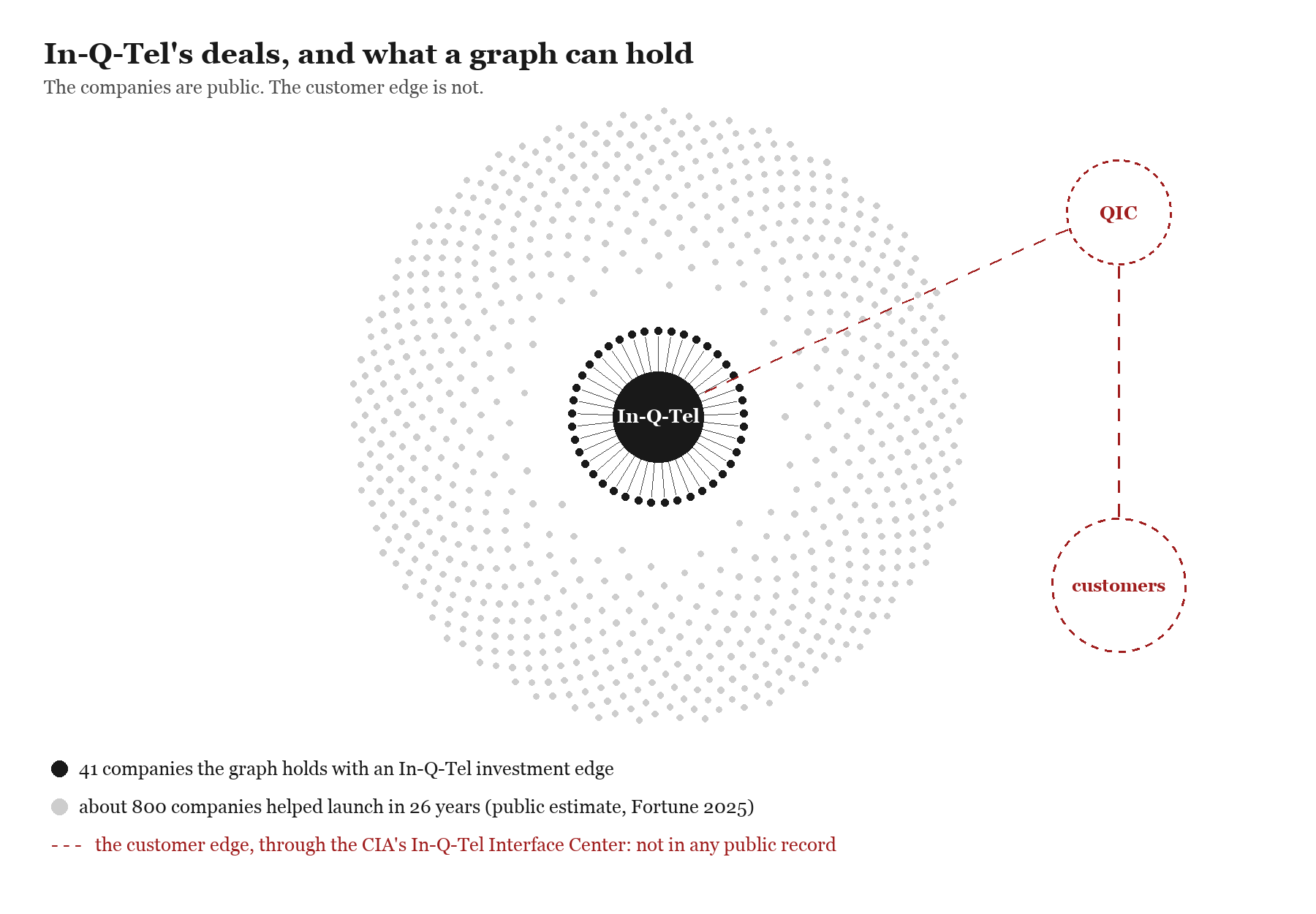
While I was there we averaged 30 to 60 deals a year. Over 13 years that is roughly 400 to 800 deals, and every one of them had a customer who came through the QIC.
Those are my numbers. The public ones point the same way. In-Q-Tel has helped launch more than 800 companies in 26 years, by one count,[3][4] and In-Q-Tel's own investment chief put it at 50 to 60 a year in 2020, and a summary of a 2024 talk of his puts it near 75.[5][6]
What the graph holds
The companies themselves are public. In-Q-Tel's own website lists a snapshot of its investments and cites more than 800 in total.[3][4] The graph my company keeps holds 41 of them for In-Q-Tel, with a handful of people. Only two of the 41 carry dates inside my 13 years; most are dated later, or not at all.
The graph is thin for every investor, not only this one. Look at the firms that make the most deals. In 2024 Andreessen Horowitz led venture capital with 100 reported post-seed rounds, Y Combinator had 97, General Catalyst 84 and Lightspeed 79, by Crunchbase's count.[7] In-Q-Tel's pace, my 30 to 60 a year and the 50 to 75 in those sources, puts it in the same neighborhood by count.
Strategic investors are the closer comparison, and corporate venture arms are the best-known kind, because they invest for a parent with its own needs. Global Venturing's 2024 ranking put Alphabet's GV first among them, and Crunchbase counted 26 deals for Salesforce Ventures by mid-September 2024.[8][9] In the graph, In-Q-Tel is the most heavily recorded corporate venture investor by a wide margin: 37 investment rows, against 12 for Salesforce Ventures, 8 for Google Ventures and 6 for Qualcomm Ventures. Ten of the 17 corporate arms the graph lists have none.
The count is where the similarity ends. A corporate arm invests for its own parent. A busy venture firm invests for its fund's return. In-Q-Tel's deals had a customer in a different institution, and the work was making that introduction. A graph can hold the company and the date. It cannot hold the customer's need, who carried it across, or the room.
What a resume shows
The same is true of the people. Take three senior people I worked with, from the same world, each with a long career. One writes it all out: the agency on every role, the offices, the titles, the size of the teams. One writes the minimum: his longest job is a single line for the whole government, with a state and two dates. One starts after: the profile begins in the second half of a career, and the first thirty years appear only in other people's biographies of him.
I could name dozens more. These are three of them. I was never a government employee, and I worked with all three.
Each resume has a reason. The rules for people who held clearances let them say they held one and at what level, and warn against naming facilities or projects that may themselves be classified.[10] Some CIA staff are publicly acknowledged, such as senior managers and recruiters, while many analysts and scientists work under what is called light cover, telling the public they work for another part of government.[11] So the form of a resume follows the role and the writer's choice. None of it is wrong. None of it is the person, and none of it shows the room they worked in.
What a network shows that a resume cannot
Network analysis has a name for the position I held. A structural hole is a gap between two groups with different information. A person who connects across it is a broker, and brokers tend to see what people inside either group do not.[12] The older finding about weak ties says something similar from the other side: acquaintances often matter more than close friends for new information, because close friends move in the same circles and know the same things.[13]
The government's needs and the companies' products sat on opposite sides of a gap, and neither side knew what the other held. I had no government employer, so I belonged to neither side's chain of command. My place was between them. A resume can list where you were. It cannot list the gap you stood in, or the people on each side who trusted you to carry a problem across.
What a reader can do
If you hire, or invest, or choose partners, and you are reading someone from this world, you are reading nodes. The line may be one generic title, or the profile may begin late. Do not read that as a gap in the person. Ask for the edges instead, at the level that can be said: who the customer was, what problem they had, who vouched for the work, how many times it was repeated. Those answers can be given without a classified word.
If you are the one writing the resume, say what you may: your clearance, the scale of what you managed, the number of deals or projects, and who else can speak to it.
What I do not know
The 800-company figure comes from In-Q-Tel and from news profiles, and the firm's public list is a snapshot rather than a full record, so every count here is an estimate, and the 75-a-year figure comes from an AI summary of a talk, not a transcript. I do not have a public source for the number of deals in my own tenure, which is my account, as is the fact that each deal's customer came through the QIC. Whether most funded companies had never considered the government a customer is also my account, from the deals I worked, not a counted figure. The graph I looked at may simply be incomplete, and that is part of the point. My sources on resume rules and cover are a job board and a magazine, not the agency. And I cannot say why any one person wrote his resume as he did.
- the CIA's archived page on In-Q-Tel (2004), The In-Q-Tel Interface Center (the CIA's archived page on In-Q-Tel (2004))
- Wikipedia, In-Q-Tel, The In-Q-Tel Interface Center (Wikipedia, In-Q-Tel)
- Fortune, "In-Q-Tel, the CIA's venture arm" (July 2025), In-Q-Tel's portfolio size (Fortune, "In-Q-Tel, the CIA's venture arm" (July 2025))
- In-Q-Tel's own portfolio page, In-Q-Tel's portfolio size (In-Q-Tel's own portfolio page)
- Sherwood News, citing George Hoyem of In-Q-Tel in a 2020 interview (50 to 60 a year), In-Q-Tel's annual investments (Sherwood News, citing George Hoyem of In-Q-Tel in a 2020 interview (50 to 60 a year))
- a third-party AI summary of Hoyem's 2024 Stanford seminar (about 75 a year), In-Q-Tel's annual investments (a third-party AI summary of Hoyem's 2024 Stanford seminar (about 75 a year))
- Crunchbase News, "Most active investors" year-end 2024 recap, Most active venture investors, 2024 post-seed rounds (Crunchbase News, "Most active investors" year-end 2024 recap)
- Global Venturing, "CVC's most active investors in 2024", Corporate venture activity (Global Venturing, "CVC's most active investors in 2024")
- Crunchbase News on corporate deals, Corporate venture activity (Crunchbase News on corporate deals)
- ClearanceJobs, What a cleared resume may say (ClearanceJobs)
- Slate, Overt and undercover staff at the CIA (Slate)
- Wikipedia, "Structural holes", Structural holes (Wikipedia, "Structural holes")
- SAGE encyclopedia entry, Weak ties (SAGE encyclopedia entry)