What Ends Your Game?
5 min read
Ask who owns a company and you learn who gets paid. Ask what ends the game the owner is playing and you learn what the company will be asked to do. The two questions sound alike. They are not, and the difference explains a good deal about which companies last.
Last updated October 25, 2026
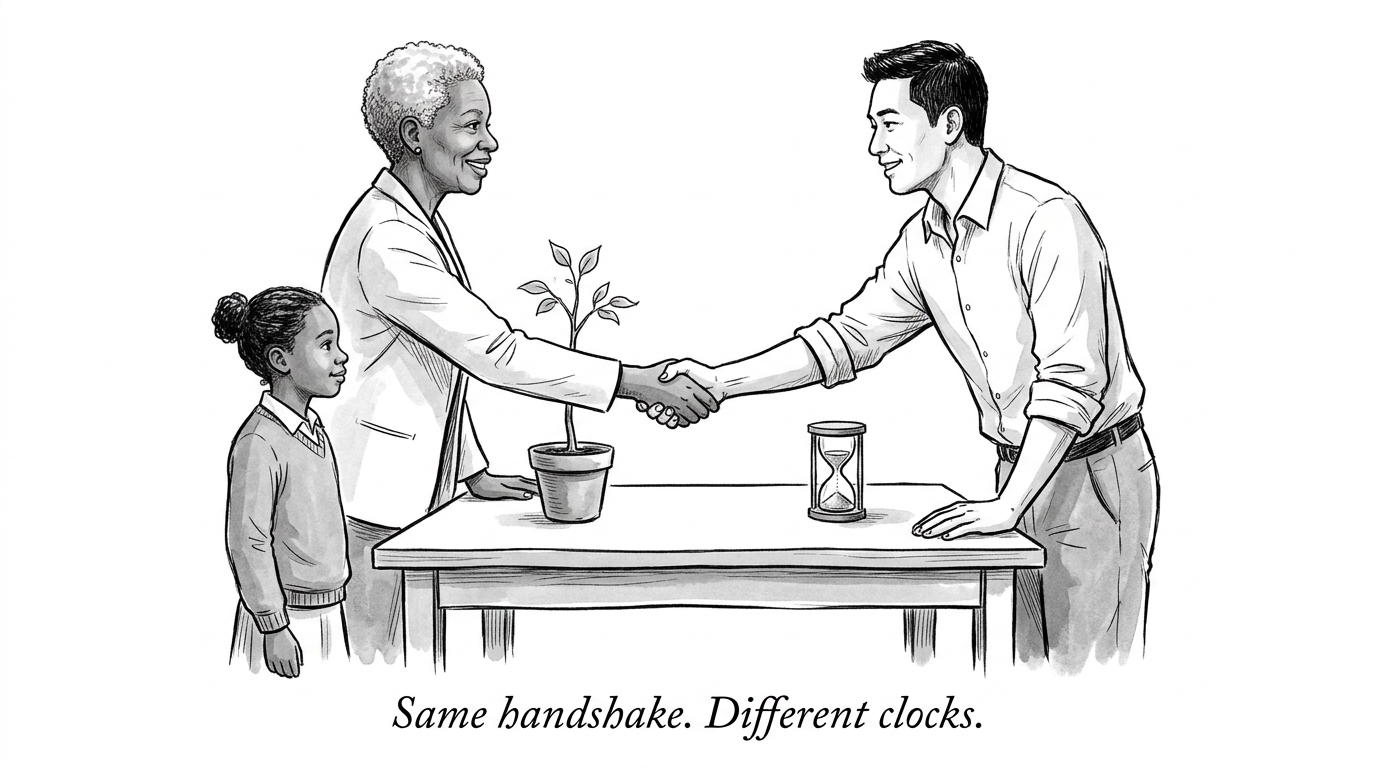
Ask who owns a company and you learn who gets paid. Ask what ends the game the owner is playing and you learn what the company will be asked to do. The two questions sound alike. They are not, and the difference explains a good deal about which companies last.
## Two kinds of game
The philosopher James P. Carse drew a distinction in a 1986 book, *Finite and Infinite Games*. A finite game is played for the purpose of winning, and it ends when someone has won. An infinite game is played for the purpose of continuing the play.[1] A finite player stays inside the boundaries; an infinite player treats the boundaries as something to play with.[1] Carse's own examples of finite games include chess, politics and war; among the infinite ones he lists language, religion and culture.[2] Not every reader found the book easy: *Kirkus* called it "thickly braided" and its profundity "choppy."[2]
Carse was not writing about business. But a company is a place where both games get played, and which one is being played depends on a question that rarely gets asked out loud: what ends it?
## Sears, and the game that had an end date
In 2005, Eddie Lampert, who ran the hedge fund ESL Investments, took control of Sears through Kmart.[7][8] By the Associated Press's account a year after the merger, he was the billionaire chairman of the combined company.[9] By early 2017 his personal assets were estimated at about $2 billion, primarily in ESL.[8] In October 2018 Sears Holdings filed for Chapter 11 in the Southern District of New York, and Lampert stepped down as chief executive, remaining chairman.[10]
A hedge fund is a vehicle with its own ledger. A man whose fortune sits in the fund and not in the company can do well while the company does badly. That is a finite game: win the position, collect, exit. Nothing in it requires the company to be there in thirty years. I wrote about this earlier as a question of who has to live with a decision.[17] Carse gives it a sharper name. The decision-maker was playing to win. The company needed someone playing to continue.
## The families that were playing the other game
Wawa's roots go back to 1803, when David C. Wood started an iron furnace in Cumberland, New Jersey; the Wood family's investments later evolved into the dairy and the convenience stores people know today, according to the Hagley Museum, which holds a deposit of Wawa's documents and images.[11] The first Wawa Food Market opened in 1964, and the Wood family still holds the land around the company's headquarters and dairy farm.[12] 84 Lumber was incorporated in 1956 by Joe Hardy; he named his daughter Maggie his heir apparent in 1991, and she became president in the early 1990s (one account says 1993, another 1992).[13][14]
Neither company stayed the same. Wawa changed its business more than once, as the Hagley account makes plain. What stayed was a family's hand on it across generations. That is the infinite game's signature: the rules and the business can change as long as the game itself is never allowed to end.
## The trap in the middle
It would be easy to stop here and say that owners who hold are good and owners who sell are bad. That is not the lesson, and Kodak is the proof. Kodak's leaders were not outsiders extracting value. They were career people whose futures were bound to the company's, and Kodak still filed for Chapter 11 in January 2012.[15][16][17] The tether pointed at the health of the business they already had and not at the survival of the company past it. They were playing a finite game too: win the film business. It was a game they could have won for years, and it ended.
So the question is not whether the owner is committed. It is committed to what, and until when.
## The funds are finite by design
Private equity funds are typically structured as limited partnerships with a fixed term of ten years, often with extensions.[5] A Canadian law firm describes the same shape for private equity and venture funds: a term of ten years, with the general partner able to add one or more one-year extensions.[4] Venture capital funds are described as maturing in ten to twelve years, with a few years of extension possible.[6] There is nothing sinister in this. A fund promises its investors their money back, and a promise like that needs an end date. But an end date is exactly what makes it a finite game, and the companies the fund backs inherit a clock they did not choose. That reading is mine; the sources describe the terms, not their effect.
Before asking whether a company is well run, ask what ends the game of the person holding it.
## A family office thinks in generations
The Securities and Exchange Commission describes family offices as entities established by wealthy families to manage their wealth and provide other services to family members.[18] Its rule defining them counts as family members the lineal descendants of a common ancestor up to ten generations removed from the youngest generation.[18] Another source describes the goal as growing and transferring wealth across generations.[19] The clock a family office runs on is not a fund's ten years. In my experience at family office events, the horizon people plan to is two or three generations, and it does not end when a position is sold.
That is a different game, and it changes what counts as a good decision. A family office that holds a business for decades is not being patient for its own sake. It is playing the one game in which a company's survival past its current business is the whole objective. That is the game Kodak's leaders were not playing and Lampert did not have to play.
## What ends your game?
If you are advising, investing, or running something, the useful question is the one that sounds least like a financial question. Not who owns it, not what it earns, but what ends the game you are in: a quarter, a fund's life, an exit, a founder's tenure, a generation. Whatever the answer is, the company will be asked to serve it. In the cases here, the companies that lasted were held by people playing to continue.
Sources
- Kirkus Reviews, review of *Finite and Infinite Games*, issue of August 15, 1986 (read as text):
- Wikipedia, "Finite and Infinite Games" (read as text; secondary):
- MLT Aikins LLP (Canadian law firm), "An overview of private equity or venture capital fund timelines" (read as text; describes Canadian funds):
- Wikipedia, "Private equity fund" (read as text; secondary):
- Wikipedia, "Venture capital" (read as text; secondary):
- Wikipedia, "Sears" (read as text; secondary):
- Wikipedia, "Eddie Lampert" (read as text; secondary):
- The Associated Press, "Sears-Kmart strategy still murky a year later," March 17, 2006, via NBC News (read as text):
- Home Furnishings News, "Sears Holdings files Chapter 11; Lampert steps down as CEO," October 15, 2018 (read as text):
- Hagley Museum and Library, "Research: Iron, Cotton, Cows and Wawa Coffee," June 16, 2016, drawing on Howard Stoeckel, *The Wawa Way* (2014) (read as text):
- Wikipedia, "Wawa (company)" (read as text; secondary):
- Funding Universe, "84 Lumber Company History" (read as text):
- Wikipedia, "84 Lumber" (read as text; secondary; gives 1992):
- Engadget, "Kodak files Chapter 11 bankruptcy, expects to complete restructuring by 2013," January 19, 2012 (read as text):
- Wikipedia, "Kodak" (read as text; secondary):
- DoAyni, "IBM Just Showed Off a Chip That Runs Two Instruction Sets at Once. The Company Is 115 Years Old. Most Companies That Old Are Dead.":
- U.S. Securities and Exchange Commission, "Family Offices," Investment Advisers Act Release No. IA-3220 (final rule, 2011) (read as text):
- Wikipedia, "Family office" (read as text; secondary):