What Survives Automation
I use a machine to read for me, write for me, check my numbers and file what I learn. It does all of that better than I do on most days. After a year of working with it, I can tell you what it has not taken, and why I do not expect it to. It is a short list, and each item on it is an act of trust.
What I handed over
A good deal. The system reads my inbox before I do. It extracts facts, resolves names, keeps a ledger of what it writes, and drafts the first pass of what I publish. I wrote about that harness in an earlier piece, and I use it every day.[1] I do not miss the work it took. I would not go back.
What stayed
Four things, so far.
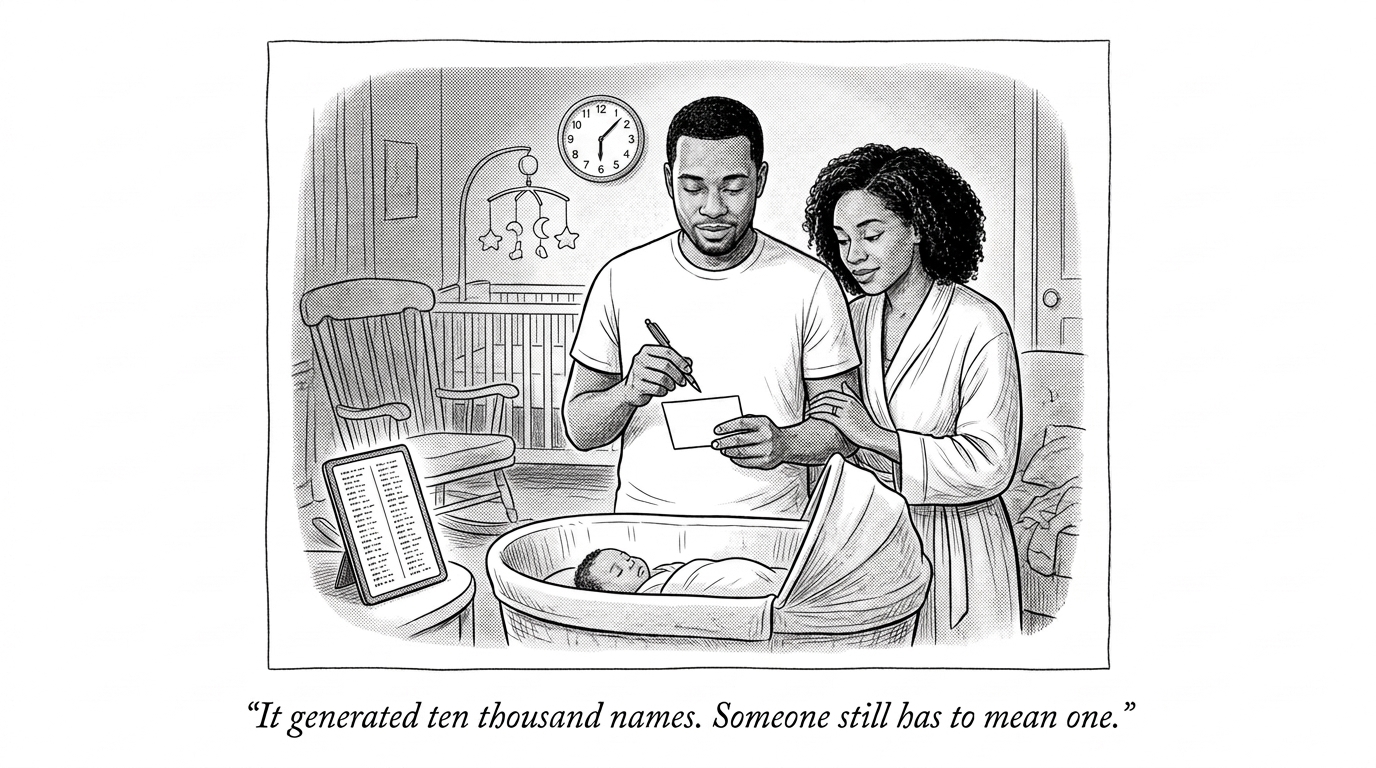
A name given on trust. When a family names a child, nothing has been achieved yet. The name is a hope for a future no one can see, given before there is anything to measure. We name on trust, on expectation, not on achievement.[2] A machine can generate ten thousand names. It cannot mean one. The meaning comes from the person who is trusting the child with it.
Handing something down. A recipe, a book, a tool, a drive on a shelf that someone else can use better than I can. I hand down only what I have used myself, because the handing is a promise: this is good, I have checked. A machine can copy a file. It cannot stand behind it.
The read. The model produces answers. Someone has to decide which one goes out under their name. In my own work I read everything the system writes before it is published, because the most valuable thing in the process is the part that is accountable for the answer. A model can process text about a meeting. It did not see who stopped nodding.
The walk. The finished piece is a document. It is not possible without the walk that produced it: the questions, the sources found and dropped, the claims I withdrew and why. I keep that record because it is how I know which claims were earned.
Trust, and how it moves
All four are acts of trust, so I should say how I decide whom to trust, because I make the decision every day, with the tools themselves.
I extend trust in two ways. The first is by transference. I read what the founders of a company say about what they are building, and then I watch whether the harness and the model behave the way they said. In my sessions, the tool I use declines certain things and asks me to run commands it could run itself. Other platforms I have used do not behave that way. That is my experience, not a measurement, and I read it as a decision its builder made on purpose.
The second is by verification. I run open models, including Meta's Llama family, Alibaba's Qwen family and the Falcon models from the Technology Innovation Institute in Abu Dhabi.[3] I trust them differently, because I can change the weights, inspect what is published, watch what they do to the GPU and build their harness myself. A hosted model is an input and an output with nothing visible between. An open one I can look inside. There is one family I decline to run, because I do not trust its builders. That is my judgment, not a finding.
I use Anthropic's Claude to help write and to run my research, and I trust that builder more than the other large labs. That is my view, and it rests on my own reading of what they say and how the product behaves. A reader should weigh it with that in mind.
The library behind the operator
The mechanism works because the operator walks in with a library behind him. I recently had to explain Schrödinger's cat to someone I was talking with, in a discussion about quantum computing and what happens to a state when you read it out. It was a hard conversation because the person was smart and had no concept to place the idea in. There was nowhere for it to land.
That is what a library is for. A good explanation needs a frame to land on, and intelligence by itself does not supply one. The same tool gives a thinner result to someone without the frame, so I suspect the person with the least access to books and teachers gets the least from the same machine. If that is right, access matters more now, not less.
What I do not know
- Whether these four acts really cannot be automated. I have an argument, that they are acts of trust and trust is given by people, but I have no evidence, and I would not be surprised to see someone try.
- Whether my trust in one builder over another will survive what they do next. It is a judgment I will have to keep checking.
- How this looks from the side of someone who does not have the library. I am describing it from the side that does.
The accounts of my own work, my reading of builders, and what I trust and why are mine. Claims about how other platforms behave are my experience, not a comparison I can document. I use Claude, made by Anthropic, as part of my work, and that is a reason to read my view on it with care.