American F-86 Pilots Beat a Technically Superior Soviet Jet in Korea Because They Decided Faster. A Driverless Car Runs the Same Race in Milliseconds -- Too Fast for a Human to Ever Get a Vote.
During the Korean War, American F-86 Sabre pilots consistently beat Soviet-built MiG-15s in air combat, even though the MiG-15 climbed faster and flew higher -- on paper, the better aircraft. Air Force colonel and strategist John Boyd studied the mismatch and built an explanation around it that became one of the most cited frameworks in modern strategy: the F-86's cockpit gave pilots a wider field of view, and F-86 pilots were trained to move through a decision cycle -- observe, orient, decide, act, the OODA loop -- faster than their opponents could. Whoever completes that cycle first doesn't just react faster. They get inside the other side's own decision cycle, acting before the opponent has even finished orienting to what just happened.[1] The commonly cited 10:1 kill-ratio figure that made this case famous has since been challenged by aviation historians as too high -- the real ratio was almost certainly lower, though still a real American advantage.[2] The mechanism Boyd named held up better than the specific number that popularized it.
Judgment lives in the Orient step -- and Orient is the one step that can wait
Working well with an AI system depends on a step that looks a lot like Boyd's Orient phase: interpreting what the system produced before deciding what to do with it. In ordinary AI collaboration -- drafting, brainstorming, research -- that interpretation step can take as long as it needs to. Nothing bad happens if a person takes an hour, a day, or a week before reacting to a draft. Discernment is only possible in the first place because deferral is always available: a human can insert judgment before anything happens, because nothing happens until the human responds.
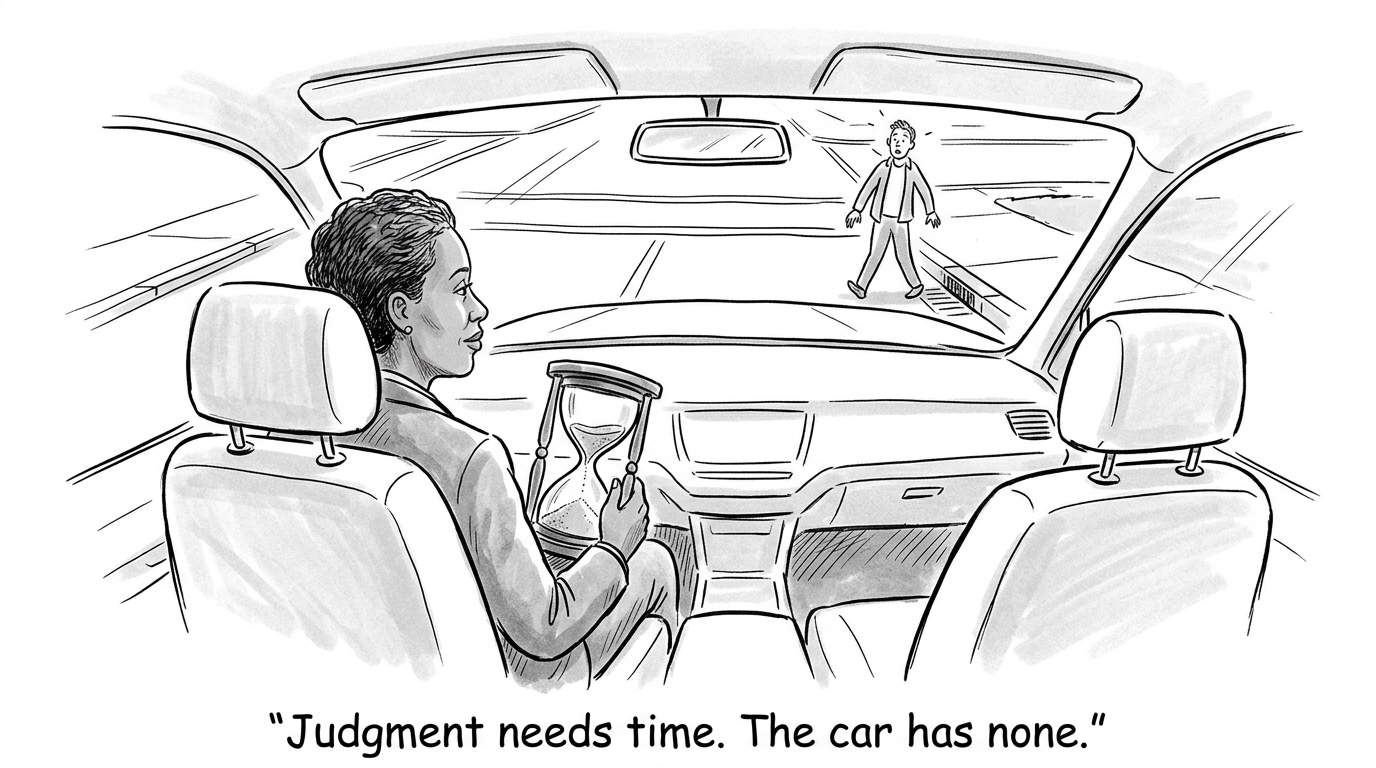
A real-time physical system has no equivalent slack, and that is a structural break, not just a harder version of the same problem. A driverless car reacting to a pedestrian, a shop-floor robot, an industrial safety interlock -- each has a decision window measured in milliseconds, faster than human deliberation can operate in at all. The device has to complete its own OODA loop and act, because there is no time budget left for a human-mediated Orient phase. This isn't a matter of the system being less trustworthy in physical form. It's that the one condition discernment has depended on this whole time -- the ability to wait -- runs out first exactly where the stakes get physical and immediate.
The everyday version isn't a weapon at all — it's the car in the next lane
You don't need a battlefield to find a machine that owns its own OODA loop with lives on the line. A self-driving car at speed has the same millisecond decision window as the shop-floor robot, except it runs on public roads, around pedestrians, with no war anywhere in the frame. When someone steps off a curb, there is no version of events where a human passenger observes, orients, decides, and acts in time — the car has already completed the loop, or it hasn't. The stakes are ordinary and total at once. This isn't hypothetical: in 2018 an Uber self-driving test vehicle struck and killed a pedestrian, Elaine Herzberg, in Tempe, Arizona — the first recorded death of a person by an autonomous vehicle. There was a safety driver behind the wheel, present precisely to supply the human judgment the system might lack, and she wasn't looking up in time. That is the whole argument in one intersection: the fallback was a human's ability to orient, and the one thing a real-time system removes is the time to do it.
The clearest version of this isn't a factory floor. It's a weapon with the judgment step removed on purpose
Most people will never stand anywhere near a military drone; nearly everyone will eventually share a road with a car that owns its own loop. That is why the car leads this argument and the weapon only closes it — the weapon is the sharpest version precisely because it is the rarest. Mass-casualty autonomous drones need no new technology to become viable -- only integration of components that already exist, because indiscriminate targeting is a far lower bar to clear than precision targeting. Precision targeting still needs something like discernment: distinguishing a real target from a decoy, a combatant from a civilian. Indiscriminate targeting removes that step from the problem entirely rather than simply speeding past it. That is a sharper, more legible version of the shop-floor example -- not because the technology is more advanced, but because the judgment step isn't merely fast in this case. It has been engineered out.
The industry is already moving from generating content to acting in the world -- and one real attempt already failed
Three separate 2026 product efforts show the same shift in direction, with genuinely mixed results. Google DeepMind's Project Astra is a multimodal agent built specifically to perceive, remember, and interact with the physical world in real time -- processing live video and audio together and taking action inside real tools (search, email, calendar, maps), not just describing what it sees.[3] NVIDIA's Cosmos platform, announced in 2025 and now on its third major version, is a "world foundation model" purpose-built to simulate physical environments and generate real robot action sequences -- a training ground where a robot policy can be tested and refined against a physics-grounded simulation before it ever moves in the real world.[4]
OpenAI's Atlas browser, launched in October 2025 to let an AI agent act directly inside a person's own browser, did not survive its first year: OpenAI shut it down in mid-2026, folding its functions into a different product, after it ran into exactly the kind of new failure surface that pure content generation never had to deal with -- prompt-injection attacks, security flaws, and an agent too slow and unreliable to trust with real actions.[5] Atlas is the concrete, dated case for this piece's own caution: giving a system the ability to act in the world doesn't just raise the stakes of an existing risk, it opens entirely new ones -- an AI system taking real browser actions can be manipulated by hostile content it encounters while acting, a risk with no real equivalent in a system that only ever produces a draft for a human to review first.
Training the judgment doesn't get faster just because deploying it does
An experienced human operator's own judgment was never installed complete in one transfer -- it was built the same slow, incremental way any real expertise is built: reached for, missed, corrected, repeated, over years. That doesn't soften the real problem with real-time physical AI -- a deployed system still can't defer once it's live, no matter how it was trained -- but it does mean the training question and the deployment question are two separate problems. Whatever judgment a real-time system runs on had to be built slowly, the same way any judgment is built. It just can't be exercised slowly once it's actually running.
Why does this matter? The interesting question about AI and judgment was never "will AI eventually be smart enough to be trusted." It's narrower and more mechanical than that: where does the human's ability to wait before deciding actually run out? Boyd's F-86 pilots won by moving through their own decision loop faster than a slower-deciding opponent -- a human advantage. Physical AI is the place that same logic flips, and the system, not the person, ends up owning the loop.
This piece is one part of a longer argument. The full essay: "How to Build a Mind".
- StrategyU / balloonstodrones.com, The OODA Loop: John Boyd's Decision-Making Framework -- Origins in Korean War Air Combat
- From Balloons to Drones, The Korean War and the OODA Loop: What Happened to the Kill Ratio?
- Google DeepMind, Project Astra -- multimodal AI agent for real-time physical-world interaction
- NVIDIA, NVIDIA Cosmos -- World Foundation Models Powering Physical AI
- The Register, OpenAI's Atlas browser doesn't make it to its first birthday