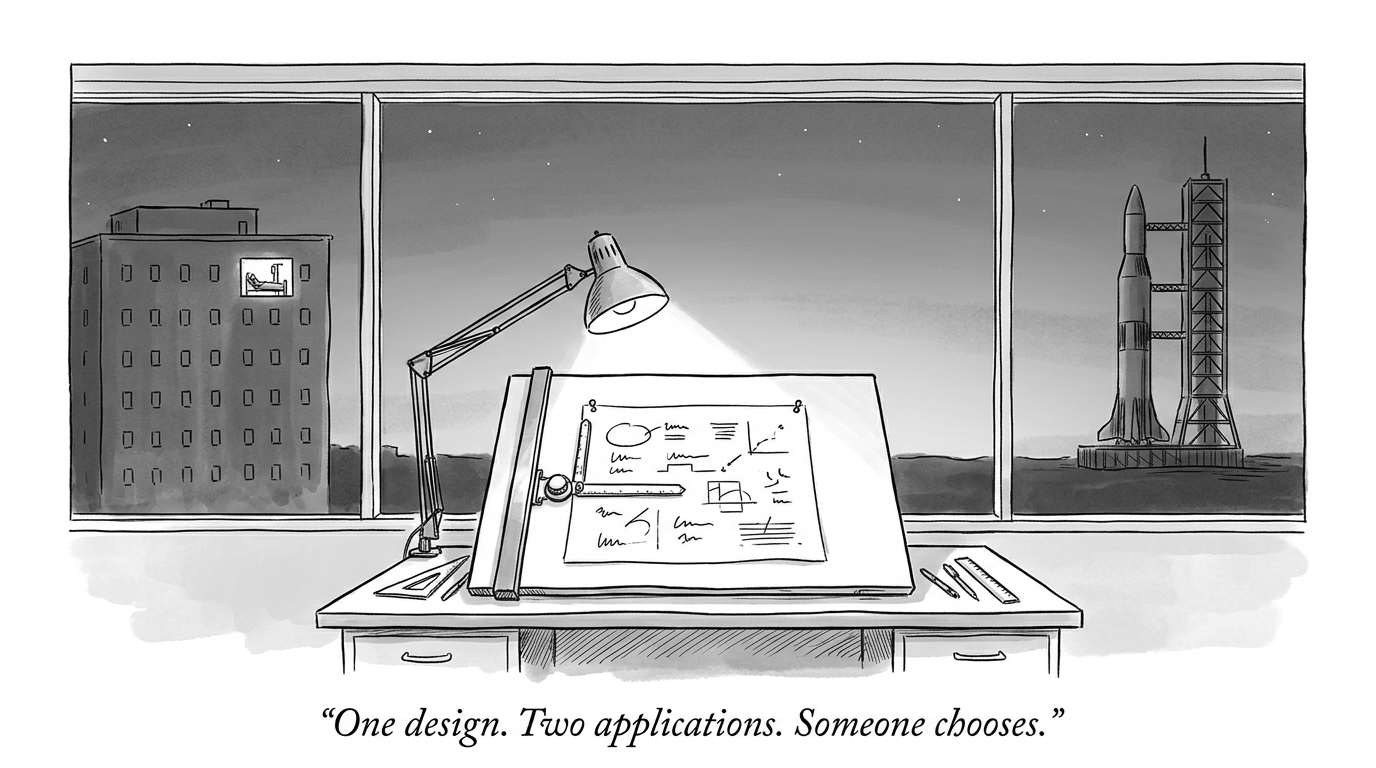
A rule can be written about a reactor, a person or a treaty. It is harder to write one about an idea. This piece follows one idea from the Institute for Advanced Study in Princeton, through a spaceship driven by bombs, a bird flu paper and an encryption algorithm, and asks what it means that the same knowledge builds and destroys. It is the second half of a story that begins with the Manhattan Project, where the rules about who decides came after the bomb. This half asks why they keep coming after the use.
Princeton, and the computer
Some of the scientists who left Europe after 1933 went to the Institute for Advanced Study in Princeton, New Jersey. The Institute was incorporated on May 20, 1930, with $5 million from a brother and sister, Louis and Caroline Bamberger.[1] It describes itself as having become "a lifeline" for scholars leaving Europe after Hitler became Chancellor in January 1933.[1] By 1933–34 its faculty included Einstein, Weyl and von Neumann. Weyl had succeeded Hilbert at Göttingen.[1] The Institute is a separate institution from Princeton University, with, in its own words, "no formal links."[2]
The computer needs two names explained first. A stored-program computer is one in which data and instructions are stored and manipulated alike: the program sits in the same memory as the numbers it works on, so a machine can be given new instructions without being rebuilt.[3] The design built at the Institute in the 1940s is called a von Neumann machine, after his 1945 report on the EDVAC, the better-known of the two plans. The idea behind it came earlier from a British mathematician, Alan Turing. In 1936–37 he published a paper that gave a definition of computation and an absolute limit on what computation can do. It described a "universal machine" that could read the instructions of any other machine and do what that machine would have done.[3] He went to Princeton for more advanced work in logic, had the chance to stay in the United States, and went home in 1938, then spent 1939 to 1945 at Bletchley Park working on the German Enigma cipher.[3] In 1945 von Neumann's report on the EDVAC set out the design of a stored-program electronic computer, and Turing wrote a detailed plan of his own, published in 1946.[3] One historian argues that von Neumann reached his insight through his pre-war familiarity with Turing's logical work; at the time, the basic principles were not much discussed.[3] The Institute itself calls its machine "the physical realization of Alan Turing's Universal Machine."[4] The field's highest honor carries Turing's name: the ACM A.M. Turing Award, given since 1966, which the Association for Computing Machinery calls its most prestigious technical award and which carries $1 million.[5]
The Institute's own account of its Electronic Computer Project is direct. It began in late 1945, in the basement of Fuld Hall, over objections from some faculty. The "original impetus," the Institute says, was "the pressing demands of war."[6] John von Neumann, who began the project, had been a consultant to the weapons laboratory at Los Alamos from 1943 to 1955, and had drafted the logical structure of a stored-program computer in spring 1945.[6] In summer 1951, a team from Los Alamos ran a large thermonuclear calculation on the Institute's machine, around the clock for about 60 days, according to the project's chief engineer, speaking in 1980.[6] Other sources credit Los Alamos's own machine, MANIAC, with a 60-day hydrogen-bomb run that summer.[7] The Institute's design was kept in the public domain, and its progress reports were widely distributed. It was copied at Argonne, Oak Ridge, Los Alamos, RAND and abroad.[6]
Here is what the sources support. They support that von Neumann's weapons work and the first stored-program computers were tied together, and that the design spread because it was published. They do not support any claim that the Institute as an institution did weapons work. Its own description of its research is that it was curiosity-driven. Individuals moved between the two.
A machine built because a weapon needed arithmetic became a template for a generation of computers. No one planned in 1945 what the world would do with that. The design was published, and the world took it.
Dual use means dual use
The phrase has a legal meaning. The Commerce Department's export rules call an item "dual-use" if it has civil applications as well as terrorism and military or weapons-of-mass-destruction applications.[8] That definition is about things you can ship. I want to use the plain meaning, about knowledge. None of the stories below came in two versions.
The same fission that ended a war lit homes. The Atomic Energy Commission, the civilian agency created in 1946 to run the country's atomic program, had both in its own list of functions: controlled development and production of atomic weapons, and research and development of civilian uses.[9] The computer that began as a way to do weapons arithmetic became a template for a generation of computers.[6][7] The laboratory at Los Alamos describes its work as nuclear deterrence and as national security science, side by side.[10] No one drew the line in the physics, because the physics does not have one.
The most literal case sits at the same Institute. Freeman Dyson joined the Institute's faculty in 1953, in the company of Einstein, Gödel and von Neumann. In 1956 he began a three-year association with General Atomic, where he worked on a reactor designed to be inherently safe, the TRIGA, which the Institute says is still in production and used mostly by hospitals.[11] In 1958 he took a leave of absence to join General Atomic's Project Orion, working with forty scientists to design an atomic spaceship that would ride a wave of controlled nuclear pulses into deep space. He later called the fifteen months he spent on it "the most exciting and in many ways the happiest" of his scientific life, and the project once set its sights on Mars by 1965 and Saturn by 1970.[11] The same man, the same company and the same decade produced a reactor for hospitals and a spaceship pushed by bombs. The project was short-lived. The Institute notes that Dyson took part in the public debate over the nuclear test ban treaty and whether an exception should be made for experimentation.[11] The treaty that took effect on October 10, 1963 bars nuclear test explosions in the atmosphere, in outer space and under water.[12]
That is my reading, and it has a consequence worth stating. If the knowledge cannot be split, a rule cannot be written at the level of the knowledge. Rules attach to uses, sites and people: a license for a reactor, a clearance for a person, a treaty about who may have what. Every one of those, in these stories, came after the use existed.
It is the same in biology. The federal policy on "dual use research of concern," issued in 2012, defined it as life sciences research that, based on current understanding, can be reasonably anticipated to provide knowledge, information, products or technologies that could be directly misapplied to pose a significant threat to public health, agriculture, the environment or national security. Its stated aim is to preserve the benefits of the research while minimizing the risk of misuse. The agents it lists include highly pathogenic avian influenza and the reconstructed 1918 influenza virus.[13] The case that pushed the policy was two papers, from Rotterdam and from Wisconsin, showing that a modified H5N1 bird flu virus could pass between ferrets. In December 2011 all 23 members of the National Science Advisory Board for Biosecurity voted to recommend that the two journals leave out key parts of the papers. The journals and the researchers agreed, though they were under no legal obligation to.[14]
And it is the same in encryption. In the 1990s, cryptography was a weapon in law. The State Department's Munitions List, which regulates defense articles, covered all cryptographic systems and software. A graduate student named Daniel Bernstein, working in what the court describes as applied mathematics that seeks confidentiality in electronic communication, was told that a stand-alone encryption algorithm he wrote, and the academic paper describing it, were defense articles requiring a license before export. He sued on First Amendment grounds.[15] On November 15, 1996, President Clinton signed Executive Order 13026, which moved export control of nonmilitary encryption from the Munitions List to Commerce, while military encryption stayed under the weapons rules. The order's own reasoning was that exporting such products could harm national security even where comparable products appear to be available abroad.[16] Bernstein amended his complaint to challenge the new rules, and the court heard the case again in 1997.[15]
In all three fields the thing at issue is not only a machine. It is a paper, an algorithm, a design, a chain of reasoning: knowledge that does the good and the harm in the same form. That is the duality of science, and it is why the rules I have described always arrive as rules about use.
Where the choice sits now
Every story above ran in the same order: the knowledge came first and the rule came after. One company reverses a step in the middle. Palmer Luckey built the prototype of the Oculus Rift virtual-reality headset and sold his company to Facebook in 2014.[17] In a May 2026 interview at the Hoover Institution he called the Pentagon's cost-plus procurement "a horrible broken set of incentives," and said, "It wasn't until I had money from Oculus that I felt like there's something that I could help do to solve that."[18] What he did was co-found Anduril, in 2017, with four others.[19]
The company describes its method in his words. "Anduril is not a defense contractor, we're a defense product company," Luckey said at Hoover. "We use our own money to decide what products to build, how to build them, and then we build those products and then we sell them to the government."[18] In 2019 he told the business school at UC Irvine that taking the risk himself was "how you short-circuit the system."[20] In 1940 the Army wrote the Jeep's specification and asked 135 companies to build it.[21] Here the company decides what to build, pays for it, and then offers it to the buyer.
The technology moves in both directions. DefenseScoop reported in October 2025 that Anduril is building EagleEye, a family of helmet, visor and glasses configurations for the Army, after the Army effectively transferred Microsoft's contract for its earlier augmented-reality program to Anduril in April 2025. Luckey said Meta is providing "some of the wave guide and display technology that they've spent billions of dollars developing." His forecast was that "you are going to see augmented reality on every soldier's head before you see it on every consumer's head," and he expects commoditization by the consumer industry to eventually bring the cost per unit down to the low thousands. He also said Anduril aims to market EagleEye to government entities beyond the U.S. military; the article names first responders and the Department of Homeland Security as possible buyers.[17]
That is my reading of what it adds: the choice of where to apply a design used to sit with whoever held the specification, a government, a laboratory, a licensing office. Here it sits with the builder, who funds the design first and picks the buyer after. The knowledge is no more separable than it was in 1945. What changed is who decides, and when.
Whoever builds a thing like this, and whoever inherits the institution that holds it, has to hold two things at once: creation and destruction. That is what dual use means.
Sources
- Institute for Advanced Study, "Mission and History" (Internet Archive snapshot, January 1, 2026): https://web.archive.org/web/20260101074611/https://www.ias.edu/about/mission-history
- Institute for Advanced Study, FAQs (Internet Archive snapshot, January 1, 2026): https://web.archive.org/web/20260101074550/https://www.ias.edu/about/faqs
- Andrew Hodges, "Alan Turing," Stanford Encyclopedia of Philosophy, first published June 3, 2002, substantive revision September 30, 2013 (read as text): https://plato.stanford.edu/entries/turing/
- Institute for Advanced Study, "George Dyson: The Electronic Computer Project" (Internet Archive copy, May 2026; read as text): https://www.ias.edu/ideas/2012/george-dyson-ecp
- ACM, "ACM A.M. Turing Award" (read as an Internet Archive copy of awards.acm.org/turing, 2025): https://awards.acm.org/turing
- Institute for Advanced Study, "Electronic Computer Project" (snapshot September 25, 2026): https://web.archive.org/web/20260925130406/https://www.ias.edu/electronic-computer-project
- Atomic Heritage Foundation, "Computing and the Manhattan Project," July 18, 2014: https://ahf.nuclearmuseum.org/ahf/history/computing-and-manhattan-project/
- 15 C.F.R. § 730.3, "'Dual use' and other types of items subject to the EAR" (Export Administration Regulations; read as text): https://www.law.cornell.edu/cfr/text/15/730.3
- National Archives, "Records of the Atomic Energy Commission (RG 326)," last reviewed August 15, 2016: https://www.archives.gov/research/guide-fed-records/groups/326.html
- Los Alamos National Laboratory, "About the Lab": https://www.lanl.gov/about
- Institute for Advanced Study, "Freeman J. Dyson (1923–2020), Scientist and Writer, Who Dreamt Among the Stars, Dies at 96," press release, February 28, 2020 (Internet Archive copy, read as text): https://www.ias.edu/press-releases/2020/freeman-j-dyson-1923%E2%80%932020
- Treaty Banning Nuclear Weapon Tests in the Atmosphere, in Outer Space and Under Water, August 5, 1963, entered into force October 10, 1963 (text, Yale Avalon Project): https://avalon.law.yale.edu/20th_century/usmu015.asp
- "United States Government Policy for Oversight of Life Sciences Dual Use Research of Concern," 2012 (read as text; a university-hosted copy): https://www.ccts.cme.uab.edu/ehs/images/docs/bio/dp/2012_United%20States%20Government%20Policy%20for%20Oversight%20of%20Life%20Sciences%20Dual%20Use%20Research%20of%20Concern.pdf
- Wendee Holtcamp, "One Study, Two Paths: The Challenge of Dual-Use Research," Environmental Health Perspectives 120(6): a238, June 1, 2012 (read as text; doi 10.1289/ehp.120-a238): https://www.ncbi.nlm.nih.gov/pmc/articles/PMC3385452/
- Bernstein v. U.S. Department of State, No. C-95-0582 MHP (N.D. Cal., Aug. 25, 1997), opinion (read as text; I did not read the holding): https://cr.yp.to/export/1997/0825-order.html
- Executive Order 13026, "Administration of Export Controls on Encryption Products," November 15, 1996 (read as text): https://clintonwhitehouse6.archives.gov/1996/11/1996-11-15-executive-order-13026-on-crypto-export-controls.html
- DefenseScoop, "Palmer Luckey previews Anduril's new, AI-powered EagleEye headwear ahead of AUSA reveal," October 13, 2025 (read as text): https://defensescoop.com/2025/10/13/palmer-luckey-anduril-eagleeye-ai-headwear-army-ausa/
- Hoover Institution, "Palmer Luckey Wants America to Win," Uncommon Knowledge transcript, published May 20, 2026 (read as text): https://www.hoover.org/plus/research/palmer-luckey-wants-america-win
- Contrary Research, Anduril company profile (secondary source; founding year and cofounder count): https://research.contrary.com/company/anduril
- UC Irvine Paul Merage School of Business, "Palmer Luckey, founder of Anduril Industries, applies entrepreneurial acumen to defense sector," May 31, 2019 (read as text): https://merage.uci.edu/news/2019/05/palmer-luckey,-founder-of-anduril-industries,-applies-entrepreneurial-acumen-to-defense-sector.html
- DoAyni, "In 1940 the Army Wrote the Jeep's Specification and Asked 135 Companies to Build It. Today a Drone Maker Decides What to Build, Pays for It With Investors' Money, and Waits for the Army to Buy.": https://doayni.com/analysis/who-writes-the-need