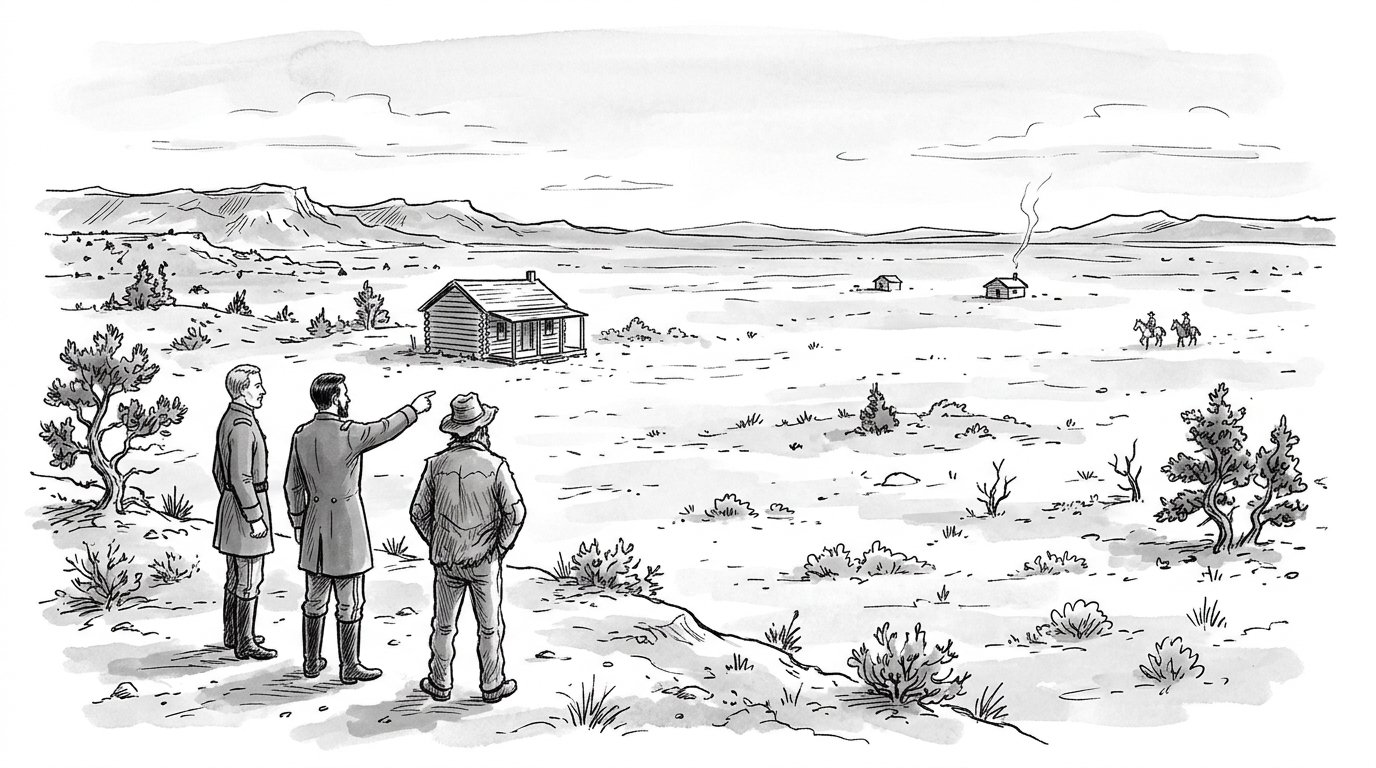
In 1943, babies were born in a town that was not on any map. Some of their birth certificates listed the birthplace as a post office box in Santa Fe, Box 1663.[1] The name of the town, Los Alamos, was itself classified. Documents called it Site Y, or Project Y.[1] The people inside could not travel more than 100 miles from it, their mail was censored, and their driver's licenses, bank accounts and ration books were issued to numbers instead of names.[2] The physicists were told not to use the word "physicist." Everyone was an "engineer."[2]
The town existed for one purpose: to build a bomb before anyone else did. This piece is about what was built first, what was built after, and who was in the room each time. It is a clear example of a pattern that shows up in nearly every large technology, including the biology in the last piece I wrote: people discover, build and use, and then work out what it costs and who pays.
The town
Oppenheimer proposed the site. In late 1942 an Army colonel working for General Leslie Groves had been searching small towns in the Southwest, and favored Jemez Springs, in a canyon. Groves rejected the canyon on sight. Oppenheimer suggested a boys' boarding school on a mesa top, the Los Alamos Ranch School, and Groves approved it.[3] On November 25, 1942, the War Department approved the purchase of the school for $440,000.[4]
The first plan was small. The Army's land memo described a demolition range, and the early estimate of the project's needs was about 30 scientists. In December 1942, construction contracts covered temporary quarters for about 300 people. By the time the school's students left, construction crews had pushed the population to 1,500.[2] By November 1943 the town held about 6,000 people.[5]
The University of California ran the laboratory, under a nonprofit contract; the University was selected on January 1, 1943. The Army ran the town.[2] There was one telephone line at the start of 1943 and three until 1945. Water was scarce. Housing did not keep up: the school's old masters' houses went to top administrators, and everyone else lived in apartments, barracks, hutments and trailers, with some families in tents.[6] A twelve-grade school opened in 1943, and military officials were upset at how elaborate it was.[7] The average resident was about 24, and 80 babies were born in the first year.[8]
Some people paid for the town without ever being inside it. Before 1943, the plateau held homesteaders and the boys of the Ranch School. The homesteaders had to leave their cabins, and the school was closed.[9] Los Alamos was one of three secret cities. At Hanford, Washington, residents of Hanford, White Bluffs and Richland got 90 days' notice, and the Wanapum lost access to their river home.[10] I wrote about Richland in an earlier piece.
What "regulation came later" means
When people say we built the bomb and then built the regulatory structure, they are right about the civilian structure and wrong if they mean there was no structure at all. During the war, the structure was command and secrecy. Groves controlled who knew what, who got in, and who got cleared. That is governance. It was not oversight, because the people who wrote the rules were the same people whose goal was to get the bomb built.
The dates tell the rest. The first nuclear device was exploded at the Trinity site on July 16, 1945. A uranium bomb was dropped on Hiroshima on August 6, and a plutonium bomb was exploded over Nagasaki on August 9.[11]
- August 1, 1946: President Truman signed the Atomic Energy Act, creating a civilian Atomic Energy Commission, one year after the bombs.[12][13]
- January 1947: the Commission took over the Manhattan Engineer District, including Los Alamos.[13] It kept the fence there. The fence came down on February 18, 1957.[14]
- 1954: amendments to the Act gave the Commission regulatory authority over privately owned nuclear fuels and production facilities, nine years after Trinity.[12]
- July 29, 1957: the International Atomic Energy Agency's statute came into force.[15]
- March 5, 1970: the Non-Proliferation Treaty took effect, nearly 25 years after Trinity.[16]
- October 11, 1974: Congress abolished the Atomic Energy Commission and split it into the Nuclear Regulatory Commission, which licenses and regulates, and a research and production agency, 29 years after Trinity.[12]
The 1974 split matters most. From 1954 to 1974, one agency both ran the weapons program and regulated private nuclear activity. The National Archives' list of the Commission's functions supports that description.[12] Whether it was a conflict of interest is a judgment I leave to you.
So the sentence "we built the bomb and then built the rules" is accurate in this form: the rules about who decides, and who checks the one who decides came 1 year, 9 years, 25 years and 29 years later, depending on which question you ask.
Need to know
The heart of the project's security was a rule: need to know. General Groves was, in the Nuclear Museum's words, the only person knowledgeable about the entire project. Knowledge was compartmentalized. Workers were told only what they needed to know and were forbidden to discuss their jobs with anyone but their designated supervisors. Badge colors tracked it: construction workers and low-level engineers had red or blue badges and worked on a need-to-know basis, while top physicists wore white badges and generally knew that the goal was a bomb. No one could travel from one site to another without Groves's permission.[17] Even Congress was inside the arrangement: its leaders agreed to secret budget processes with no legislative oversight.[17]
The scientists rebelled against it. At Los Alamos, Oppenheimer insisted that weekly colloquia and other exchanges were essential to solving hard problems, and that openness among the top scientists was allowed. The Nuclear Museum calls it an exception, contained "inside the fence." For everyone else, it was "Stick to your knitting!"[17]
The rule reached into the household. At Los Alamos, according to the laboratory's own history, not even wives could be told where the work would take them or why, and throughout the spring and summer of 1943 hundreds of bewildered families converged on New Mexico.[2]
The rule did not die with the project; it is now written into law. Executive Order 13526 defines need-to-know as a determination that a prospective recipient requires access to specific classified information in order to perform or assist in a lawful and authorized governmental function. A person may have access to classified information only if three things are true: an agency has made a favorable determination of eligibility, the person has signed a nondisclosure agreement, and the person has a need to know the information.[18] A clearance, in other words, is only eligibility. The Congressional Research Service puts it plainly: to gain access to specific classified materials, a person also needs a demonstrated need to know them.[19]
What lasts is the agreement that comes with it. The standard nondisclosure form, Standard Form 312, has the person promise never to divulge classified information unless the recipient has been verified as authorized, or the agency has given prior written notice that the disclosure is permitted. Its item 8 says that, unless the person is released in writing by an authorized representative of the government, the agreement's conditions and obligations apply while the person has access and "at all times thereafter." The form lists the penalties: loss of the clearance and of the job, and possible prosecution under named criminal statutes. It also says that it does not override the rights and liabilities created by whistleblower protections.[20] In effect, it is a lifetime nondisclosure agreement, signed in exchange for access. As I read the definition in the executive order, need to know is a judgment about a specific person and a specific job, so it lapses when the job does; the promise does not.
A compartment is how that rule is applied to the most sensitive material. The Congressional Research Service describes two categories that require additional handling and access restrictions: Sensitive Compartmented Information (SCI), which concerns intelligence sources, methods and processes, and Special Access Programs, which are highly sensitive projects. Eligibility standards and investigative requirements for both are higher than for other information at the same classification level.[19] The formal definition of SCI is classified information concerning or derived from intelligence sources, methods or analytical processes that must be handled within formal access control systems established by the Director of National Intelligence.[21] A Special Access Program can be created only by named officials, such as the Secretaries of State, Defense, Energy and Homeland Security, and only when the vulnerability of the information is exceptional and the normal criteria for access at its classification level are not enough. The number of people who will ordinarily have access is supposed to be reasonably small.[18] In plain terms, which is my gloss and not a quotation: the clearance level says how sensitive the information can be, and the compartment says which room you have been let into.
Here is why that matters for this piece. Need to know protects secrets, and it also decides who can check. The people in a position to say no must first be let in. In 1943 the one person who knew the whole project also controlled the rules, and the budget was exempt from legislative oversight. That is my inference from the sources, not a finding of any of them. It is a large part of why the question "who is in the room" does not have a simple answer.
Who decided who could be in the room
The most telling decision was not about a weapon. It was about a person.
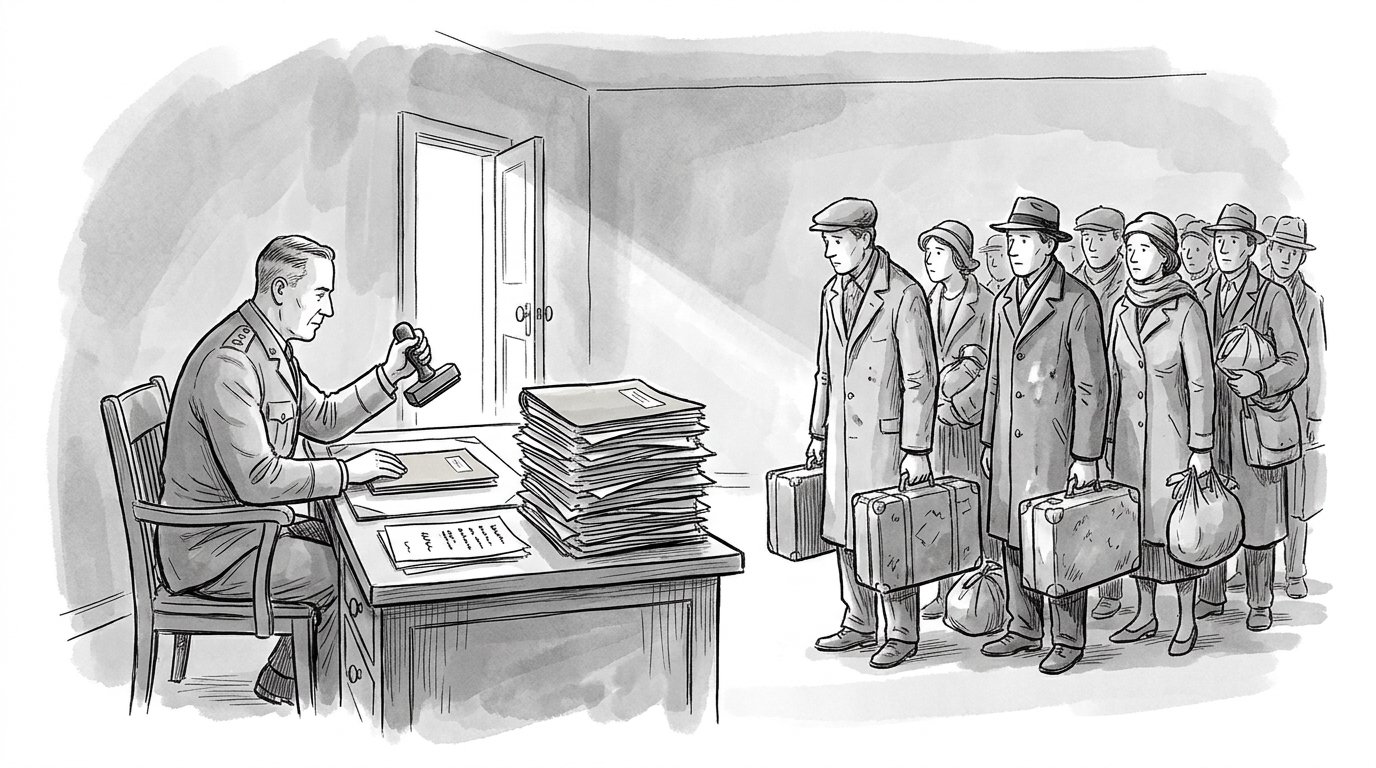
Security officers opposed clearing Oppenheimer. In July 1943, after he had been working on the program for months, Groves made the decision anyway. The project's single mandate was a bomb as fast as possible, and Oppenheimer was seen as nearly indispensable.[22] Army counterintelligence had good reasons for concern. His office was wiretapped, and the man who drove him was secretly a counterintelligence officer.[23] In June 1943 military intelligence saw him visit Jean Tatlock, a Communist Party member under FBI surveillance.[23]
In 1954, Groves testified that he did not regret the 1943 decision given the circumstances, but that under the Atomic Energy Act as he then read it, he would not clear Oppenheimer.[22] Notice what that sentence says. The man who made the exception was telling the record that it was an exception, that wartime urgency was the justification, and that the rules written afterward would not have allowed it.
The rules written afterward were then used on Oppenheimer himself. The Atomic Energy Commission suspended his clearance in December 1953. A three-member personnel board heard the case in April and May 1954, and voted 2 to 1 against reinstatement. The Commission voted 4 to 1 on June 29, 1954, to deny him access.[24] The board's majority cited his associations with known Communists, which went on well past what it considered prudent, and one member, Ward Evans, dissented.[24] On December 16, 2022, the Secretary of Energy issued an order vacating the 1954 decision, saying it had come from a "flawed process" that violated the Commission's own rules.[25] That is the Secretary's position, not an independent finding. It is also the same Department that now applies the successor rules.
The people who did pass secrets did not look like the person the system worried about. Klaus Fuchs, born in Germany, had been cleared in Britain from 1941 and worked at Los Alamos from August 1944; he was convicted in March 1950 and sentenced to 14 years.[26] Theodore Hall was 18 or 19, a Harvard graduate and a former Young Communist League member, and began passing information in November 1944; he was never prosecuted because the government would not reveal in court that it had decrypted Soviet cables.[27] David Greenglass was an Army machinist in the Special Engineer Detachment.[28] What these three cases show, and I mean these cases only, is that the people who did pass secrets were found by decrypted cables and later arrests, not by the vetting.
And today
The written rules now are very different. The adjudicative guidelines in effect since June 8, 2017 (SEAD 4) list thirteen guidelines and tell adjudicators to weigh nine factors, including seriousness, recency, age and maturity at the time, and rehabilitation, "in the context of the whole person."[29] The guideline on allegiance names no political party. What disqualifies is the means, such as involvement in or advocacy of sabotage, espionage, sedition, or the violent overthrow of government.[29] The guideline on personal conduct turns on candor: a person who is honest on the forms about an association can be weighed, and a person who conceals it is a concern.[29]
There is also not one clearance system. Adjudication and the final decision are generally made by the sponsoring agency, and at least 21 federal agencies have their own authority to run all or some of their own background investigations; the CIA investigates for itself.[19] A clearance granted by one agency must generally be accepted by the others, under a 2004 law, but with limited exceptions, particularly at the top secret, SCI and special-access levels, where an agency may add requirements such as a polygraph. The same report says it is difficult to tell how much reciprocity actually happens.[19] The Department of Energy runs its own procedures, in a separate regulation that adopts the shared adjudicative guidelines but is its own rulebook.[29]
Eligibility for a clearance is granted only to U.S. citizens, with narrow exceptions for limited access by foreign nationals with special expertise, and only if the prior ten years of their life can be investigated.[19] That matters for this story, because the Manhattan Project ran on foreign-born scientists. Some of them were: Fermi, Bethe, Teller, von Neumann, Bohr as a consultant, and a British Mission of about 19 to 25 people, depending on whose count you read.[30][31]
I want to be careful about what follows from that. It would be easy to write that Oppenheimer, Fermi or Bethe "would not be cleared today." The sources do not support that sentence. A real adjudication would turn on facts I cannot reconstruct. What the sources do support is narrower, and I think more useful: the 1943 decision was an exception granted by one official on grounds of urgency, and today's written rules require a citizen, a documented investigation, and a weighing of the whole person.
One current number, with a flag: a 2024 Institute for Progress paper reports that foreign-born experts make up 37% of the advanced-STEM workforce on Defense Department-funded projects, against 14% of the U.S. population, and that 85% of the high-skilled immigrants on those projects are naturalized citizens.[32] The figures come from a study the paper cites as forthcoming, and the link to clearance rules is the paper's own interpretation; the Institute is an advocacy organization.
Where the people came from
The bomb was built by people a different government had thrown out.
On April 7, 1933, Germany enacted a law that ended the positions of thousands of Jewish scientists.[33] About a quarter of German physicists, including eleven past or future Nobel laureates, lost their posts. The Emergency Committee in Aid of Displaced Foreign Scholars helped more than 300 scholars between 1933 and 1941, about 100 of them physicists.[34] Göttingen, the quantum-physics center where Oppenheimer earned his doctorate in 1927, went from one of the leading centers to what one history calls a backwater within a year.[33]
Fission was discovered in Germany, by Hahn and Strassmann in 1938. A German "uranium club" formed in April 1939, with Heisenberg as its scientific head.[35] The American Alsos Mission, launched in 1943, concluded that it was far from a bomb. Another historian argues that after Hahn's discovery Germany had few competent atomic physicists left and could not have mounted a Manhattan Project of its own.[33] Ten German scientists were held in a bugged English house from July 1945 to January 1946.[35] I note this as a parallel: one country spent its physicists on a purge, and another built a town for the ones it received.
Who bore the cost
Los Alamos and Oak Ridge were places people chose to go. Hanford was a place people were told to leave. The 90 days' notice and the loss of the Wanapum's river are in the record.[10] So are the homesteaders on the mesa.[9] The bill for the plutonium that was made there is a separate story, and I told it in the Richland piece: a cleanup the Department of Energy estimates, at the high end, at $578 billion, with 60 to 75 more years of work.
The fuel with nowhere to go
The 1946 Act did not ask who pays for what is left, or what happens to the fuel. The 1982 Nuclear Waste Policy Act did, and it set a date: the Department of Energy was to begin removing spent fuel from reactor sites by January 31, 1998.[36] Amendments in 1987 restricted the repository search to Yucca Mountain in Nevada. DOE filed its license application on June 3, 2008, and the Obama administration decided the repository should not open.[36] As of the Congressional Research Service's 2021 report, Congress had not provided new Yucca Mountain funding since FY2010 and had not amended the Act, which still names Yucca Mountain as the sole candidate.[36] The deadline was missed, and utilities sued to recover the cost of storing the fuel themselves. Through FY2020, DOE had paid about $8.6 billion from the Treasury's Judgment Fund, $6.3 billion in settlements and $2.3 billion in court judgments.[36] That was the most recent total I found, and it is not current.
The fuel stayed where it was made. About 88,300 metric tons of spent fuel was stored at U.S. nuclear plants in 2021, including 7,300 metric tons at closed plants, and roughly 30,000 metric tons of it was in dry casks at the end of 2017.[36] That already exceeds the 70,000-metric-ton limit the Act set for Yucca Mountain.[36] Two private storage sites were proposed to take some of it. The Texas one received an NRC license in September 2021.[36] In June 2025 the Supreme Court ruled 6 to 3, Justice Kavanaugh writing for the majority, that Texas and a landowner were not parties to the NRC's licensing proceeding and so could not seek judicial review of it under the Hobbs Act. That settled the case on procedure, not on whether the NRC has the authority to license such a site; Justices Gorsuch, Thomas and Alito dissented.[37] Holtec's New Mexico site had its license vacated by the Fifth Circuit in March 2024, and in October 2025 Holtec announced it was cancelling the project, citing an "untenable path forward" in New Mexico.[38]
Oyster Creek
Oyster Creek, in the Forked River section of Lacey Township, Ocean County, New Jersey, is what that looks like in one place. It opened in 1967 as New Jersey's first nuclear station.[39] It was a 619-megawatt boiling water reactor, the oldest operating plant in the country when it shut down on September 17, 2018, after 49 years.[40]
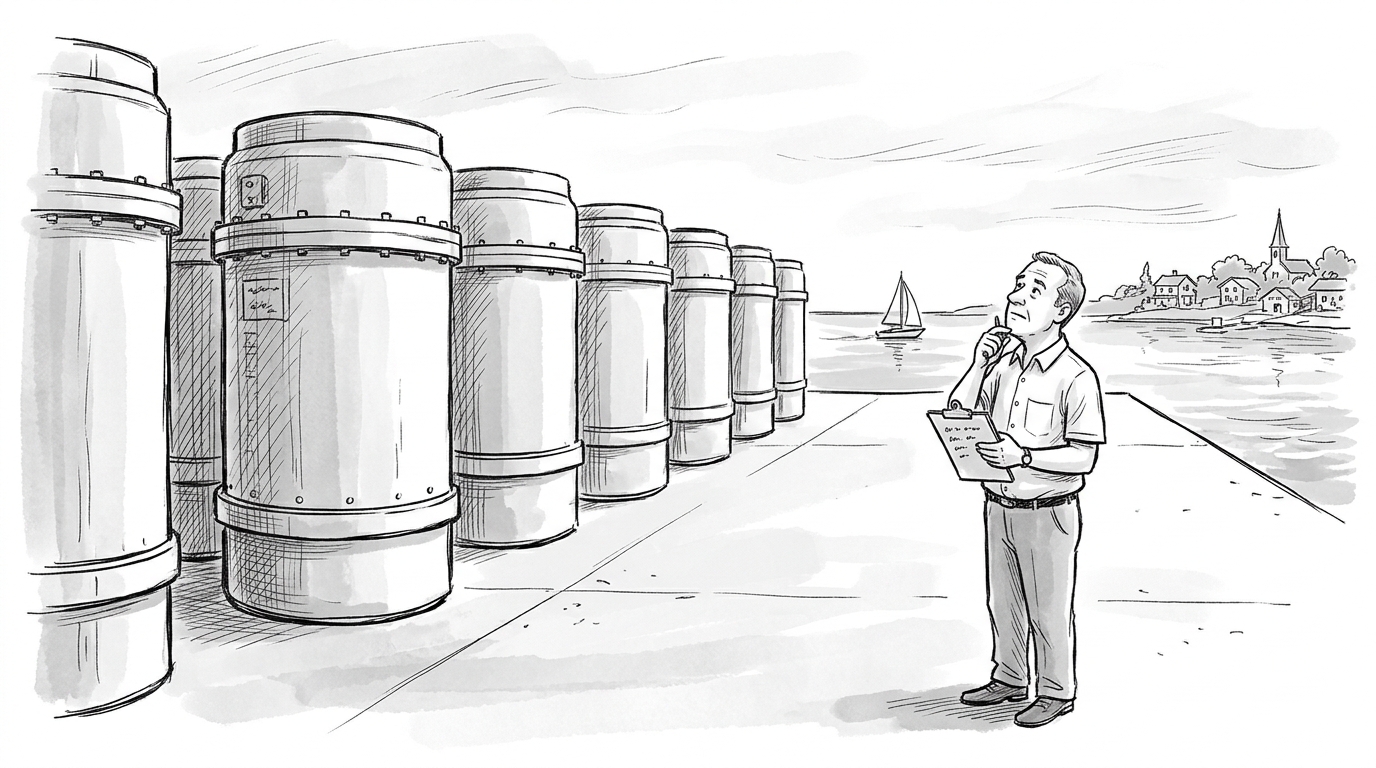
Exelon's first decommissioning plan would have taken 60 years, ending in 2078, and cost more than $1.3 billion, with more than $900 million in a trust funded by utility customers.[39] Holtec International bought the plant, and the sale closed on July 1, 2019. Holtec said it could finish in about eight years.[39][40] Holtec's own account is that it demolished buildings, cut up reactor internals, and planned to finish decommissioning by 2025, with one exception: the used fuel, which in its words "must remain at the site" until the federal government takes it under the 1982 law, or until another location such as its proposed New Mexico facility becomes available.[41]
That exception is the whole story. In late 2020 the township and Holtec were in a legal dispute over moving the remaining fuel from the pool into casks; Holtec described the settlement as an agreement on communication and said it would load the remaining fuel into 33 casks over the next year.[41] By 2025 the site's storage pad held 67 casks.[40] That count includes casks of reactor components as well as fuel.[40]
Then the township sent a tax bill. Holtec and the former owner Exelon argued that the casks were temporary, waiting for a repository. The township argued that with nowhere to move them, they were permanent. On February 25, 2025, the Tax Court of New Jersey agreed with the township and ruled the casks taxable as real property. As World Nuclear News quotes the court, "aspirations and dreams of offsite storage are speculative."[40]
What this means for a new plant
The environmental reviews for new plants treat on-site storage as the baseline. In 2014 the NRC adopted a rule, with a generic environmental impact statement behind it, that covers storing spent fuel after a reactor's licensed life. It looks at three periods: a short term of 60 years, a long term of a further 100 years, 160 in all, and an indefinite period in which a repository never opens. The NRC calls the short term the most likely case, and it assumes a repository by the end of the short and long terms.[42] The rule applies to renewals of storage installations, construction permits and early site permits, and it says applicants do not need to address continued storage in their own environmental reports.[42] It is also explicit about what it does not do: "the rule does not authorize the storage of spent fuel at any site." Each site still needs its own license and its own safety analysis.[42]
The NRC reached for that rule because a federal appeals court had overturned its earlier "waste confidence" finding in 2012, saying the agency had not considered what happens if a repository is never built.[42][43] In April 2026 the NRC finalized a second generic environmental review, this one for licensing new reactors, effective May 26, 2026. It incorporates the 2014 analysis by reference, notes that the 2014 analysis covered only light-water reactors, and concludes that its findings also apply to the fuel from other designs, provided it is stored in a manner that meets the regulatory requirements for spent fuel storage.[44]
So the generic analysis for fuel from a new plant, of any design, assumes storage at the plant in the meantime. That is my reading of the two documents. Plans for new reactors are moving. Trade-press headlines this month mention six AP1000 reactors eyed for a Kentucky site and a Google agreement to add 890 megawatts of capacity at 11 existing Constellation reactors.[45] An industry advocacy group, the Nuclear Innovation Alliance, argues that advanced designs are being built to minimize waste, through greater fuel efficiency or recycling, which would reduce the spent fuel needing permanent storage.[46] If it is right, it is a reason to build. It does not answer the question Lacey Township's tax court asked: where does this go, and who lives next to it until it does?
The labs that built it still run it
The 1974 split sent licensing to the NRC. It left the weapons with the builder: the Energy Research and Development Administration, then the Department of Energy from 1977.[12] The weapons side of DOE is now the National Nuclear Security Administration, which Congress created in 2000 as a semi-autonomous agency inside the Department. It maintains the stockpile and shares responsibility for the deterrent with the Department of Defense, through a Nuclear Weapons Council on which senior leaders from both sit.[47]
The laboratories are the same institutions. Los Alamos, established in 1943 for the Manhattan Project, is now a federally funded research and development center for NNSA. Its priority roles are serving as a nuclear weapons design agency and a nuclear weapons production agency.[48] A company, Triad National Security LLC, operates it; Triad employs about 13,200 of the laboratory's roughly 14,150 workers. The laboratory occupies almost 40 square miles of DOE-owned property, with about 900 facilities, 13 of them nuclear.[48]
The work changed in 1992. The United States has observed a voluntary moratorium on nuclear explosive testing since then, so NNSA now certifies the stockpile through the Stockpile Stewardship Program: modeling and simulation, subcritical experiments and other science.[47] The laboratory also makes the plutonium cores, called pits. Los Alamos's plutonium facility has produced certified "war-reserve" pits since 2000, and NNSA is pursuing a second site, at Savannah River in South Carolina.[47]
Put the pieces side by side, and note that each comes from a different source I read separately. One Department holds the weapons and the laboratories that design and certify them. It is the Department whose cleanup estimate I cited for Hanford, in the Richland piece. And under the 1982 Act it is the agency that was supposed to begin taking commercial spent fuel in 1998.[36] I do not know whether that arrangement is the right one. What the record shows is that the 1974 split separated the builder from the licensing of civilian reactors, not from the weapons or the waste.
The counterexample, and how measured to be about it
I want to end with something better than "we always build first and ask later," because it is not always true.
When the Human Genome Project began in 1990, it set aside money for the ethical, legal and social questions from the start, and Congress later required at least 5% of the National Human Genome Research Institute's research budget to go to them.[49] That is the same country, the same kind of government science, and a different order of operations. I do not know whether it worked. I cited the gaps that remain in the biology piece, and many of them still exist. My inference is that asking early is necessary and not sufficient.
Here is what I take from the bomb. I am not claiming the physicists were careless. What did not exist in 1943 was a body with the standing to say no that was separate from the body that wanted the answer to be yes. The Atomic Energy Commission was created a year after the bombs, and it took until 1974 to separate the builder from the regulator. A rule written afterward was then applied to the man who had built the town, and it took 68 years for the Department that applied it to say the process was flawed.
So when you hear that a new technology will be governed, and that the rules are coming, ask which year of the story you are in. And ask who is in the room when the rules are written, and whether any of them are the people who will pay. The next piece asks why the rules keep arriving after the use: the knowledge itself will not split.
What I do not know
I do not know whether a separate civilian regulator in 1943 would have changed what was built, or whether the Soviet program and the war would have made it irrelevant. I do not know whether keeping the weapons, the waste and the cleanup in one department is the right arrangement.
Sources
- Atomic Heritage Foundation, "Los Alamos, NM" (undated, copyright 2022): https://ahf.nuclearmuseum.org/ahf/location/los-alamos-nm
- "Los Alamos: Beginning of an Era, 1943–1945," Los Alamos National Laboratory publication, reproduced at AtomicArchive: https://www.atomicarchive.com/resources/documents/los-alamos/los_alamos_part_3.html
- Atomic Heritage Foundation, "Selecting the Site": https://ahf.nuclearmuseum.org/ranger/tour-stop/selecting-site/
- National Park Service, "Manhattan Project Site Selection," updated April 5, 2023: https://www.nps.gov/articles/000/manhattan-project-site-selection.htm
- National WWII Museum, Rob Wallace, "Making Public What Was Once Secret: Los Alamos and The Manhattan Project," May 11, 2022: https://www.nationalww2museum.org/node/55332
- National Park Service, Bandelier, "Housing the Manhattan Project," updated January 13, 2024: https://home.nps.gov/band/learn/historyculture/housing-the-manhattan-project.htm
- Education Week, "Los Alamos: The Making of a Community," April 10, 1996: https://www.edweek.org/education/los-alamos-the-making-of-a-community/1996/04
- Education Week, April 10, 1996 (80 babies in the first year; average age 24), same page as source 7.
- National Park Service, "Los Alamos Displacement," updated August 19, 2025: https://home.nps.gov/mapr/learn/historyculture/losalamos-displacement.htm
- Atomic Heritage Foundation, "Hanford, WA" (undated, text adapted from a 1999 DOE history): https://ahf.nuclearmuseum.org/ahf/location/hanford-wa
- U.S. Department of Energy, Office of Scientific and Technical Information, Manhattan Project history: https://www.osti.gov/opennet/manhattan-project-history/Events/1945/trinity.htm
- National Archives, "Records of the Atomic Energy Commission (RG 326)," last reviewed August 15, 2016: https://www.archives.gov/research/guide-fed-records/groups/326.html
- Atomic Heritage Foundation, "Atomic Energy Commission": https://www.atomicheritage.org/history/atomic-energy-commission
- Los Alamos National Laboratory, "Guarding Science," August 29, 2022: https://www.lanl.gov/media/publications/the-vault/0822-guarding-science
- International Atomic Energy Agency, Statute: https://www.iaea.org/sites/default/files/statute.pdf
- U.S. Department of State, Treaty on the Non-Proliferation of Nuclear Weapons: https://2009-2017.state.gov/t/isn/trty/16281.htm
- Atomic Heritage Foundation / National Museum of Nuclear Science & History, "Security and Secrecy," June 5, 2014 (read as text): https://ahf.nuclearmuseum.org/ahf/history/security-and-secrecy/
- Executive Order 13526, "Classified National Security Information," 75 Fed. Reg. 707, January 5, 2010 (read as text; sections 4.1, 4.3 and 6.1(dd)): https://www.federalregister.gov/documents/full_text/text/2010/01/05/E9-31418.txt
- Executive Order 12968, August 2, 1995, sections 2.6 and 3.1: https://www.govinfo.gov/content/pkg/FR-1995-08-07/html/95-19654.htm
- Standard Form 312, "Classified Information Nondisclosure Agreement," Rev. 7-2013 (read as text; prescribed under 32 CFR 2001.80 and E.O. 13526): https://www.archives.gov/files/isoo/security-forms/sf312.pdf
- NIST Computer Security Resource Center glossary, "sensitive compartmented information (SCI)," quoting CNSSI 4009-2022 (from ICD 703): https://csrc.nist.gov/glossary/term/sensitive_compartmented_information
- K. D. Nichols, recommendations to the Atomic Energy Commission, June 12, 1954 (Yale Avalon Project): https://avalon.law.yale.edu/20th_century/opp05.asp
- National Park Service, "The Life of J. Robert Oppenheimer: The Manhattan Project Years, 1941 to 1946," updated September 3, 2026: https://www.nps.gov/articles/000/the-life-of-j-robert-oppenheimer-the-manhattan-project-years-1941-to-1946.htm
- Atomic Energy Commission decision of June 29, 1954, with the Board's findings (Yale Avalon Project): https://avalon.law.yale.edu/20th_century/opp06.asp
- U.S. Department of Energy, Secretary Granholm statement, December 16, 2022: https://www.energy.gov/articles/secretary-granholm-statement-doe-order-vacating-1954-atomic-energy-commission-decision
- UK National Archives, Gill Bennett, "What's the context? Sentencing of atomic spy Klaus Fuchs," March 2, 2020: https://history.blog.gov.uk/2020/03/02/whats-the-context-sentencing-of-atomic-spy-klaus-fuchs-1-march-1950
- GlobalSecurity.org, "Theodore Hall" (reproducing Venona translations; a secondary host): https://www.globalsecurity.org/intell/ops/hall.htm
- Atomic Heritage Foundation, "David Greenglass": https://ahf.nuclearmuseum.org/ahf/profile/david-greenglass/
- Security Executive Agent Directive 4 (effective June 8, 2017), as reproduced in the Department of Energy final rule, 82 Fed. Reg. 57105, December 4, 2017: https://www.federalregister.gov/documents/2017/12/04/2017-25257/procedures-for-determining-eligibility-for-access-to-classified-matter-or-special-nuclear-material
- Dennis C. Fakley, "The British Mission," Los Alamos Science, Winter/Spring 1983: https://www.atomicarchive.com/history/british-mission/index.html
- U.S. Department of Energy, OSTI, "Manhattan Project: Scientists" (21 British scientists): https://www.osti.gov/opennet/manhattan-project-history/People/Scientists/scientists.html
- Amy Nice, Institute for Progress, "Meeting U.S. Defense Science and Engineering Workforce Needs," July 25, 2024: https://ifp.org/meeting-u-s-defense-science-and-engineering-workforce-needs-a-progress-report/
- Linda Hall Library, "Law for the Restoration of the Professional Civil Service," April 7, 2026: https://www.lindahall.org/about/news/scientist-of-the-day/law-for-the-restoration/
- Atomic Heritage Foundation, "Scientific Exodus" (same as source 27).
- Atomic Heritage Foundation, "German Atomic Bomb Project," October 18, 2016: https://ahf.nuclearmuseum.org/ahf/history/german-atomic-bomb-project/
- Congressional Research Service, Mark Holt, "Civilian Nuclear Waste Disposal," RL33461, September 17, 2021: https://www.everycrsreport.com/reports/RL33461.html
- Supreme Court, Nuclear Regulatory Commission v. Texas, No. 23-1300, decided June 18, 2025 (syllabus and opinions, read as text): https://www.law.cornell.edu/supremecourt/text/23-1300
- World Nuclear News, "Holtec cancels plans for New Mexico interim storage facility," October 10, 2025: https://world-nuclear-news.org/articles/holtec-cancels-plans-for-new-mexico-interim-storage-facility
- WHYY / NJ Spotlight, Tom Johnson, "Sale of Oyster Creek could speed up decommissioning by decades," August 2, 2018: https://whyy.org/segments/sale-of-oyster-creek-could-speed-up-decommissioning-by-decades
- World Nuclear News, "Court rules Oyster Creek fuel storage casks are permanent," March 4, 2025: https://wnn.world-nuclear.org/articles/court-rules-oyster-creek-fuel-storage-casks-are-permanent
- Holtec International, "Holtec and Lacey Township Reach Amicable Agreement to Continue Prompt Decommissioning of Oyster Creek," December 17, 2020: https://holtecinternational.com/holtec-and-lacey-township-reach-amicable-agreement-to-continue-prompt-decommissioning-of-oyster-creek/
- Nuclear Regulatory Commission, "Continued Storage of Spent Nuclear Fuel," final rule, 79 Fed. Reg. 56238, September 19, 2014 (read as full text): https://www.federalregister.gov/documents/full_text/text/2014/09/19/2014-22215.txt
- World Nuclear News, August 27, 2014 (the 2012 court ruling and the 2010 "waste confidence" decision), same page as source 45.
- Nuclear Regulatory Commission, "Generic Environmental Impact Statement for Licensing of New Nuclear Reactors," final rule, 91 Fed. Reg. 22394, April 24, 2026, effective May 26, 2026 (read as full text; NUREG-2249): https://www.federalregister.gov/documents/full_text/text/2026/04/24/2026-08015.txt
- American Nuclear Society, Nuclear Newswire headlines, October 6 and October 22, 2026: https://ans.org/news/article-6800/nj-court-finds-oyster-creek-spent-fuel-casks-taxable-as-real-property
- Nuclear Innovation Alliance, "Spent Fuel Management and Advanced Reactors," fact sheet, 2021 (read in full; an industry-aligned advocacy source): https://www.nuclearinnovationalliance.org/sites/default/files/2021-09/NIA%20Fact%20Sheet%20on%20Spent%20Fuel%20and%20Advanced%20Reactors.pdf
- National Nuclear Security Administration, "The U.S. Nuclear Weapons Stockpile" and "About NNSA": https://www.energy.gov/nnsa/missions/maintaining-stockpile
- Los Alamos National Laboratory, "About the Lab": https://www.lanl.gov/about
- National Human Genome Research Institute, "Human Genome Project" fact sheet, updated June 13, 2024: https://www.genome.gov/about-genomics/educational-resources/fact-sheets/human-genome-project