A Mold Is a Bet That the Design Won't Change. A Printer Is a Bet That It Will.
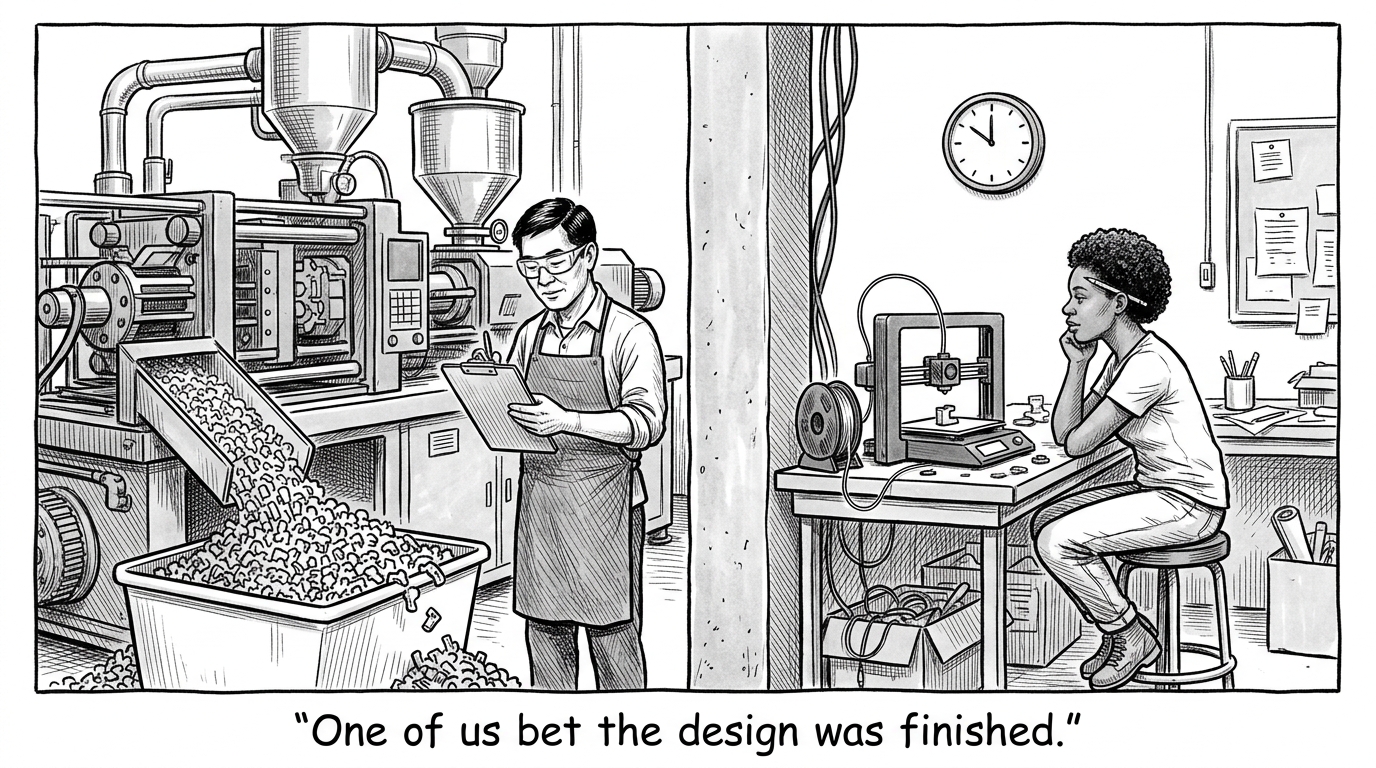
Every way of making things is a bet on two numbers: how many will you sell, and how much will the design change. A mold wins if the design holds and the parts sell. A printer wins if the design keeps changing or the run stays short. The line between them is not fixed, and someone has built a factory to move it.
What fifty cards cost
I own three Bambu 3D printers, and they sit idle most of the time. Only one is set up for business cards, with a 0.2 mm nozzle instead of the usual 0.4. That finer nozzle buys detail and costs time. It prints eight cards in about three hours. Fifty cards is seven batches, about 21 machine-hours, which is about two days if nothing goes wrong. That is roughly 22 minutes of one machine for each card.
That is the whole economics of a bespoke shop, and it is not a complaint. A printer charges the same for the fiftieth card as for the first, and a card can be changed with a file edit. What it cannot do is go fast. A meaningful production run on my machines is measured in weeks, not hours.
What two hundred coasters cost
I bought my first printer at a science fair, swapped it for three Bambu printers, designed a coaster, and decided to sell those. Three, because I had an order for 200 coasters in five colors. A Bambu's color system holds four, so every machine needed two of them. A coaster in two colors takes about an hour and in five about three. Four fit on a build plate, and a five-color plate takes six to seven hours. Two hundred coasters is fifty plates, roughly 300 to 350 machine-hours, which is four to five days of printing nonstop across three machines. I did not sleep for a week.
What the mold charges
An injection mold works the other way around. Slant 3D, a print-farm manufacturer, puts a mold at $10,000 to $100,000 or more "before part one."[1] After that the parts come out at the pace of the press. Fictiv, a manufacturing marketplace, gives typical cycle times of 2 to 10 seconds for thin-walled parts such as closures, 15 to 45 seconds for housings and brackets, and 60 to 120 seconds or more for large structural parts.[2] A part that costs me 22 minutes of machine time comes off a press in the time it takes to read this sentence.
Formlabs, which sells printers and so has a stake in the answer, shows the shape with a hypothetical enclosure: $4 a part for 100 parts from a $100 printed mold, $2.60 a part for 5,000 parts from a $3,000 aluminum mold, and $1.70 a part for 100,000 parts from a $20,000 steel mold.[3] The mold's price does not shrink. It gets divided by a bigger number.
Where the line falls
The break-even is a division: the mold's cost, divided by what it saves on each part, is the number of parts at which the mold starts to win. In 2018 Plastics Technology reported Slant 3D's claim that its printed parts were cheaper than molding under 10,000 parts, and the article's own chart assumed a $5,000 mold, 20 cents a molded part, and 70 cents a printed one.[4] By that chart the line falls at 10,000 parts: $5,000 divided by 50 cents.
Then the line moved. In 2020 Slant 3D's founder, Gabe Bentz, told TCT Magazine the company's runs were cheaper than molding up to 50,000 units, rising to 100,000 once a planned second farm was built.[5] Slant 3D's website now says additive "typically beats molding on cost once tooling is counted in" up to about 250,000 units.[1] Those are the company's own figures, and nobody has independently confirmed them. But look at what moved the line. It was not a better printer. It was scale.
What the mold also charges
A mold does not make one part. It makes thousands before the first is sold, and every one of them has to be stored, paid for and insured until someone buys it. The cheap part is only cheap if the run sells. So the mold's arithmetic has a second number in it: the sales volume that has to be met downstream. If the product sells slower than the plan, the saving on each part turns into a shelf of inventory. A printer makes the part when the order arrives, and its inventory is a file.
The mold's other price is change. A maker who had enclosures molded in China for AirGradient wrote that once the mold has been made, downstream changes can be very costly, and that small features can have an outsized effect on cost.[6] A printer's price for a change is a file edit and a new batch. A mold is a bet that the design is finished.
What a farm is
That week is the cost a farm absorbs for its customers. I have not used Slant 3D's service, but I know what dealing with a jam at 3 a.m. feels like. The difference between my shop and a farm is not a difference in kind of machine. A farm is a printer's economics with a factory's utilization, and farms come in sizes. Travis, who runs Print Farm Academy, started with a woodworking channel and a store, Shop Nation, and found that 3D printing was his best way to manufacture what it sold: its miter-saw dust chutes are printed in PETG and sell for about $55.[7] He says he went from one printer in 2019 to 70 machines, a figure he reports himself.[8] It is the usual way into a farm, and it was mine: you have a product, and the printer becomes how you make it. Prusa Research, which prints parts for its own printers, reported 585 machines on its farm in 2020, plus 60 to 70 backups.[9] Slant 3D describes a service of more than 1,000 machines and calls it a "digital warehouse," with parts stored on a server instead of a shelf.[10] Its announcement says the Megafarm is growing to 5,000 machines, a target and not a count.[11] The company that was running close to 100 printers in 2018 now plans thousands.[4] Idle capacity is the fixed cost with nothing to spread it over, and a farm is built so that it is never idle.
Its showcase customer is Tidy Tool, which makes organizers for Milwaukee's Packout system. Slant 3D says it became a business of roughly $500,000 a year with no molds and no large inventory, and draws the lesson that Tidy Tool succeeded by varying the product while keeping the production system standardized.[10] The company's argument has also moved past price. It describes AI agents ordering parts made by other AI systems, and says "Molding required that every product be carved in stone."[11] That is a company announcing a direction, with no figures behind the agent claim. But the argument is no longer that printing is cheaper at 50,000 parts. It is that the premise of a mold, a finished design, is the thing going away.
The farm is honest about what it cannot do. The 2018 Plastics Technology piece was plain that surface smoothness favors molding, that printed parts can be weaker in the Z direction, and that structural parts have to be designed for printing instead of converted from molded designs.[4]
Where the mold wins
At the other end the mold has no competition. Lego produces approximately 36 billion bricks a year, about 1,140 every second, in injection-molding machines working to tolerances as small as 10 micrometres.[12] At that volume any mold's cost rounds to zero, and no print farm closes the gap. A part that never changes is the safest bet a mold can have.
Farms mold too. In 2020 Prusa Research said it was building an injection molding factory, and was plain that "It is not cheaper for us to make injection parts."[9] The reason was time. Some parts "take a ton of time to print" and their "design does not change," and the MINI's front and back plates alone took almost half the time needed to make all the parts for the MINI.[9] A farm that prints the parts that are still changing and molds the parts that have stopped is the whole argument in one company.
Both, in the same factory
The war-time version of this is the same argument at speed. One Ukrainian drone maker runs rows of 3D printers for frames and braces so variants can be flown and revised quickly,[13] and another had its propellers made at Ukrainian plastics companies on injection molding machines, with a "very simple two-component mold," after a shipment of Chinese propellers arrived with a 90 percent defect rate.[14] I wrote about that in The Army Bought 13,000 Interceptor Drones. The printer takes the part that is still changing. The mold takes the part that has stopped.
Why does this matter?
A founder who cuts steel early has made a bet that the design is finished and that the volume will sell, and a founder who prints is betting that neither is settled yet. Neither is wrong. The question worth putting to the one who tooled is when the mold was cut, what changed afterward, and what the plan is for the parts on the shelf. The question worth putting to the one who prints is how many machines are busy, and whether the run is long enough that the line has already moved.
Part of a longer argument about what the next decade's machines will be made of. See also DoAyni's piece on what a Jeep and a drone maker have in common.
- Slant 3D, Slant 3D: mass production 3D printing without molds (company site; claims as read Oct 2026)
- Fictiv, Injection molding cycle time
- Formlabs, How to estimate injection molding cost
- Plastics Technology, 3D printing start-up competes with injection molding (Jan 2018)
- TCT Magazine, Interview: Slant 3D CEO on building the world's biggest 3D printer farm (Feb 2020)
- Hackaday, Lessons Learned: Plastic Injection Molding For Products
- Shop Nation LLC, DeWalt DWS779/780 miter saw dust collection chute (product page: "printed in either BLACK or YELLOW high strength PETG plastic," $55.00)
- Print Farm Academy, Print Farm Academy (course page; figures self-reported)
- Original Prusa 3D Printers (Prusa Research blog), The great recap of 2020 in Prusa Research and plans for 2021
- Slant 3D, Real 3D Printed Products: Tidy Tool (Slant 3D video and description, Aug 28, 2026; text supplied by Troy)
- Slant 3D, This Future Could Never Exist with Molding (article dated Oct 2, 2026 on the page and Oct 3 on the blog index)
- Wikipedia, Lego
- Fabbaloo, Ukraine's homegrown 1 million unit drone industry takes flight with 3D printing
- Militarnyi, No more "Made in China": Ukraine inches closer to self-sufficient FPV drone manufacturing (Dec 31, 2024)