The Same AI Boom That Just Posted Record Chip Sales Is Now Opposed by 7 in 10 Americans in Their Own Backyard. Both Numbers Are Real, at the Same Time.
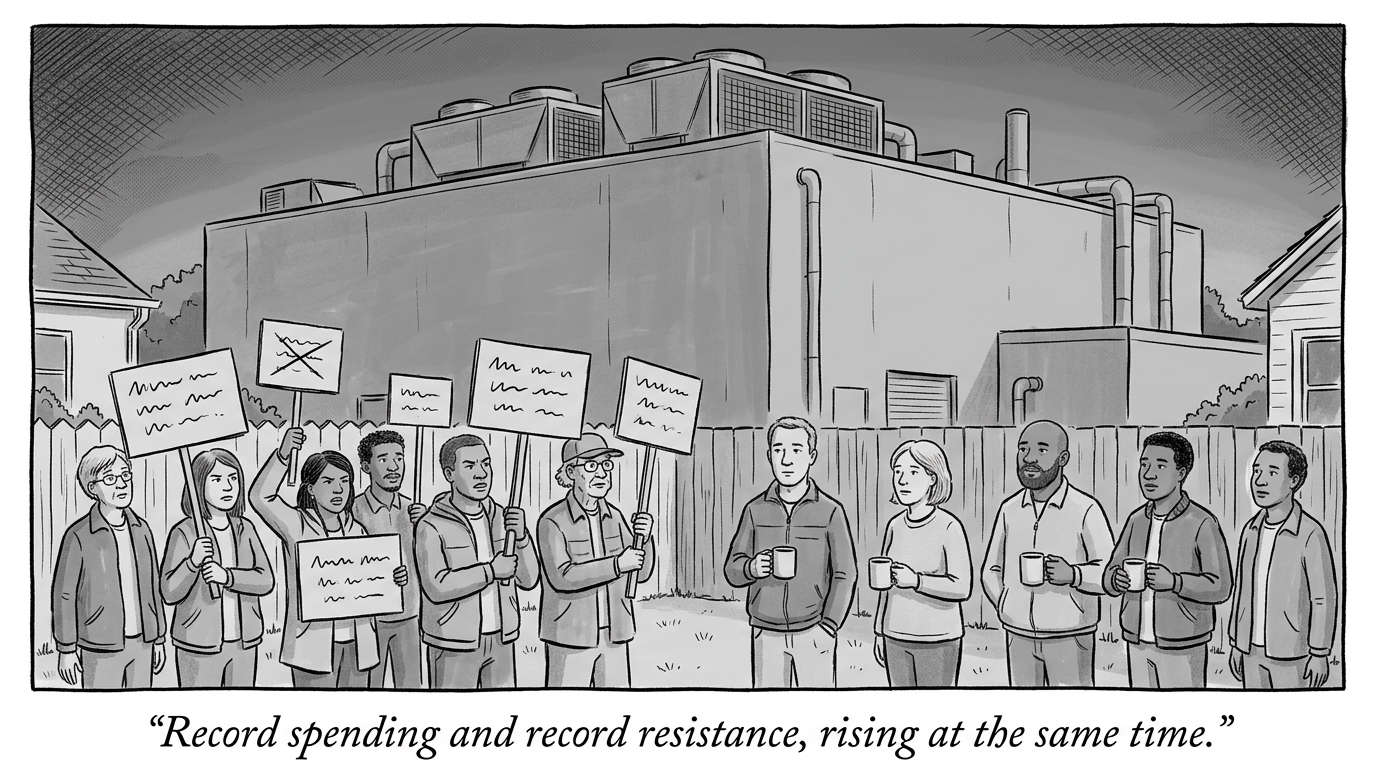
Multiple independent 2026 polls now put local opposition to new AI data centers at somewhere between 61% and 75% of Americans -- Gallup found 7 in 10 opposed (48% strongly), a Decision Desk/SurveyMonkey poll found 69% opposed, Annenberg Public Policy Center found 61% opposed (up 12 points from just months earlier), and Heatmap Pro found three-quarters opposed.[1][2] The opposition is bipartisan -- Republicans and Democrats oppose local data centers in almost identical numbers.[2]
This is not a story about being anti-technology
It is running at the exact same time as record AI infrastructure spending -- global data-center capital investment is projected to exceed $31 trillion through 2050, with fresh multibillion-dollar commitments landing weekly: a Qualcomm chip deal with Amazon, a $14 billion EU data-center push, Japan committing $60 billion to quadruple its own capacity.[3] This outlet has already covered the infrastructure side of this same boom -- Broadcom, AMD, Intel, and Micron all posting record AI-driven numbers without directly competing with each other,[4] and OpenAI buying its own hardware while Anthropic signs a $45 billion, six-year commitment to rent someone else's instead.[5] The industry-level story and the neighborhood-level story are describing the same buildout from two different distances, and they disagree.
What's actually driving the local number, as distinct from the general-AI-anxiety number: water, power, and land use -- concrete, measurable, and local. A large data center can use as much electricity as a small city and, for cooling, water on a similar scale; both draws land on the same regional grid and the same water table residents already share, in a facility that in most towns employs a small fraction of the workers a comparable-sized manufacturing plant would. That is a specific, locally-felt cost profile, not a diffuse fear of AI in the abstract -- which is why opposition is rising even as national attitudes toward AI as a technology are mixed rather than uniformly negative.
What that looks like as one real, named deal instead of a poll
Energy Storage Solutions withdrew its $19.2 billion AI data center project in Edgecombe County, North Carolina in early July 2026, pulling its offer to buy land near Tarboro for a campus that could have reached 300 acres and roughly 900 megawatts. Residents' objections tracked exactly the mechanism above: water consumption, electricity demand, noise and air quality, and the effect on local electricity rates. A related ESS project in the town of Tarboro itself had already been rejected 6-1 by the town council, prompting litigation the company ultimately agreed to drop as part of a settlement. The company's own president gave the reason plainly: investors wanted to pursue projects "in friendlier communities" instead.[6] Edgecombe County's commissioners then moved to a two-year moratorium on any new data-center development, giving county leaders time to actually understand the long-term impact before approving another one.[6] A $19.2 billion project is not a rounding error, and it didn't die from a permitting delay or a financing problem. It died from exactly the local opposition the polling above describes, at the scale where it actually stops a real deal instead of just showing up in a survey.
Why does this matter? The AI-infrastructure story usually gets told from the boardroom out -- who's buying chips, who's signing the power-purchase agreement, whose stock moved. The polling is the same story told from the property line in. Both are true at once, and a boom that keeps winning at the balance-sheet level while losing ground at the town-hall level is not a contradiction that resolves itself -- it is a gap that eventually shows up as zoning fights, ballot initiatives, and utility-rate disputes in exactly the communities the industry needs to keep building in.
Philadelphia is now the named, dated instance -- and it just pulled in a governor and a congressional race
A coalition called No Data Centers in Philly, sponsored by the advocacy group People's Tech Project, launched a campaign in September 2026 calling on Philadelphia City Council to pass a citywide moratorium on new data-center construction -- the same demand that already stopped the $19.2 billion Edgecombe County project above, now made in a city that currently has no rules at all governing where a data center can be built or what protections it owes its neighbors.[7] Philly Thrive managing co-director Shawmar Pitts described the mechanism in almost the same terms as the North Carolina residents above: "We can't let an industry that raises our PECO bills, pollutes air and water, and powers surveillance expand without guardrails, and that's what will happen if Council doesn't act."[7]
Philadelphia's opposition is pre-emptive rather than reactive, and the numbers explain why: the city currently hosts about eight small operating data centers -- one South Philly facility is a quarter the size of the smallest contemporary hyperscale build -- and the Planning Commission has identified only two sites in the city physically capable of hosting a large one. The first is the Bellwether District, a multibillion-dollar redevelopment of a 1,300-acre former oil refinery in South Philadelphia; the second is a city-owned parcel at 2600 Grant Ave. near the airport in Northeast Philadelphia. Neither site has a confirmed data-center proposal attached yet -- the moratorium campaign is aimed at the two places it could still happen, not at a project already announced.[8] The same fight is already running in the suburbs: active opposition in Plymouth Township and in Upper Merion Township, where the township board rejected a 4.6-million-square-foot proposal, and in Falls Township, where more than 3,100 residents signed a petition against a data center already under construction.[11][12]
What raises this past the town-hall level is who has now moved with it. Pennsylvania Governor Josh Shapiro -- who in 2025 appeared alongside Amazon officials to announce a $20 billion state data-center investment -- reversed course in August 2026, signing an executive order he said put "the strictest guardrails in the nation" on the industry: pulling data centers out of the fast-track permitting program his own administration had built for them, requiring local approval before state approval, and criticizing "predatory developers" for "bullying our neighbors," as public polling on data centers turned sharply against the industry.[9] And in Bucks County, Democratic congressional candidate Bob Harvie made a data-center moratorium the subject of his first general-election TV ad against Rep. Brian Fitzpatrick: "I don't want any more data centers. I want a moratorium. Big tech owns enough; they shouldn't own our congressman, too" -- a harder line than the strict-regulation-only position he himself held just days earlier.[10]
This is the same pattern this piece already documents -- water, power, land use, few jobs, all locally felt and nationally repeated -- but Philadelphia is where it stopped being only a local-advocacy story and became a governor's-office story and a live U.S. House-race story in the same metro area, in the same month.
- Gallup, Americans Oppose AI Data Centers in Their Area
- Annenberg Public Policy Center, Opposition to Local Data Centers Rises Sharply, Annenberg Survey Finds
- Semafor, High Symbolism -- AI Infrastructure Spending
- DoAyni, Broadcom, AMD, Intel, and Micron Are All Posting Record AI Numbers Right Now
- DoAyni, OpenAI Bought Its Own Mac Minis... Anthropic Signed a $45 Billion Commitment to Rent Someone Else's Instead
- Data Center Dynamics, North Carolina AI data center proposal withdrawn as county officials mull moratorium
- WHYY, Protest planned Monday at Philadelphia City Hall for data center moratorium
- The Philadelphia Inquirer, Planning Commission considers how — and if — data centers should be built in Philly
- PublicSource, Shapiro U-turns on data centers as backlash mounts
- The Philadelphia Inquirer, In a shift, Bob Harvie calls for data center moratorium in new TV ad in race against Brian Fitzpatrick
- Northeast Times, Philadelphia Activists to Rally at City Hall for Data Center Moratorium
- Bucks County Herald, More than 3,100 sign petition opposing Falls Township data center