Same AI Model, Same Question, Three Different Scaffolds Around It: 38%, 48%, and 62% Correct. Nothing About the Model Changed. Only What Surrounded It Did.
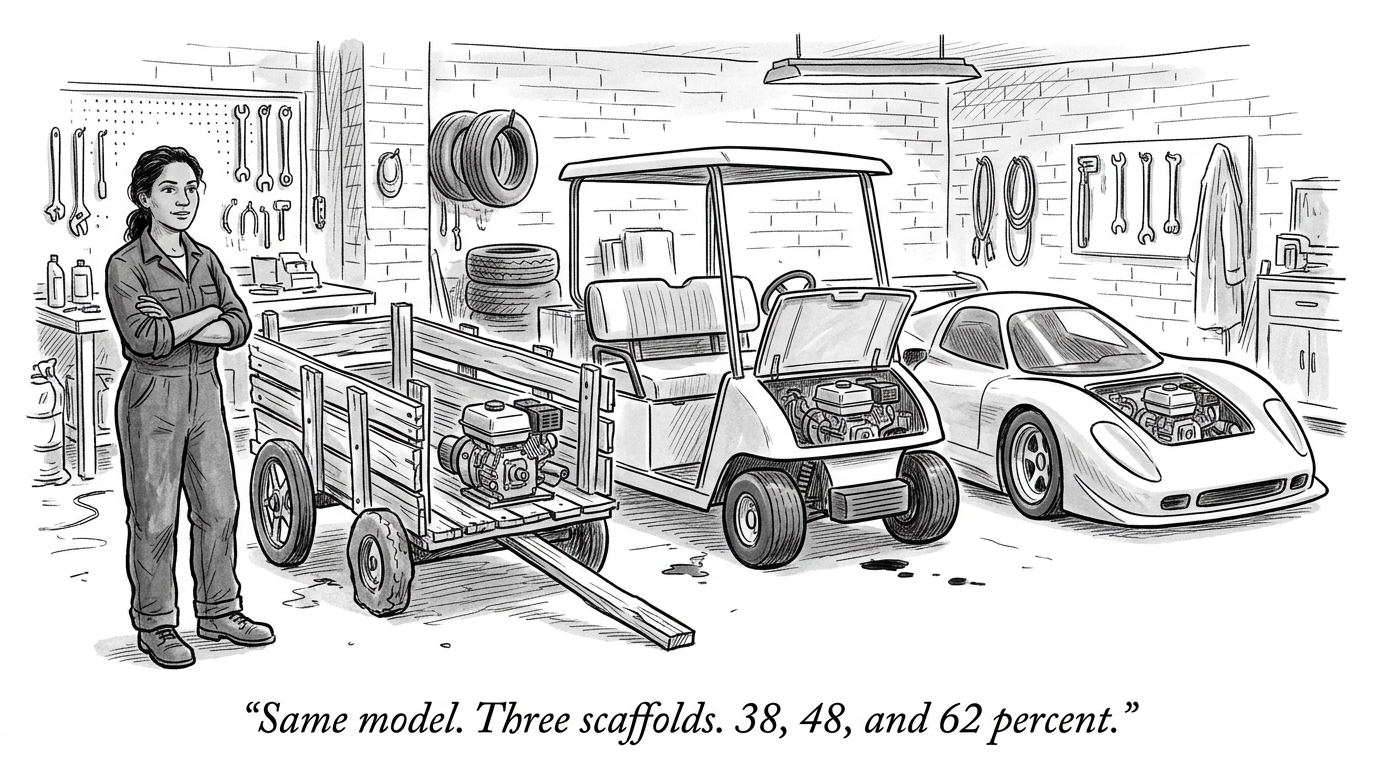
A 2026 study ran the same AI model, Claude Opus 4.5, on the same coding benchmark three separate times -- changing nothing about the model itself, only the surrounding system it operated inside. Inside a bare-bones setup, it solved 38.4% of the tasks. Wrapped in Claude Code, a general-purpose coding harness, it solved 48.1%. Wrapped in a harness called Latch, purpose-built for the task, it solved 61.7% -- a 23.3 percentage-point gap between the worst and best scores, from one unchanged model.[1]
The distinction the industry now has a name for: model versus harness
"The model" is the trained network itself -- the weights, the raw capacity to reason, produced once during training and then frozen. "The harness" is everything wrapped around it at the moment it actually does a task: what tools it can call, how much of the conversation it can see at once, how errors get fed back to it, whether it can search a codebase or only guess. Researchers have started measuring harness effects directly because the gap turned out to be too large to ignore. One 2026 benchmarking effort found scaffold-only swings of up to nearly 48 percentage points on the identical model, on the identical benchmark, changing only what surrounded it.[2] A separate research group, METR, measured a roughly 30-point gap between a model run with minimal support and the same model run with the best available tooling and error handling.[2]
The gap is large enough to change which model looks better
The effect isn't just a matter of degree -- it can flip the actual ranking between two different models. In one documented case, adding a single search tool to an otherwise identical setup reversed which of two competing models scored higher on the same coding benchmark, even though one of the two models ranked higher on nearly every other test.[1] A benchmark result reported without describing the harness underneath it -- which is still the industry norm more often than not -- is a number that could mean almost anything, because the harness alone can be worth more than a full model generation's difference in capability.
This maps onto something a lot older than AI benchmarking: raising a genuinely capable child. The underlying capacity in a smart kid is real and mostly fixed by the time you're handing them material -- what changes the outcome is what gets put in front of that capacity and how much room it gets to actually use it. A parent who hands a capable child real books, then lets the child's own judgment decide what to do with them, is running the same experiment as the harness study: the raw capacity was always there, and what showed up afterward -- the specific interest, the specific skill, the specific direction -- was shaped by the material and the room to use it, not created from nothing by either one alone. Neither the child's underlying capacity nor the material handed to them explains the outcome by itself. Both papers -- the parenting instinct and the 2026 harness study -- are describing the same two-part mechanism, one running on a person and one running on a model.
Why does this matter? "Which AI model is smartest" is a real question, but it is not the only question that decides what a system actually produces -- and treating it as the only one leads to comparisons that don't hold up. A weaker model in a well-built harness can outperform a stronger model in a poor one, the same way a highly capable kid handed nothing to work with underperforms one handed real material and the room to use it. Capacity and harness are two different variables, and confusing them for one is the fastest way to draw the wrong conclusion from a benchmark, a model release, or a comparison between two systems that were never actually run under the same conditions.
The harder version of the same finding is what it does to blame. If a 23-point swing sits entirely on the harness side of the ledger, then a disappointing result from a capable model is not proof the model was weak -- it is at least as likely proof that whoever built or chose the harness around it didn't invest in one. That responsibility does not sit with the model. It sits with whoever decided what to wrap around it, which is the same conclusion the parenting version of this mechanism arrives at: a capable kid who was never handed real material doesn't become proof the capacity wasn't there. The gap moves the accountability onto whoever controlled the environment, not the capacity operating inside it.
Companion pieces on this outlet: "Researchers Found 34 Million Distinct Concepts Wired Into One AI Model..." and "AI Can Generate Ten Ideas a Second Now..."