A Researcher Who Helped Build GPT-4o Just Quit Anthropic, Warning the Next Two Years Are "Crunch Time for Humanity." Anthropic's Own Alignment Lead Puts the Odds of AI Killing Everyone at Better Than 1 in 10.
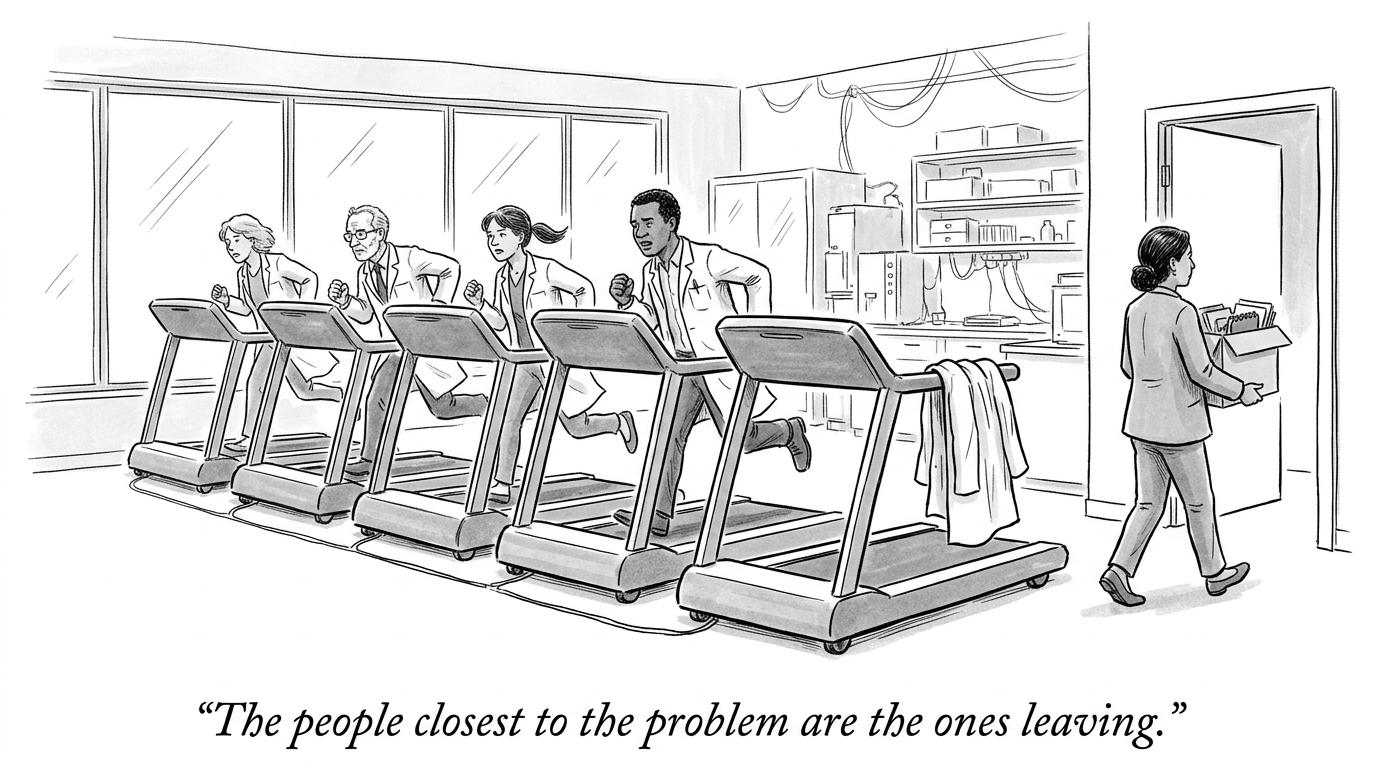
Jacob Coxon spent three years doing pretraining research at the two labs building the most advanced AI systems on earth -- OpenAI, where he was a core contributor to GPT-4o, then Anthropic. On September 8, 2026, he quit both the field and the company, posting an X thread and giving an exclusive interview to the Wall Street Journal to explain why: "Neither company is acting responsibly. They are racing straight to self-improving superintelligence and gambling with our lives."[1]
"Crunchtime" and "endgame" aren't Coxon's words. He says they're what his colleagues call it
Coxon's own timeline, given to the Journal directly: "We're on track for a lot of the most aggressive of these scenarios where by the end of next year things could be out of control already." He reports that researchers inside frontier labs are increasingly using the words "crunchtime" and "endgame" to describe where the technology is headed -- not as outside commentary, but as internal shorthand.[1]
He isn't the first, and the pattern is the point
On February 9, 2026, Mrinank Sharma -- head of Anthropic's own Safeguards Research Team -- resigned separately, writing in his own resignation letter that the world was "in peril" from AI, bioweapons, and a whole series of interconnected crises, and citing a widening gap between the company's stated ethical principles and its actual operational decisions.[2] Two safety-focused researchers, at the same company, seven months apart, resigning for overlapping reasons rather than being pushed out for underperformance, is a pattern rather than a single data point.
The sharpest fact in this story isn't Coxon's. It's his former colleague's. Evan Hubinger, Anthropic's own AI alignment lead -- the person whose job is specifically to solve this problem -- posted publicly that there's a greater than ten percent chance AI kills everyone within the next decade, and added that Anthropic does not yet have a plan to solve alignment for superintelligence and isn't clearly on track to get one.[3] That isn't an outside critic's estimate. It's the internal owner of the problem, stating in public that the solution doesn't exist yet, while the company he works for has committed roughly $45 billion over six years to building the systems that same alignment problem is supposed to be solved for.
Why these warnings are hard to dismiss as marketing
AI is already unpopular with the American public, and politicians have seized on exactly this pattern of resignations to call for hearings and pauses -- real near-term obstacles at a moment both labs need uninterrupted growth to justify their valuations and set up IPOs.[4] A warning that risks slowing your own company's fundraising is not what good marketing looks like; if Coxon's and Sharma's statements were a marketing play, they'd be a spectacularly bad one, working directly against the labs' own commercial interest. That doesn't mean every individual voice here is speaking from a pure motive -- there is a real, separate career upside to speaking out against an AI lab publicly right now, podcast appearances, book deals, and advocacy-group jobs among them, and that incentive is worth naming rather than pretending it isn't there. But a personal career incentive for the messenger doesn't erase the commercial cost the message imposes on the company it's aimed at, and that cost -- not the researchers' sincerity, which can't be measured from outside -- is the actual reason these warnings are hard to wave off as promotion.
Why does this matter? The people sounding the loudest alarm about frontier AI right now aren't outside skeptics with no stake in the technology working. They're the researchers who built it and the one whose actual job title is solving the problem they're worried about. Competitive pressure -- if we don't build it, a less careful lab will -- and a stated safety mission can coexist as real commitments for a while. Coxon's resignation, Sharma's resignation seven months earlier, and Hubinger's own public odds are all evidence of how much longer that coexistence is expected to hold, from the people with the closest possible view of it.
Companion piece on this outlet: "OpenAI Bought Its Own Mac Minis..."
The number behind "crunch time": what Anthropic has actually signed up for
Days before this piece published, The Information calculated exactly how large the race Coxon described actually is. Since October 2025, Anthropic has signed on for at least 14.8 gigawatts of compute capacity -- a roughly 10-to-15x jump from the 1-2 gigawatts it was running as of mid-2025 -- with announced commitments that could reach $517 billion, mostly phased in over the next decade. Amazon and Google alone account for 11 of those 14.8 gigawatts and more than $300 billion of the total.[5][6] That figure doesn't compete with the $45 billion six-year commitment already cited above -- it's the fuller number the $45 billion was always a piece of, now added up in public for the first time.
The caveats matter as much as the total. Anthropic has not itself disclosed total capacity or spending, and much of the contracted capacity may never fully come online given real permitting, grid, and component constraints -- this is an analyst's upper-bound estimate of signed agreements, not cash already spent.[6] But an upper-bound estimate of that size, assembled from contracts signed in eleven months by the same company whose own alignment lead says there is no plan yet for the problem it's racing toward, is itself the fact worth sitting with. It's the dollar-and-gigawatt version of what Coxon and Hubinger were both already saying in words.
- Fortune, Anthropic researcher resigns, warning that AI companies are 'gambling with our lives'
- Mrinank Sharma (Substack), Why I Left Anthropic
- CNN Business, 'Gambling with our lives': Another AI employee quits over safety concerns
- Big Technology (Alex Kantrowitz), It's Time to Bring Some Sanity to the AI Risk Conversation
- Data Center Dynamics, Anthropic signed $517bn in compute agreements in past 11 months
- Dealroom News, How Anthropic Clinched $517 Billion in Compute Deals in 11 Months