Reading and Math Scores Fell by More Than a Year of Learning Across Wealthy Countries Since 2015. England Went the Other Way -- After Deliberately Ripping Out the Curriculum Everyone Else Kept.
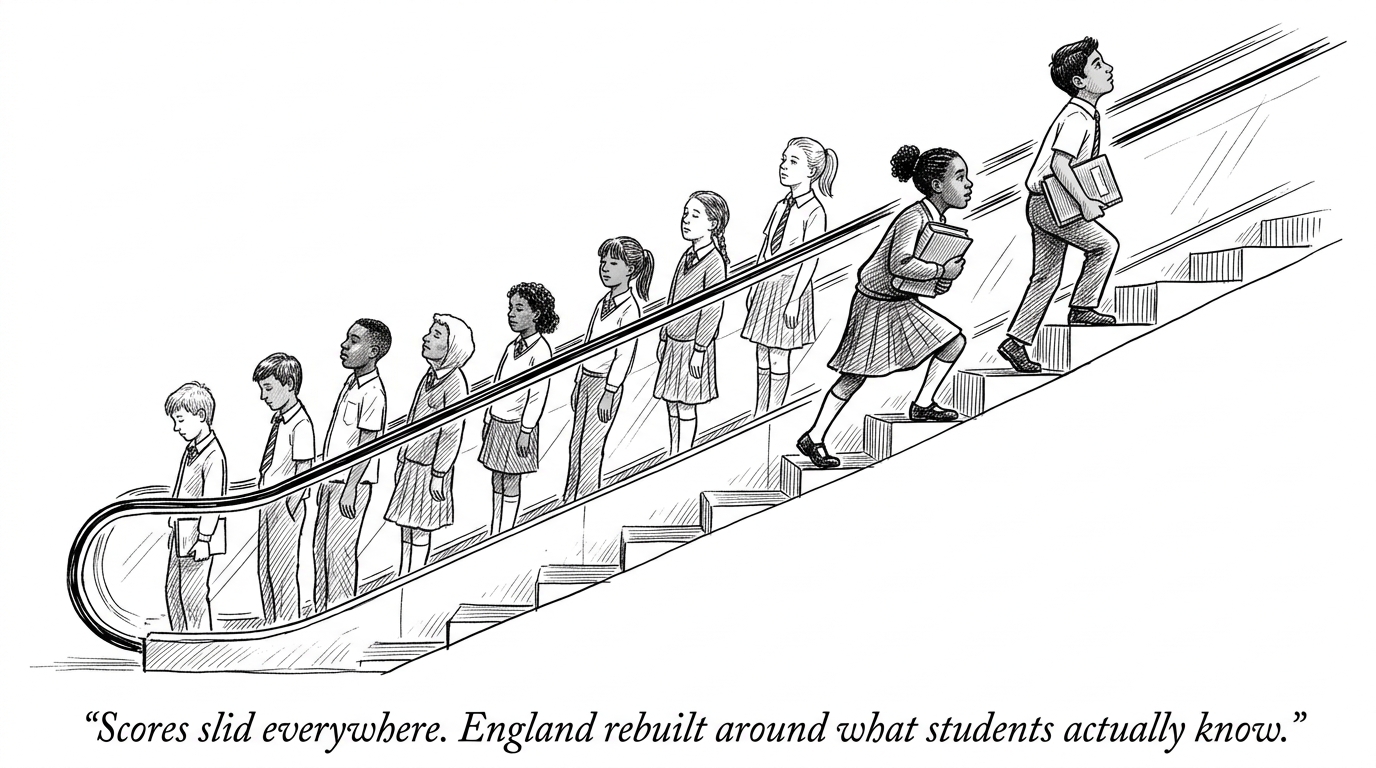
Student performance has declined across wealthy OECD nations since 2015 -- the 2025 PISA results show reading and math scores down by more than a full year's worth of learning across the group as a whole.[1] England is the visible exception. Its science score rose to 516 in 2025, up from 503 in 2022 and 507 in 2018 -- the country's best science result since 2012 -- moving England from 13th to 8th in the international rankings. Its math score, at 492, sits well above the OECD average of 463.[2]
The gap traces to a specific, dated policy fight, not a cultural mystery
England's official 2025 PISA report attributes the improvement in part to a national curriculum rebuilt around explicit content knowledge and direct instruction, rather than the "discovery learning" and skills-first approaches that dominated English and international education reform in the 2000s and 2010s.[3] The reform was contested at every step -- teacher-training colleges, much of the education press, and a substantial share of practicing teachers argued that memorization-heavy, knowledge-first teaching was outdated and that skills like "critical thinking" could be taught independent of subject content. England kept the reform anyway, through multiple governments, long enough for a cohort of students to move through it start to finish.
The honest complication: this is not an unqualified victory story, and treating it as one would be the wrong lesson. England's own results are uneven -- math and reading scores essentially flatlined even as science rose, and a gender gap opened in science, with boys pulling ahead of girls for the first time in this data.[2] A single subject improving sharply while two others stay flat is evidence that something specific happened in how science is taught -- not proof that "knowledge-based curriculum" is a universal fix that transfers cleanly across every subject.
Why does this matter? Every wealthy country in this data set had access to the same research, the same international comparisons, and the same warning signs since 2015 -- and nearly all of them still declined. England is the one clear case of a country naming the specific pedagogical fight it was having, picking a side, and holding that choice long enough to see it show up in outcomes a decade later. This outlet has already written about how tracking students too early narrows who gets access to a broad foundation.[4] This is the companion finding: what actually gets taught, not just who gets sorted into which room to be taught it, is its own lever -- and it is one a system can still choose to pull.