Verrocchio's Workshop Taught Leonardo Metallurgy, Anatomy, and Sculpture in the Same Six Years. American Schools Now Sort 75% of Eighth Graders Into One Lane, Starting in First Grade.
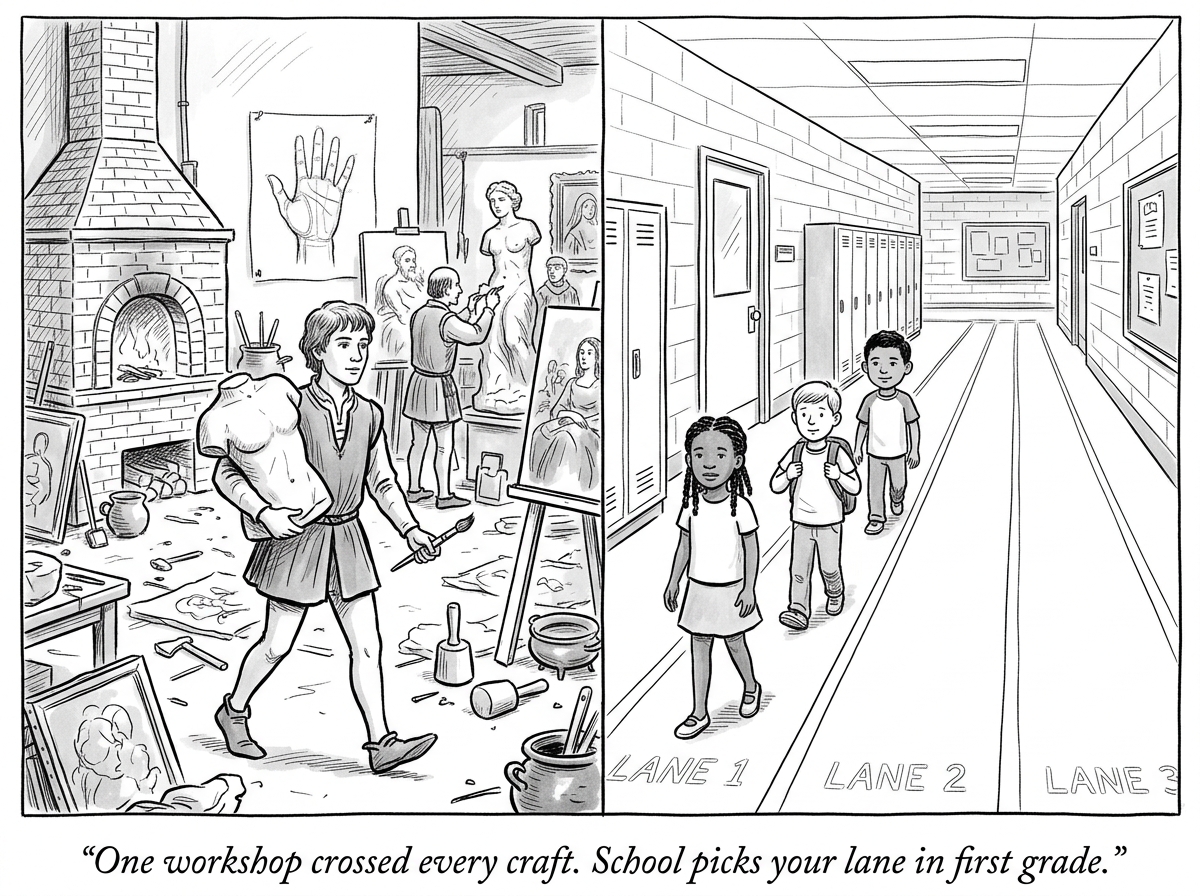
Leonardo da Vinci did not become a polymath by being born one. Around age fourteen, he entered the workshop of Florentine master Andrea del Verrocchio, and spent roughly six years there before becoming a paid collaborator.[1] The bottega's curriculum, as it has come down to us, was not "learn to paint." Apprentices were trained in drafting, chemistry, metallurgy, metalworking, plaster casting, leatherworking, mechanics, and carpentry, alongside drawing, painting, sculpture, and modeling -- with surface anatomy and the effects of light on drapery folded into the same rigorous program.[1] This outlet has already documented what that specific combination produced: an anatomist accurate enough that a conclusion he reached about the aortic valve in 1513 wasn't confirmed by cardiology until 1969, alongside an engineer, a sculptor, and a painter, in one person.[2] The bottega didn't stumble into that outcome. It was built to produce it.
The research says this isn't nostalgia -- it's how real competence actually forms
Science journalist David Epstein's research, compiled in Range: Why Generalists Triumph in a Specialized World, draws a specific distinction that explains why the bottega model worked rather than merely happened to work. Some domains are "kind" learning environments -- clear rules, immediate feedback, repeating patterns, like chess or golf -- where early, narrow specialization genuinely does produce faster mastery. Most of real life is a "wicked" environment instead: unclear rules, delayed or misleading feedback, genuinely novel situations. Specialization is the right tool for kind environments. It is the wrong tool for wicked ones, and most of adult, civic, and scientific life is wicked.[3]
Elite performers across most fields, per Epstein's research, typically go through a broad "sampling period" before narrowing -- exposure across several disciplines before committing to one -- and the resulting skill, conceptual transfer (applying a principle learned in one domain to solve a problem in a different one), is one of the more reliable markers of high performance found in the research. Across most professional domains studied, late specialization preceded by broad sampling predicted higher performance over a full career than early, narrow specialization did.[3] Verrocchio's workshop is, structurally, a sampling period with a name and a master craftsman running it on purpose.
Four hundred years later, a different structure produced the same shape of person
Andy Warhol earned a BFA in pictorial design from the Carnegie Institute of Technology in 1949 -- a curriculum built around graphic design, illustration, and advertising art together, not fine-arts painting alone.[6] He spent the 1950s as one of the era's highest-paid commercial illustrators, producing work for Tiffany & Co., I. Miller Shoes, Bonwit Teller, Vogue, Harper's Bazaar, Mademoiselle, and Columbia Records -- a real, separate professional discipline, mastered commercially before anything else.[7] What happened next is the part that matters here: he carried the actual production method of commercial printing -- silkscreen, mass repetition -- directly into fine art, which is what Pop Art's founding technique literally is. That's the same intersection this page already showed in Leonardo's anatomy feeding his painting: one discipline's method becoming another discipline's breakthrough, not two unrelated hobbies held side by side.
He kept doing it for the rest of his career, well past painting. He managed and co-produced The Velvet Underground & Nico's 1966 debut album and designed its sleeve -- the peelable-banana cover -- crossing into music production.[8] In 1969 he co-founded Interview magazine with journalist John Wilcock, crossing into publishing.[9] In 1985, two years before his death, Commodore brought him to Lincoln Center to demonstrate the new Amiga 1000, and he used its paint software to digitally render Blondie's Debbie Harry live in front of an audience -- crossing into computer art before almost anyone else did.[10]
Warhol's route there wasn't Leonardo's, and the difference is worth keeping rather than flattening away. There was no single Verrocchio holding six years of metallurgy, anatomy, and sculpture under one roof for him -- his formal training was already narrower, one applied commercial-design program. The cross-domain capacity came afterward, self-directed, industry by industry, across four decades. Both routes reached the same place. An institution can build the capacity deliberately in six years, the way Verrocchio's bottega did, or a person can keep building it on themselves, one industry at a time, the way Warhol did. Neither is the only way there. What both share, and what a single tracked lane doesn't produce, is the habit of carrying a method learned in one domain into a different one on purpose.
Neither one stopped at their own capacity. Both built the next studio.
Leonardo did not only pass through Verrocchio's bottega -- he became the next one. From roughly 1482 to 1499, Duke Ludovico Sforza employed him in Milan and let him run his own workshop with his own apprentices, organized in tiers the same way Verrocchio's had been.[11] Salaì joined Leonardo's household at age ten and stayed for the rest of his life; Francesco Melzi became his favored pupil and companion, and eventually the heir who preserved his notebooks after his death -- the specific reason any of the aortic-valve work covered on this page survived to be rediscovered at all.[11] A wider circle of students -- Cesare da Sesto, Giampetrino, Bernardino Luini among them -- carried his methods forward under a name art historians still use: the Leonardeschi, Milan's own school of Leonardo.[11] The bottega that made him did not end with him. He ran the next one.
Warhol did the identical thing in a different century. In 1962 he rented a fifth-floor loft at 231 East 47th Street in Manhattan and painted it silver -- the Factory. He chose silkscreen and lithography specifically because they allowed assembly-line production, the same commercial-print logic from his 1950s illustration career, now run as a working studio instead of a private technique.[12] The people who passed through -- Gerard Malanga, Billy Name, Edie Sedgwick, Paul Morrissey, Joe Dallesandro, and the Velvet Underground already covered above -- were not spectators. Warhol called them "art workers": they filmed his movies, silkscreened his paintings, and built the environment itself, several going on to independent careers in film, music, and photography after passing through it.[12]
This is the part that actually answers the education question, rather than just illustrating it. A structure that produces one cross-domain person and stops there is a curiosity. A structure that produces a person who then builds the next structure -- Verrocchio's apprentice becoming Milan's own workshop-master, Warhol's commercial-print training becoming a studio that trained a rotating cast of art workers -- is self-replicating. That is the real difference between an interesting historical accident and an actual answer to what education should be doing: not a single well-run bottega producing a single Leonardo, but a design that keeps producing the next bottega, generation after generation, because the people who came through the first one go on to build the second one themselves.
The same shape, present tense: Jobs, Ive, and Apple's own next studio
Jobs said the whole argument out loud, once, directly. At the iPad 2 launch in March 2011: "It is in Apple's DNA that technology alone is not enough -- it's technology married with liberal arts, married with the humanities, that yields us the results that make our heart sing."[13] He had already lived the specific version of it. After dropping out of Reed College, he stayed on campus and audited a calligraphy class -- serif and sans-serif type, letter-spacing, what makes typography beautiful -- with no practical use he could see at the time. Ten years later, that exact knowledge went directly into the first Macintosh, which shipped with multiple typefaces and proportional spacing no earlier personal computer had offered.[14] Calligraphy feeding typography feeding a computer is the same shape as Leonardo's anatomy feeding his painting and Warhol's commercial silkscreen feeding his fine art, run a third time in a third medium.
And Jobs built the next studio the same way Leonardo and Warhol had. Apple hired a young designer named Jony Ive in 1992; when Jobs returned as CEO in 1997 he made Ive senior vice president of industrial design and built the company's design studio into what is still described as the most secretive room at Apple, accessible by badge alone.[15] Ive kept the team deliberately small -- roughly twenty people at its peak -- for over two decades. When Ive left Apple in 2019, the studio did not simply close. Nearly the entire team scattered outward, many of them to LoveFrom, the design firm Ive founded next -- the studio's own alumni becoming the seed of another studio, the identical pattern the Leonardeschi and Warhol's art workers already show on this page.[16]
What the actual system does instead, and what tracking a real cost-benefit shows
American K-12 tracking -- sorting students into different classroom lanes by earlier academic performance or perceived ability -- affects roughly 75 percent of eighth graders nationwide, and commonly begins as early as first or second grade.[4] A meta-analysis spanning more than 300 studies found that tracking produces minimal effects on learning outcomes overall, alongside real, documented negative effects on equity -- the students placed in lower tracks early are the ones who bear the cost, for a system-wide academic gain the research doesn't reliably find.[4] The pattern repeats one level up: research on early specialization in higher education finds that a narrow range of majors can carry real negative effects specifically for students who know their general strengths but haven't yet located the particular subfield that fits them -- exactly the population a Verrocchio-style sampling period would have served, and exactly the population a system built around early sorting serves worst.[5]
The actual claim, stated plainly. Leonardo is proof that cross-domain competence isn't a rare genetic gift arriving by accident of birth -- it's a buildable outcome of a specific kind of structure, and Verrocchio's bottega is the structure that built it, on purpose, in six years. Most of what a person actually has to solve as an adult -- a business problem, a civic problem, a scientific problem, a self one has to keep examining, as this outlet has separately documented -- is a wicked environment, not a kind one, and wicked environments are exactly where narrow, early specialization performs worst and cross-domain transfer performs best.[3] A system that sorts 75 percent of its students into one lane before they've finished eighth grade is optimizing for the kind of competence that is easiest to measure, not the kind that actually solves wicked problems. That isn't a values disagreement. It's a structural mismatch between what the sorting mechanism selects for and what the world it's preparing students for actually demands.
The point isn't to find the next Leonardo. It's to build the capacity on purpose, at scale
The wrong lesson to take from Leonardo is that he was exceptional and most people aren't. The bottega record argues the opposite: a specific, describable, repeatable structure -- broad exposure across real disciplines, held together long enough for the disciplines to start informing each other, before narrowing -- produced that outcome in an ordinary workshop apprentice system operating across all of Renaissance Florence, not in one uniquely gifted household. Verrocchio ran that workshop for many apprentices, not one. The actual, harder job isn't identifying which rare student might turn out polymathic despite the system. It's building the system so that cross-domain capacity is the default output, not the exception that survives a sorting mechanism built to prevent it.
Why does this matter? A student sorted into one lane in first grade is being prepared for a kind environment that mostly doesn't exist past the classroom. The actual adult world -- the wicked one, full of unclear rules and delayed feedback and problems that don't respect subject-area boundaries -- rewards exactly the cross-domain transfer that early tracking is structurally built to prevent. Leonardo didn't happen to a system that was trying to produce something else. He happened because a system was built, on purpose, to hold several disciplines in one person long enough for them to start talking to each other. The real measure of an education system isn't how efficiently it sorts students into their eventual lane. It's whether it's still trying to build people capable of holding more than one lane at once.
Leonardo, Warhol, and Jobs each did the individual version of this well enough to be remembered for it alone. What made it last, in every case, was the second act each is less known for: building a studio that trained other people to do the same thing, on purpose, so the capacity did not end when they did -- the Leonardeschi, the Factory's art workers, Ive's design team scattering into LoveFrom. That is what legacy actually looks like. Not the work one person leaves behind. The structure that keeps producing people capable of doing the work after they are gone.
Companion pieces on this outlet: "Socrates Chose Death to Keep Examining. Galileo Recanted to Keep Living. Leonardo da Vinci Just Stopped Publishing...", which covers Leonardo's aortic-valve discovery and the 456-year gap before it was confirmed, and "Socrates Chose Execution Over Exile Specifically So He Could Keep Examining His Own Life...", on self-examination as the same kind of deliberately built, hard-won capacity this piece argues education should be building on purpose.
Companion piece on this outlet: "Bell Labs Built a 700-Foot Hallway on Purpose in 1941...", which traces the same room mechanism into pure science and hard engineering.
This piece is one part of a longer argument. The full essay: "How to Build a Mind".
- Educational Renaissance, The Virtue of Art: Leonardo da Vinci and Renaissance Apprenticeship
- Ayni Analysis, Socrates Chose Death to Keep Examining. Galileo Recanted to Keep Living. Leonardo da Vinci Just Stopped Publishing...
- Pan Macmillan, How to Become a Generalist in a World of Specialists (David Epstein, Range)
- ACE (American Consortium for Equity), Academic Tracking in K-12 Schools: Improving Achievement or Widening Gaps?
- ScienceDirect, Early specialization in higher education and labor market outcomes
- The Andy Warhol Museum, Andy Warhol: The College Years
- Phillips, Andy Warhol, From Adman to Artist and Back Again
- ARTnews, The Story Behind Andy Warhol's 'Velvet Underground and Nico' Cover
- Wikipedia, Interview (magazine)
- The Andy Warhol Museum, Warhol and the Amiga
- Old Masters Academy, Leonardo's Relationship With His Students and Apprentices
- Wikipedia, The Factory
- The Seattle Times, Feisty Steve Jobs talks up Apple's 'post-PC' iPad 2
- Reed College, Steve Jobs and Reed College
- Britannica Money, Jony Ive
- 9to5Mac, Jony Ive's Former Design Team Is Nearly All Gone From Apple, Has It Mattered?