Socrates Chose Execution Over Exile Specifically So He Could Keep Examining His Own Life. Modern Research Says Only 10-15% of People Actually Do What He Died Defending.
At his trial in 399 BC, Socrates was offered a way out: exile instead of execution. He turned it down, and gave a specific reason recorded in Plato's Apology -- that the greatest good available to a person is "daily to converse about virtue... examining myself and others," and that "the unexamined life is not worth living." That line gets quoted as a piece of gentle philosophical wisdom, detached from what it actually was: the stated reason a man chose death over giving up the practice of turning a critical eye on his own life and beliefs.[1] Self-examination, in the original telling, was not framed as a nice habit. It was framed as the thing that made a life worth continuing at all.
Most people already think they're doing it. The research says otherwise, by a wide margin
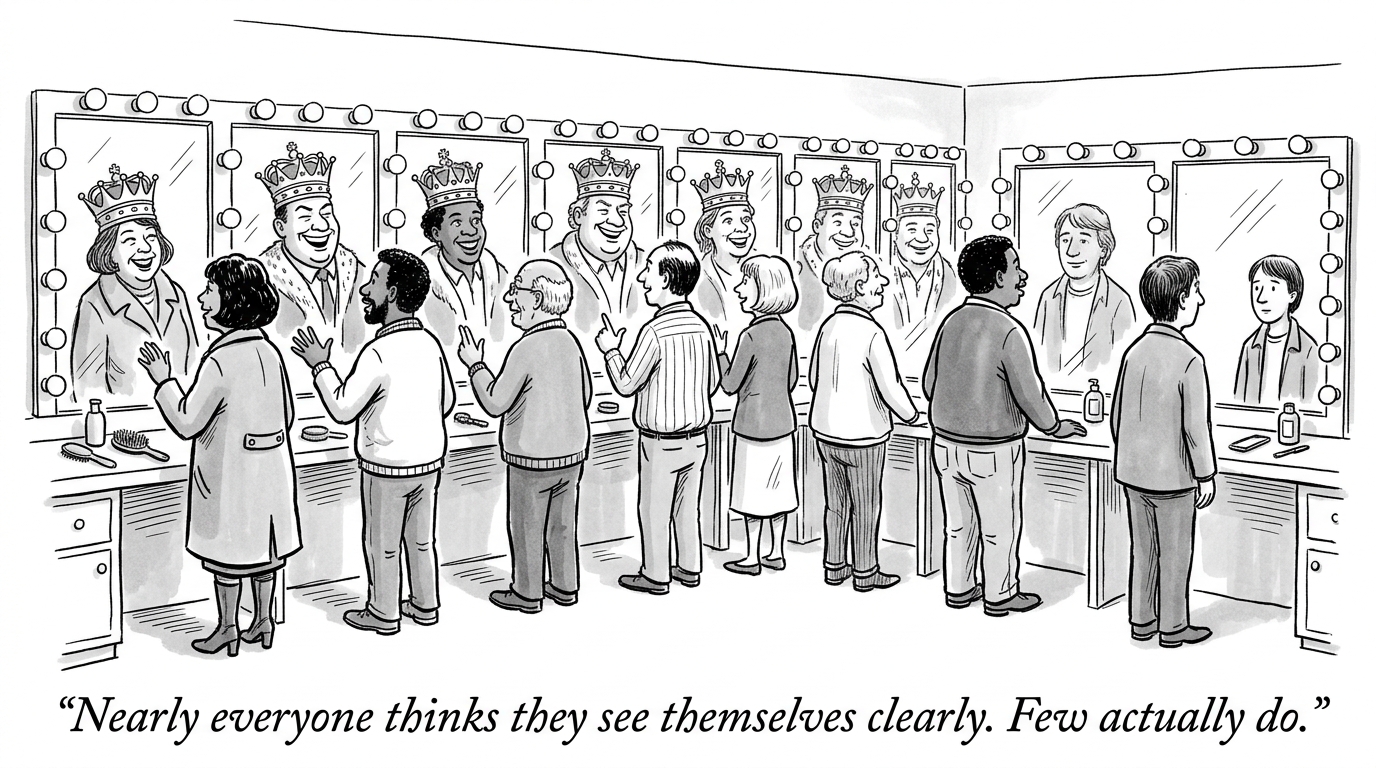
Organizational psychologist Tasha Eurich spent years researching self-awareness across hundreds of studies and her own work inside Fortune 500 companies, and found a striking, specific gap: roughly 95 percent of people believe they are self-aware, while real, tested self-awareness -- an accurate read on your own values, patterns, and impact on others -- is only actually present in something like 10 to 15 percent of people.[2] That is not a small margin of error. It means the overwhelming majority of people confidently believe they possess a skill that real testing shows most of them don't have -- and the confidence itself is part of what keeps the gap invisible from the inside.
Why the gap is this wide isn't a mystery -- it's built into how introspection actually works
Psychologists Richard Nisbett and Timothy Wilson found something specific about introspection back in 1977: people routinely give confident, coherent explanations for their own thoughts, judgments, and behavior that don't match the actual mental process that produced them -- not because they're being dishonest, but because direct introspective access to that process often simply isn't available. When asked to explain themselves, people don't report on the real mechanism. They construct a plausible-sounding story based on what seems like a reasonable cause, and then experience that story as if it were direct self-knowledge.[3]
This is the actual reason self-examination is hard work rather than a passive mood: the mind's default mode produces a confident, coherent self-narrative automatically, whether or not that narrative is accurate. Nothing about the default process flags itself as unreliable -- a plausible story feels exactly like an accurate one from the inside. Real self-examination isn't the act of having thoughts about yourself; everyone does that constantly, and it's what produces the 95 percent who believe they're already self-aware. It's the much harder, actively resisted act of checking a self-narrative that already feels true against evidence that might contradict it -- which requires treating your own comfortable story about yourself with the same suspicion you'd apply to an unverified claim from someone else.
What the work actually consists of, stated plainly
If the default setting produces a confident story automatically, then the actual practice of self-examination has to be an interruption of that default, not an extension of it. It means noticing when a self-assessment arrived quickly and felt obviously true, and treating that speed and certainty as a reason to check rather than a reason to trust. It means being willing to be told something about yourself that contradicts the story you'd have told, and updating instead of explaining it away -- which is the same identity-level resistance that makes being wrong about anything else uncomfortable, applied to the hardest possible subject, because there's no external fact to fall back on to settle the disagreement.
Why does this matter? Calling self-examination "hard work" isn't a modest understatement. It's the accurate description of what's actually required, given what the research shows about the alternative: a fast, confident, mostly automatic self-narrative that 95 percent of people mistake for the real thing. Socrates thought the difference was worth dying to preserve access to. The more measured modern version of the same claim is smaller but no less real: the difference between the story you tell yourself and an actually accurate one doesn't close on its own, and closing it takes real, sustained, uncomfortable effort -- which is exactly why so few people's self-narrative and their actual self ever really converge.
Companion piece on this outlet: "Verrocchio's Workshop Taught Leonardo Metallurgy, Anatomy, and Sculpture in the Same Six Years...", on deliberately building the same kind of hard-won capacity at the level of an education system rather than one person.
Companion piece on this outlet: "Bell Labs Built a 700-Foot Hallway on Purpose in 1941...", which traces the same room mechanism into pure science and hard engineering.
This piece is one part of a longer argument. The full essay: "How to Build a Mind".
- Plato, Apology of Socrates (38a) -- via Center for Hellenic Studies
- Eurich, T., Insight: Why We're Not as Self-Aware as We Think, and How Seeing Ourselves Clearly Helps Us Succeed at Work and in Life
- Nisbett, R. & Wilson, T., Telling More Than We Can Know: Verbal Reports on Mental Processes, Psychological Review (1977)