Bell Labs Built a 700-Foot Hallway on Purpose in 1941. It Produced the Transistor and a Nobel Prize. Xerox Built the Room That Produced the Macintosh -- and Its Own People Never Saw It.
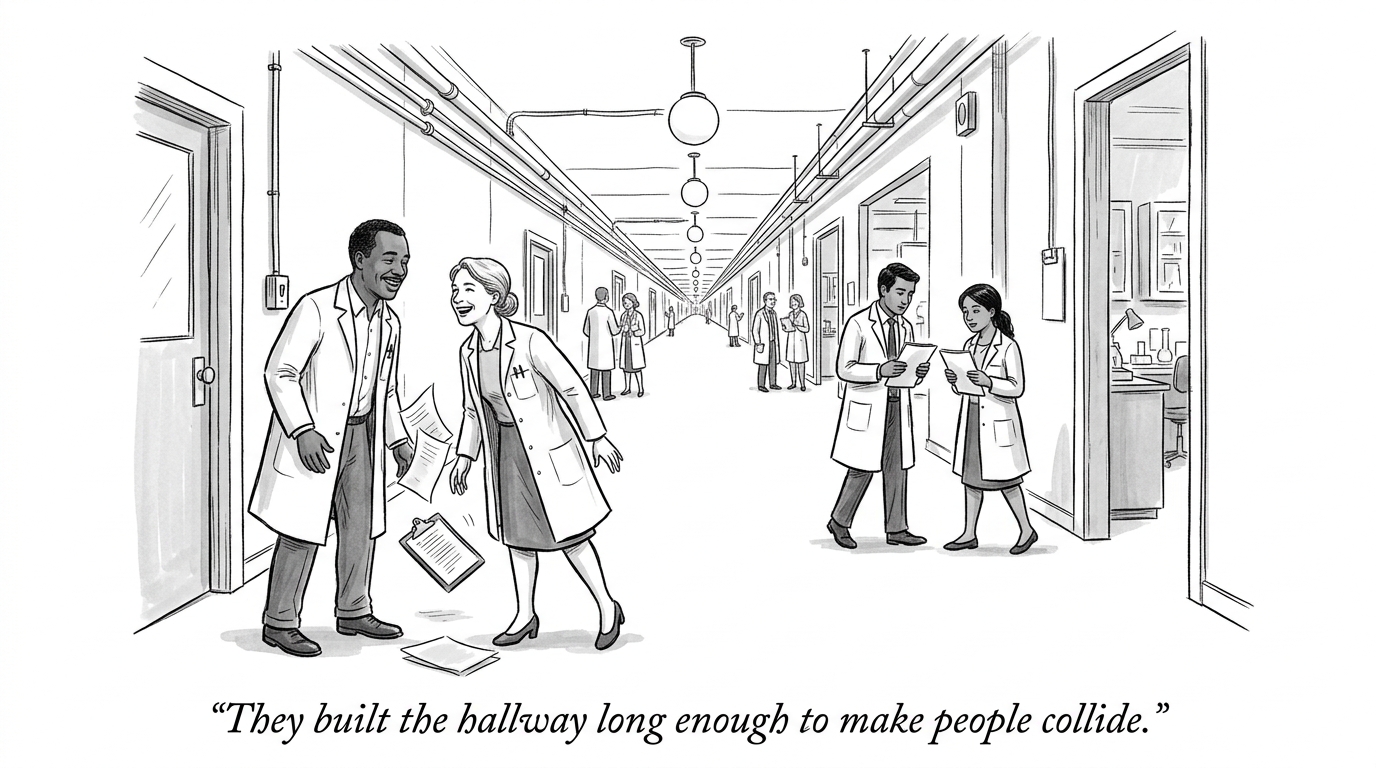
In 1941, Bell Labs opened a new research building in Murray Hill, New Jersey, and its physical layout was not an afterthought. Mervin Kelly, the executive who shaped the lab's culture more than anyone else, personally helped design a structure meant to make people interact with each other whether they intended to or not. The corridor running past the physics offices was built to be seven hundred feet long -- long enough that looking down it, the far end vanished at the horizon -- and staff routinely kept both a lab and a separate office in different corridors, guaranteeing a walk past colleagues, problems, and half-formed ideas every single day.[1] Kelly's own reasoning, as later reconstructed: force basic researchers and applied engineers to bump into each other often enough, and something useful will eventually fall out.
What that hallway actually produced
On December 16, 1947, Bell Labs researchers John Bardeen and Walter Brattain built the first working point-contact transistor -- two closely spaced gold contacts on a sliver of germanium, one voltage modulating the current through the other, amplifying a signal up to 100 times. Bardeen, Brattain, and their department head William Shockley shared the 1956 Nobel Prize in Physics for it.[2] In the same building, in the same years, Claude Shannon developed the mathematical theory of information that still underlies every digital communication protocol in use today -- a field with no Nobel Prize to award it, though its actual footprint arguably exceeds most that do get one.[3] The laser and the silicon solar cell trace to the same building, the same corridor, the same deliberately engineered collisions.
A second room, in Palo Alto, that produced the machine you are probably reading this on
Xerox's Palo Alto Research Center had, by the late 1970s, already built a working graphical user interface, a computer mouse, Ethernet networking, laser printing, and object-oriented programming in Smalltalk -- a genuinely staggering concentration of the technology that would define personal computing for the next four decades, sitting inside one lab.[4] In December 1979, as part of a deal letting Xerox buy shares of the still-young Apple, Steve Jobs got a tour. He was reportedly stunned by what he saw and grasped its commercial potential immediately -- and what he saw at PARC became, directly, the graphical interface Apple shipped first on the Lisa and then the Macintosh.[4]
Here is the part that keeps the room from being just a metaphor for talent finding itself. Xerox's own engineers and executives had been standing inside that exact room for years before Jobs ever walked into it. Researchers at PARC reportedly referred to their own company's leadership as "toner heads" -- Xerox was a copier company that had accidentally built a computing research lab, and its management structure, incentives, and internal culture stayed built around selling paper machines, not computing platforms. The people who lived in the room every day, for years, did not see what one visitor saw in an afternoon.[5] The room held the same technology for both groups. Only one of them had already been prepared, by an entirely separate formation, to recognize what he was looking at -- a formation this outlet has already traced, running from a Reed College calligraphy class through the first Macintosh's typography. The room was necessary. It was not sufficient. Readiness was doing real work too.
This is the same mechanism this outlet has now traced four times in one week -- it finally has a name for what's doing the work
Verrocchio's bottega, where Leonardo trained in metallurgy, anatomy, and sculpture in the same six years. Warhol's Factory, where silkscreen technique crossed over from commercial printing into fine art and then into film and music. Apple's own industrial design studio, the most secretive room in the company, which trained a generation of designers who scattered into their own careers when it closed.[6] Bell Labs' corridor and Xerox PARC's lab are the same shape again, in pure science and hard engineering rather than art or design: a physical or institutional space, built or maintained on purpose, that puts specific people in specific proximity to each other and to a body of half-formed work, for long enough that something neither one of them would have produced alone gets produced instead.
Every one of these rooms was admission-gated -- not everyone got a desk at Bell Labs, an apprenticeship under Verrocchio, or a badge into Apple's design studio -- and every one of them required something from the person inside it beyond simply being present, the same refinement this outlet has already made explicit about self-examination: the work itself is hard, not automatic, and access to the room is where the work becomes possible, not where it finishes itself.[7] Socrates needed Plato's pen to survive him; Galileo needed a printing press a year ahead of his trial; Leonardo needed neither and nearly lost 456 years of a correct discovery to a private notebook no one read.[8] The room is the newest name for the oldest part of that same argument: what a person becomes capable of doing depends, in real and traceable part, on which specific room they were standing in, at which specific moment, already carrying which specific preparation.
Why does this matter? "Being in the right place at the right time" usually gets said as a shrug -- a way of crediting luck instead of explaining anything. Bell Labs and Xerox PARC are two real, documented cases where the room itself was not luck at all. Kelly built his corridor on purpose, to a specific length, for a stated reason, and it produced a transistor and a Nobel Prize. Xerox built a lab that held the future of computing for years without its own leadership ever recognizing what was in it, until one visitor who had been separately prepared to see it walked through. The room is not where credit should stop. It is where the actual causal chain starts, and it is buildable -- Kelly built one on purpose in 1941, which means the same design choice is available to anyone deciding how to physically or institutionally arrange the people they most want to produce something neither of them could produce alone.
Companion pieces on this outlet, same thread: "Socrates Chose Execution Over Exile Specifically So He Could Keep Examining His Own Life...", "Socrates Chose Death to Keep Examining. Galileo Recanted to Keep Living. Leonardo da Vinci Just Stopped Publishing...", and "Verrocchio's Workshop Taught Leonardo Metallurgy, Anatomy, and Sculpture in the Same Six Years...".
This piece is one part of a longer argument. The full essay: "How to Build a Mind".
- Growth List (via Jon Gertner, 'The Idea Factory'), Bell Labs in Murray Hill ran on a rule Mervin Kelly built into the architecture
- IEEE-USA InSight, Your Engineering Heritage: Bell Labs and the Transistor
- Wikipedia, Claude Shannon
- Stanford University Libraries, The Xerox PARC Visit
- Strategy From History, Incentive Misalignment and the Xerox PARC Innovation Failure
- Ayni Analysis, Verrocchio's Workshop Taught Leonardo Metallurgy, Anatomy, and Sculpture in the Same Six Years...
- Ayni Analysis, Socrates Chose Execution Over Exile Specifically So He Could Keep Examining His Own Life...
- Ayni Analysis, Socrates Chose Death to Keep Examining. Galileo Recanted to Keep Living. Leonardo da Vinci Just Stopped Publishing...