Socrates Chose Death to Keep Examining. Galileo Recanted to Keep Living. Leonardo da Vinci Just Stopped Publishing -- and His Correct Discovery Waited 456 Years for Someone Else to Prove It.
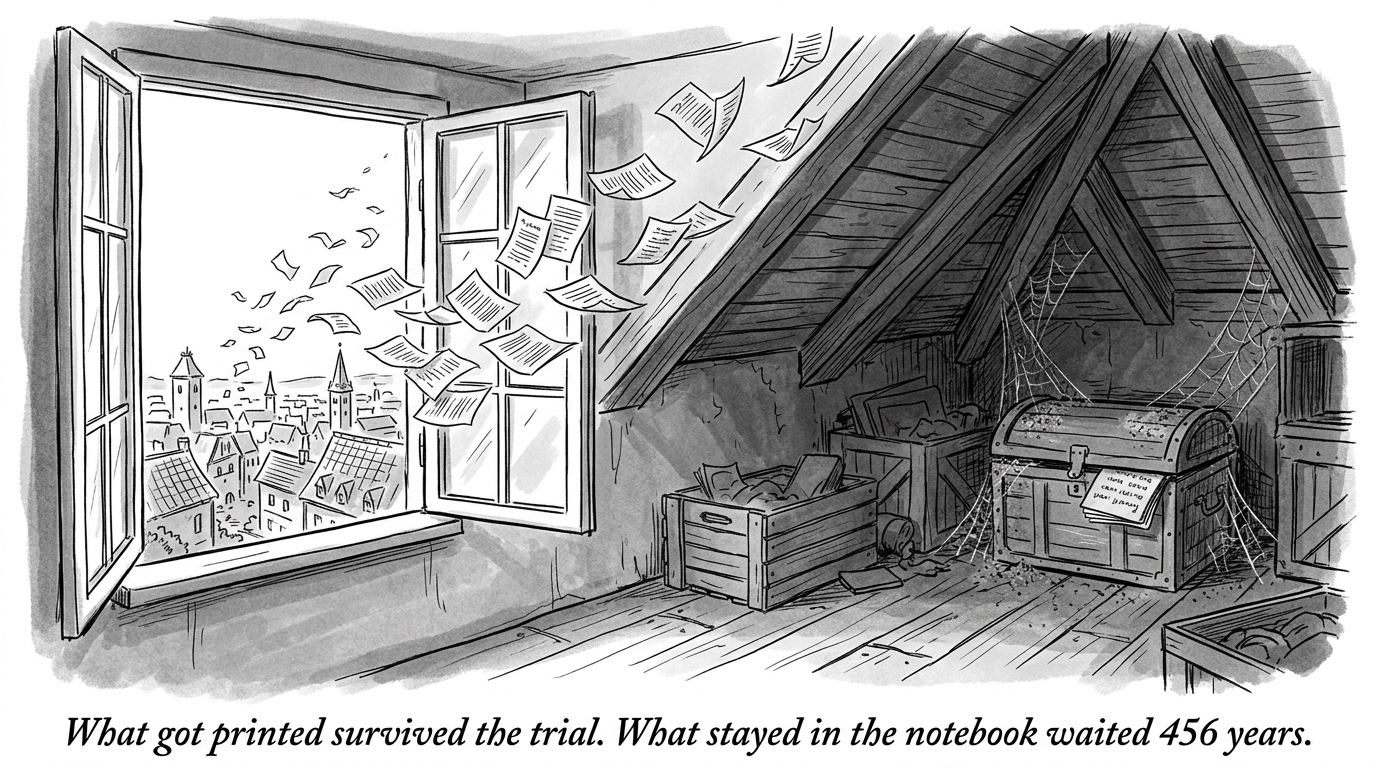
Start with what the two famous cases have in common, because it isn't what it looks like. Socrates chose execution over exile at his 399 BC trial specifically to keep practicing self-examination -- "the unexamined life is not worth living," his stated reason for refusing to stop.[1] Galileo, tried by the Roman Inquisition in 1633 for advocating that the Earth moves around the sun, did the opposite: he recanted, formally and on his knees, to avoid the worse penalty a full heresy conviction would have carried.[2] One chose death over silence; one chose silence over death. It reads like a clean moral contrast -- courage against its absence. It isn't, and the actual mechanism is more useful than the moral reading.
Galileo's recantation didn't erase anything, because the truth had already left the building
The often-repeated detail that Galileo muttered "eppur si muove" -- "and yet it moves" -- under his breath right after recanting is a myth. No contemporary record exists. The first known appearance of the story is in print in 1757, more than a century after Galileo died, and historians have doubted it since.[3] The real story doesn't need the myth. Galileo published his Dialogue Concerning the Two Chief World Systems in February 1632 -- a full year before his trial began.[4] By the time the Inquisition tried him in 1633 and found him "vehemently suspected of heresy" -- a formal distinction one step short of full heresy, which is what let him avoid execution in exchange for recanting -- the book was already in print, already circulating, already read.[2] His sentence was commuted to house arrest at his villa in Arcetri, where he lived until his death in 1642.[2] The Inquisition could force the man to recant. It could not un-print a book that had already left his hands a year earlier. The recantation cost Galileo his freedom. It didn't cost the argument its readers.
Leonardo never got tried for anything, and that's exactly the problem
Between 1508 and 1513, Leonardo da Vinci personally dissected around thirty human corpses, producing 240 anatomical drawings and more than 13,000 words of notes describing nearly every bone, muscle group, and major organ in the human body.[5] To study how the aortic valve closes, he built a glass model of it from a wax cast, then pumped water mixed with grass seed through the model to make the fluid turbulence visible -- and correctly concluded that swirling vortices of blood behind the valve, not just the forward pressure of the next heartbeat, are what snap it shut.[6] That conclusion was right. It sat unconfirmed for 456 years, until cardiologist David Bellhouse used high-speed imaging and fluid models in 1969 to demonstrate the same vortex mechanism Leonardo had described with grass seed and glass -- a finding later reconfirmed again by modern MRI of a beating heart.[6]
Leonardo's dissections ended in 1513 by papal decree, which barred him from continuing -- officially because he wasn't a licensed physician, though some of his anatomical speculations, particularly on embryos, also ran against Church teaching at the time.[5] Unlike Galileo, Leonardo was never tried, never forced to recant anything, never publicly confronted at all. He simply never published. His notebooks -- written in his own private mirror-script, by choice, not under any court order -- went unread and undiscovered for centuries after his death.[5] There was no trial because there was nothing public enough yet to put on trial.
The actual claim, and it isn't about courage. Line the three up and the moral story -- brave Socrates, compromised Galileo, absent Leonardo -- falls apart. What decided whether each person's examined truth survived them wasn't how they behaved when power showed up. It was whether the examination had already reached a form that could outlive the examiner before power got the chance to act at all. Socrates wrote nothing himself; his own "unexamined life" argument survives only because Plato, a student who outlived him, wrote it down after his death.[1] Galileo's argument survived because a printing press had already put it into hundreds of readers' hands a year before any inquisitor arrived. Leonardo's argument nearly didn't survive at all -- not because anyone silenced him, but because he never gave it a form that didn't depend entirely on his own private notebook surviving intact for four and a half centuries. Confrontation with power is the dramatic part of all three stories. Publication -- or its absence -- is the part that actually decided the outcome.
What this changes about how to read the Socrates story specifically
Socrates' choice to die rather than stop examining reads, on its own, as the purest version of intellectual courage on this list -- and it still is. But the reason his argument reached anyone at all wasn't his own courage; it was Plato's decision, afterward, to write it down. Courage kept Socrates examining until the end. It took someone else's separate act of publication to make sure the examining didn't end with him. Leonardo had no Plato. Galileo, in effect, was his own Plato a year ahead of schedule -- the publication happened before the confrontation instead of after the death.
Why does this matter? The comfortable version of this history rewards the person who stood their ground and quietly judges the one who didn't. The actual mechanism doesn't care about anyone's spine. Examined truth survives its examiner running into power for one reason: it already existed somewhere power couldn't reach with a single trial, a single decree, or a single silenced man. Socrates needed a devoted student with a pen. Galileo needed a printing press that had already done its work. Leonardo had neither, and the correct discovery he made about his own heart valve sat waiting, unconfirmed, for 456 years -- not suppressed, just never let out of the room.
Companion piece on this outlet: "Verrocchio's Workshop Taught Leonardo Metallurgy, Anatomy, and Sculpture in the Same Six Years...", which follows Leonardo's aortic-valve discovery forward into an argument about what education should be deliberately building.
Companion piece on this outlet: "Bell Labs Built a 700-Foot Hallway on Purpose in 1941...", which traces the same room mechanism into pure science and hard engineering.
This piece is one part of a longer argument. The full essay: "How to Build a Mind".
- Stanford Encyclopedia of Philosophy, Socrates
- HISTORY / famous-trials.com, Galileo Goes on Trial for Heresy; Recantation of Galileo (1633)
- Darin Hayton, Haverford College, Toward a History of "Eppur si muove"
- Wikipedia, Dialogue Concerning the Two Chief World Systems
- British Journal of General Practice (PMC/NIH), Leonardo da Vinci: anatomist
- Circulation Research (American Heart Association), Cardiovascular Research by Leonardo da Vinci (1452-1519)