In the Cartoon, the Bill Sits on the Capitol Steps, Goes to a Vote, and Either Passes or Doesn't. In 2025, Congress Introduced 11,815 Real Bills. 274 Became Law -- and Most Never Got the Vote the Cartoon Shows as the Whole Story.
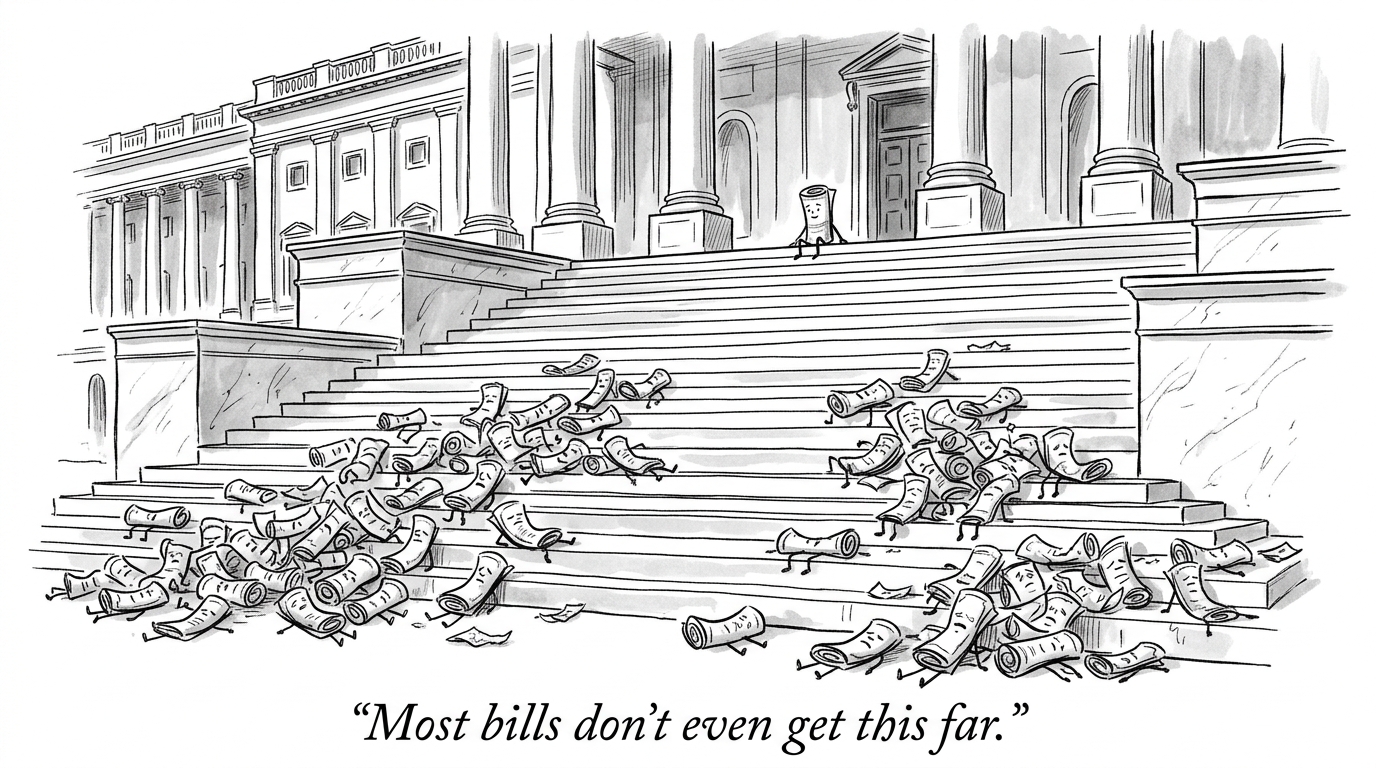
"I'm Just a Bill" first aired March 27, 1976, and for a generation of American kids it was the whole civics lesson: a bill sits on the Capitol steps, hoping to become a law, gets introduced, argued over in committee, voted on by the House and Senate, and signed by the President.[1] The cartoon even admits its own bill is unusual -- "most bills don't even get this far," it says, before the song moves on. This piece is the part the song skips past in one line: what actually happens to the bills that don't.
The real odds: worse than the cartoon lets on, and getting worse
In 2025, members of Congress introduced 11,815 bills. 274 became law -- a success rate of roughly 2.3%.[2] The prior Congress did worse: of 12,354 bills introduced in the 118th Congress, only 46 became law, a 0.37% rate -- the lowest of any Congress on record back to 1990.[2] The cartoon's bill makes it all the way to a floor vote in both chambers. In reality, the overwhelming majority of bills never get that vote at all -- they die earlier, in a room the cartoon never shows.
The room the cartoon skips: who decides a bill gets a vote at all
Most bills never die from losing a vote. They die from never being scheduled for one. In the House, a bill cannot reach the floor unless the Rules Committee -- nine of thirteen seats held by the majority party, effectively controlled by the Speaker -- first writes a "rule" governing how it will be debated: an open rule allowing any amendment, a closed rule allowing only amendments the committee itself pre-approves, or something between the two.[3] A committee chair who simply never schedules a hearing, or a Rules Committee that never writes a bill a rule at all, can kill it without a single member ever voting no. The cartoon's bill gets its committee hearing and its floor vote as a matter of course. Most real bills get neither.
This is the same mechanism this thread has traced through the Senate's 60-vote threshold, already covered on this outlet: the formal process taught in civics class and the actual gatekeeping that decides outcomes are not the same layer.[4] A bill's fate is frequently decided before any recorded vote exists to point to -- in a committee chair's calendar, in a Rules Committee's choice of which amendments to allow, in whether Speaker or Majority Leader wants a given bill to reach the floor at all. None of that shows up in "how a bill becomes a law." All of it decides which bills do.
The workaround built specifically to skip the Senate's own custom
The Senate's 60-vote cloture threshold isn't in the Constitution -- this outlet has already covered that it's tradition, not law.[4] Congress built a formal escape hatch around its own custom: budget reconciliation. A reconciliation bill, if it stays within specific budget-related limits set by the Senate's "Byrd Rule," can pass with a simple majority and only 20 hours of debate -- no 60 votes required, because it legally cannot be filibustered.[5] Major legislation with no realistic path past a filibuster -- including the 2010 Affordable Care Act's companion bill and the 2017 tax cuts -- has passed specifically by being written to qualify as budget reconciliation, a mechanism the cartoon never mentions because it barely existed as a major tool in 1976.
Why does this matter? The cartoon was never wrong about the sequence it shows -- introduction, committee, vote, vote, signature is real. It was only ever showing the bill that survives every gate along the way, in a system where survival is now a roughly 1-in-40 outcome and dropping. The actual decisions -- whether a committee chair schedules a hearing, whether the Rules Committee writes an open or closed rule, whether a bill gets written specifically to dodge the filibuster through reconciliation -- happen in rooms the three-minute version never opens the door to. Most bills don't become Schoolhouse Rock's bill. They become the 97.7% that never get the vote it treats as inevitable.
Companion pieces on this outlet: "Sixty Votes, Tradition Not Law" and "Seven Documents Built America..."
- Schoolhouse Rock Wiki, I'm Just a Bill
- HuffPost, Less Than 1% Of Bills Introduced This Congress Have Become Laws: Analysis
- Taxpayers for Common Sense, Five Fast Facts about the Committee on Rules of the House of Representatives
- DoAyni, Sixty Votes, Tradition Not Law
- Bipartisan Policy Center, Budget Reconciliation, Simplified