How People Chose to Be Whole
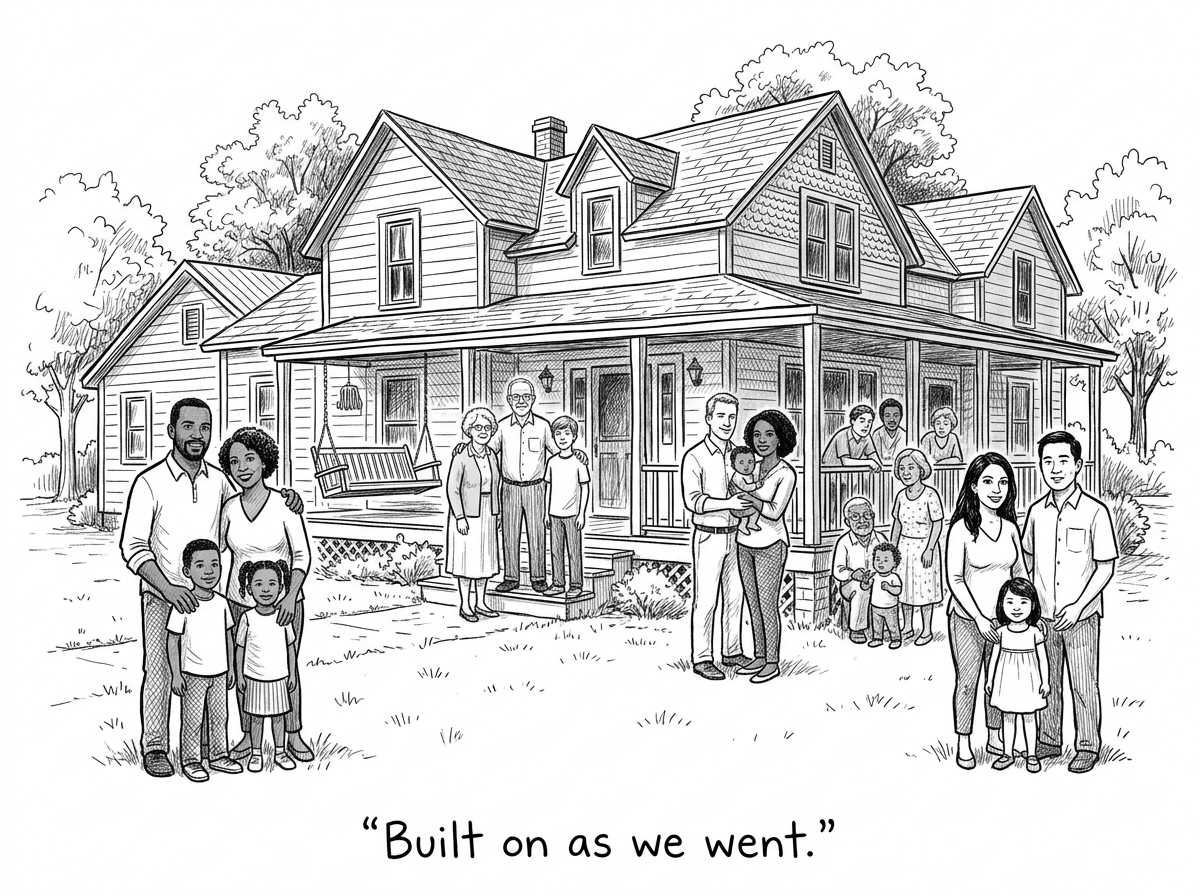
The law decides who may marry. People decide what they are to each other, and the law has been catching up for a long time.
The paperwork
In 1967 the Supreme Court struck down the laws that barred people of different races from marrying. That year about 3 percent of newlyweds had married across race or ethnicity. By 2015 it was 17 percent.[1] The change did not wait for anyone's permission to start, and the ruling did not make it happen. It removed a rule that people had been living around.
It is worth noting that the test case came from a southern, former slave state. Mildred and Richard Loving married in Washington in 1958, came home to Virginia, and were arrested there under a 1924 state law. The judge suspended their sentence on the condition that they leave Virginia. They went to court instead, and in 1967 the Supreme Court ruled unanimously that Virginia's law was unconstitutional.[2][3]
Two ceremonies
Other countries do not always work this way. In France, marriage has two ceremonies, and they are different things. Since 1792 the only marriage with legal effect is the civil one, performed by a municipal officer at the town hall. A religious wedding is optional, comes second, and carries no legal weight of its own.[4][5] One is a contract and the other is a religion. I know this from experience. I once worked for a Parisian who was married in one of the largest Catholic churches in Paris.
In the United States a single ceremony usually does both jobs. State law decides who may officiate, and states recognize clergy and civil officials alike, so the person who marries a couple in the eyes of the church can marry them in the eyes of the state.[6] I read that as one reason the argument over who may marry became so hard here. When the contract and the religion are fused, a question about the contract is also a question about the religion, and the state's definition had to be argued in the vocabulary of faith.
The names
Step, half, in-law, foster. These words name the path someone took into a family. They answer the question of how you came to be related. They do not answer what you are to each other.
About 1 in 6 American children, 17 percent, live in a blended family most or all of the time, meaning a household with a stepparent, a stepsibling or a half sibling.[7][8] Counts vary with the definition: a narrower measure of children living with a stepparent runs closer to 9 percent.[7][8] Whatever the count, that is millions of children, and the adults around them, deciding every day what the words mean. The label says how someone arrived. The choice says what they are.
The adoption wall
For 33 years Florida barred gay people from adopting. The ban was enacted in 1977 and stood until a state appeals court overturned it.[9][10] Florida was one of three states a 2012 Congressional Research Service report listed with such a bar, along with Arkansas and Mississippi.[9][10] The state held the law, and the families existed anyway.
The arc
In 1996 President Clinton signed the Defense of Marriage Act, which defined marriage in federal law as a union of one man and one woman.[11][12] That year Gallup first asked Americans whether same-sex marriage should be legally recognized, and 27 percent said yes.[13] Gallup first recorded a majority in 2011.[13] Years later Clinton wrote that the law was incompatible with the Constitution and that he had signed it to head off worse legislation.[11][12] In February 2011 the Justice Department stopped defending the law in court.[14]
In 1993 the Clinton administration set the military's rule, "Don't Ask, Don't Tell": gay and lesbian service members could serve only if they stayed silent about who they were. Thousands were discharged anyway, more than 13,000 by one count and at least 14,316 by another.[15][16][17] Congress repealed the policy in December 2010, 250 to 175 in the House and 65 to 31 in the Senate, and President Obama signed the repeal on December 22.[15][16][17]
In 2013 the Supreme Court struck down the part of the law that barred federal recognition of same-sex marriages.[18][19] In 2015, in Obergefell v. Hodges, it held 5 to 4 that the Fourteenth Amendment requires states to license same-sex marriages and recognize those performed elsewhere, resting on the reasoning of Loving.[18][19] Support stood at 60 percent when the Court ruled, and reached 70 percent in 2021, the high point in Gallup's trend.[13] In 2022 Congress passed the Respect for Marriage Act, which repealed the federal definition and requires federal recognition of both same-sex and interracial marriages, though it does not codify every part of Obergefell.[20][21]
People moved first. The leaders who held the older position moved with them. Then the law moved.
What I read in it
I read this as the story of how America actually gets built. A country is not made only by its statutes. It is made in households, by people who decided to be whole across lines the paperwork could not see: a different race, a different faith, a different sex, a different father, a different history. They did it before it was legal, sometimes at a cost, and the law followed.
That is the complexity of the country, and it is not a flaw in the design. It is the design working: the arc bends because people choose, one household at a time, and eventually enough of them have chosen that the rule cannot stand.
What I do not know
Public support for same-sex marriage has softened a little since its 2021 high, and Gallup describes the recent change as subtle and partisan. I did not find the most recent year's number. The blended-family counts depend on how the survey defines a stepfamily, so I have given both figures. I have not read the Court's opinions in full; I relied on summaries and news coverage of them. I have left out what each President thought before he changed his mind, because I could not source it.
See also DoAyni's account of the case: A Sheriff Walked Into Their Bedroom at 2 A.M.
- Pew Research Center, "Key facts about race and marriage, 50 years after Loving v. Virginia", Share of newlyweds who married across race or ethnicity, 1967 and 2015 (Pew Research Center, "Key facts about race and marriage, 50 years after Loving v. Virginia")
- Encyclopedia Virginia, "Loving v. Virginia (1967)", The Loving case (Encyclopedia Virginia, "Loving v. Virginia (1967)")
- Institute for Justice, The Loving case (Institute for Justice)
- Aleteia (in French), "Pourquoi en France le mariage civil précède le mariage religieux", Civil and religious marriage in France (Aleteia (in French), "Pourquoi en France le mariage civil précède le mariage religieux")
- Les Cahiers du Temps, "Le mariage civil de 1792 à nos jours", Civil and religious marriage in France (Les Cahiers du Temps, "Le mariage civil de 1792 à nos jours")
- FindLaw, "Who Can Officiate My Wedding?", Who may officiate a marriage in the United States (FindLaw, "Who Can Officiate My Wedding?")
- Pew Research Center, "5 facts about U.S. children living in blended families" (April 2026), Children in blended families (Pew Research Center, "5 facts about U.S. children living in blended families" (April 2026))
- Bowling Green State University, National Center for Family & Marriage Research, Children in blended families (Bowling Green State University, National Center for Family & Marriage Research)
- Congressional Research Service, "Same-Sex Adoptions", Same-sex adoption bans (Congressional Research Service, "Same-Sex Adoptions")
- Jurist on the Florida ruling, Same-sex adoption bans (Jurist on the Florida ruling)
- CBS News, The Defense of Marriage Act and Clinton's later position (CBS News)
- CBS News San Francisco, The Defense of Marriage Act and Clinton's later position (CBS News San Francisco)
- Gallup, record-high support (2021), Public support for same-sex marriage (Gallup, record-high support (2021))
- Baptist News Global, The Justice Department and the Obama administration on DOMA (Baptist News Global)
- Servicemembers United figures, via Washington Blade, "Don't Ask, Don't Tell" (Servicemembers United figures, via Washington Blade)
- Facing South, "Institute index: ending Don't Ask, Don't Tell", "Don't Ask, Don't Tell" (Facing South, "Institute index: ending Don't Ask, Don't Tell")
- Indy Week, "Don't Ask, Don't Tell" (Indy Week)
- Respect for Marriage Act background, Wikipedia, *United States v. Windsor* (2013) and *Obergefell v. Hodges* (2015) (Respect for Marriage Act background, Wikipedia)
- Georgia Public Broadcasting on the history of interracial and same-sex marriage, *United States v. Windsor* (2013) and *Obergefell v. Hodges* (2015) (Georgia Public Broadcasting on the history of interracial and same-sex marriage)
- Wikipedia, The Respect for Marriage Act, 2022 (Wikipedia)
- Mercer legal analysis, The Respect for Marriage Act, 2022 (Mercer legal analysis)