A Native English Speaker Needs About 2,200 Classroom Hours to Reach Fluency in Mandarin -- Nearly Three Times What Spanish Takes. That Gap Is Also an Argument for Starting at Three, Not Thirteen.
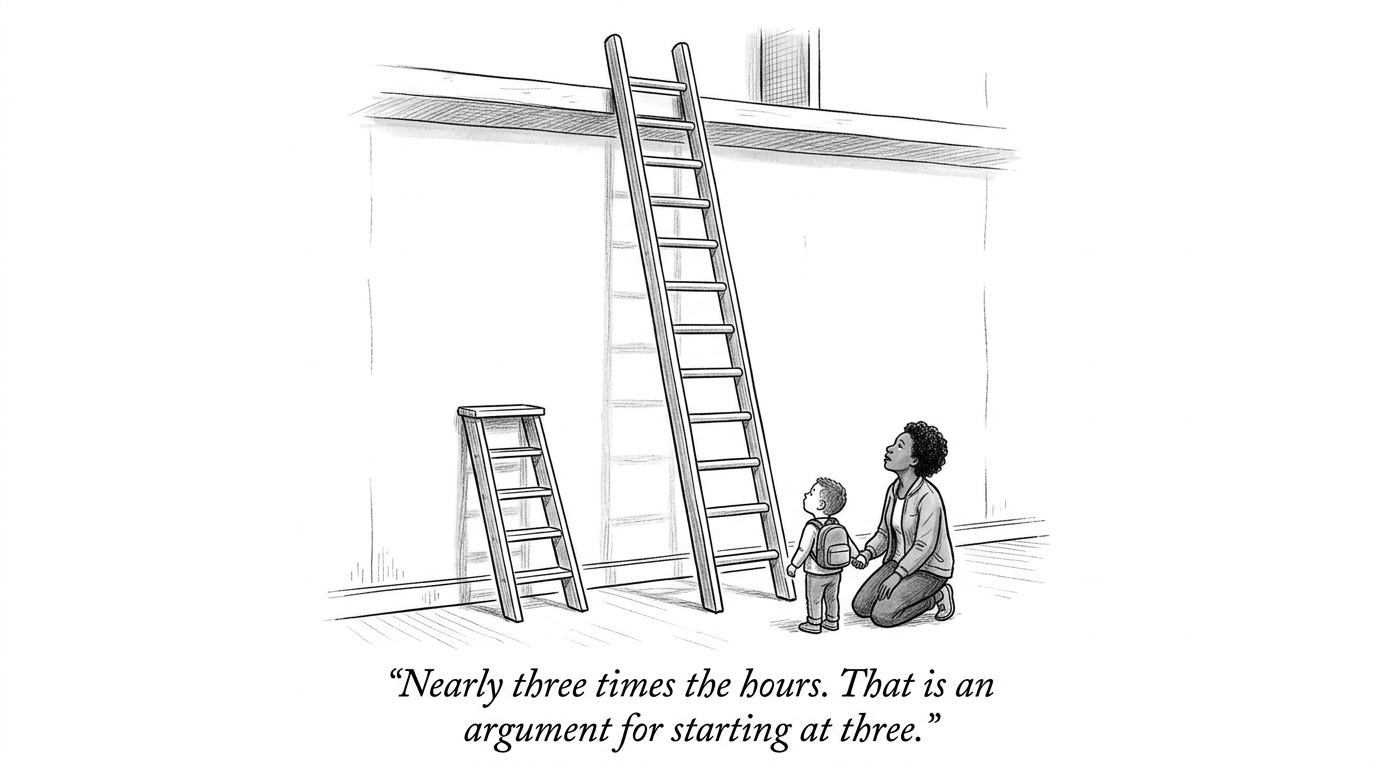
Start with the size of the gap, because "Mandarin is harder" undersells it by a wide margin. The U.S. Foreign Service Institute ranks languages by how many classroom hours an English speaker needs to reach professional working proficiency. French and Spanish sit in Category I: roughly 600 to 750 hours, about 24 to 30 weeks of full-time study.[1] Mandarin sits in Category V, the hardest tier the FSI tracks: roughly 2,200 hours, about 88 weeks.[1] Not twice as hard. Nearly three times the cumulative instructional time, for the same destination -- working professional fluency, not casual conversation.
A third way to state the same bet, sharper than "where the puck is going"
Institutions can see a language need coming years in advance and still fail to build it in time, because the actual pipeline -- recruiting, training, testing, promoting people around one specific expertise -- runs on a decade-plus clock that no amount of early warning shortens. The FBI knew immediately after September 11, 2001 that it needed Arabic speakers; five years later, only 33 of its roughly 12,000 agents had any Arabic capability at all. A 2023 federal audit found the identical shape of gap already opening in Mandarin, the language the government has itself named its own current top priority. A parent doesn't share that excuse. Nobody inside a family's own pipeline has a competing career incentive to leave the capacity unbuilt -- the only real obstacle is starting late, the same clock running at a household's tiny scale instead of a country's, and starting early is a decision a parent can just make.
Two real reasons for the same choice, four months apart, neither one canceling the other
A choice to start a child in Mandarin instead of Spanish, and in piano instead of saxophone, made years before either could matter, carries a real, dated reason on record: **"why my kids own pianos and not sax. mandarin and not spanish. go to where the puck is going."** Spanish was already established and low-risk. Mandarin was a bet on where global economic and geopolitical weight was actually shifting, not where it already sat -- the harder, less convenient choice, made anyway, closed with the line: **"it is a way of being."**
Months later, a second, entirely different reason for the identical choice surfaced -- not instead of the first one, alongside it: fluency deep enough to think and dream in a language, not just hold a conversation in it, has a real developmental window. Hartshorne, Tenenbaum, and Pinker analyzed nearly 670,000 English speakers in a 2018 study and found a real, measurable critical period for second-language grammar acquisition, with the capacity to reach native-like competence declining sharply after roughly age 17.[2] Layer that against the FSI's own hour count: a language that takes almost three times as long to master needs to start earlier just to fit inside the window at all. Geopolitical foresight explains why Mandarin. The critical period explains why age three and not age thirteen.
What the investment actually produced, and what it did not decide
The concrete result is real, and it is not a single lucky case: all three of the children this choice was made for can now speak and read multiple languages -- the eldest daughter four or five, the other two at least three each. The capacity landed, consistently, across every child it was tried on, not once. But the specific direction that capacity was originally aimed at did not: the early hope, stated plainly, was a career at the United Nations for the daughter it was most directly imagined for. The reasoning wasn't that fluency would let her personally win an argument against a billion-plus people -- that was never on offer to anyone, a matter of simple math, not persuasion. It was that the UN is the one real structure actually built to operate at that scale, and fluency was the entry ticket into the room where it happens, not a tool for winning something outside it. At 19, she chose law instead, on her own, as her actual calling.
This is not a story about a plan that failed. It is the honest, load-bearing limit on what deliberate formation was ever able to promise in the first place. A parent can pick the instrument, the language, the age it starts, and get every piece of that reasoning right -- foundational over niche, rising over established, early enough to fit inside a real neurological window. All of that is real, and all of it built genuine capacity: a young adult fluent in several languages, capable of doing serious work in any number of directions. What it never was, and was never going to be, is a decision about which direction she would actually choose. Parents have a view. The child ultimately decides. The formation's job was only ever to build the capacity wide enough that her own choice, whatever it turned out to be, would have real range to choose from -- not to choose it for her.
Why does this matter? The honest version of "invest early, invest deliberately" is not a guarantee that the investment gets spent the way the investor originally imagined. It is closer to the opposite: the more real capacity a person is given, the more genuine choices they actually have, and a wider set of genuine choices means the outcome becomes less predictable, not more. A parent aiming at the UN and getting a lawyer instead is not a plan gone wrong. It is what a real, working choice looks like once someone actually has the capacity to make one.
Companion pieces on this outlet: "How to Build a Mind," "Replacing a Bad Teacher With Just an Average One Adds $250,000...," and "The FBI Had 70 Arabic Translators on September 11, 2001" -- the institutional version of the identical clock.
- FSI Language Courses / Foreign Service Institute, Foreign Service Institute Language Difficulty Rankings
- MIT / Cognition (Hartshorne, Tenenbaum, Pinker), A Critical Period for Second Language Acquisition: Evidence from 2/3 Million English Speakers