No One Told You
I was never a federal employee, and the Hatch Act never applied to me. I did not talk about politics anyway. Everyone knew who I worked with. My résumé and my LinkedIn say it plainly, and I live in Northern Virginia, just outside of D.C. You bump into people, and they ask where you work.
The agencies I worked with are on the statute's list: the CIA, the NSA, the DIA, the FBI, the National Geospatial-Intelligence Agency. Employees of those agencies are "further restricted" under the Hatch Act and may not take an active part in partisan political management or campaigns.[1] In-Q-Tel's own published partner list names the same agencies.[2] I held a TS/SCI clearance and lived in that world.
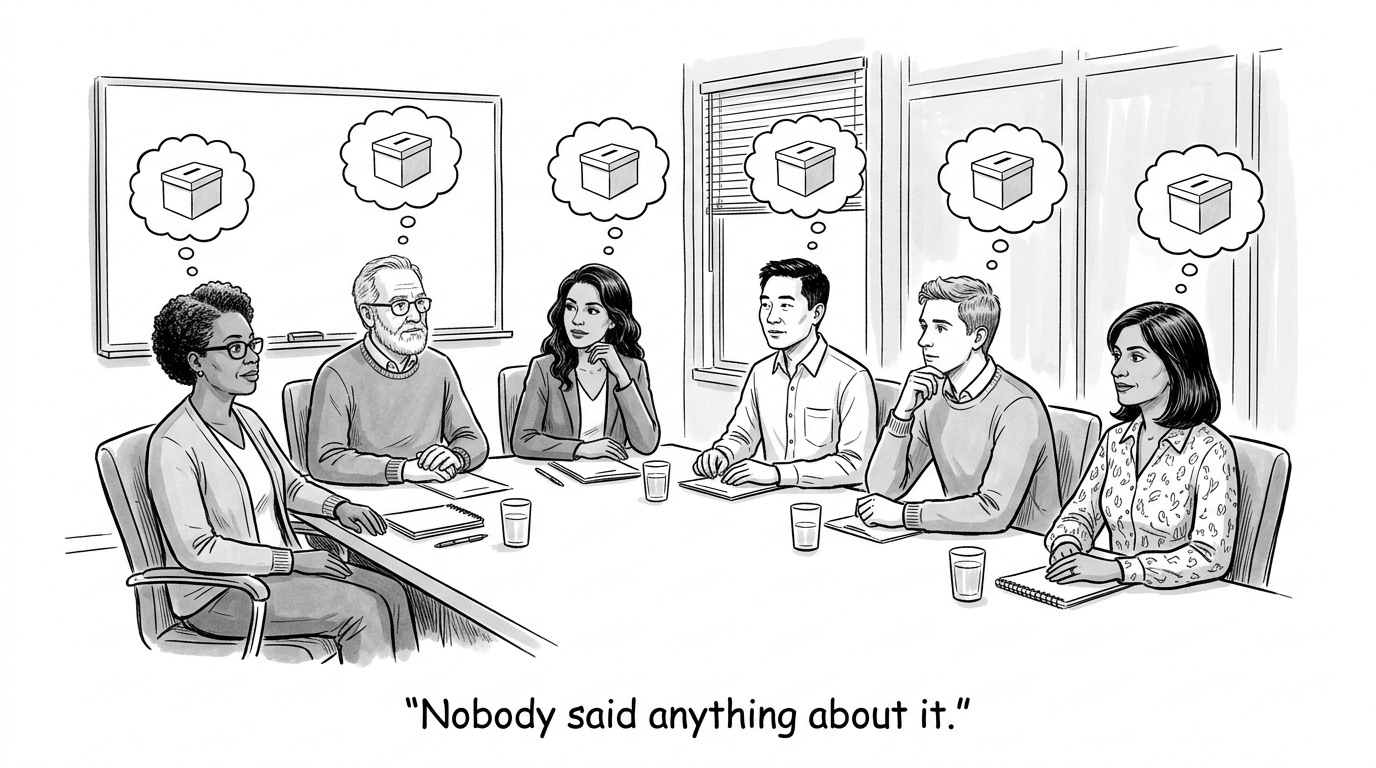
No one told me not to express my views. We just did not. I knew it the way you know a thing nobody says: it was inferred, never stated. That is what this piece is about. It is not about the law. It is about the shadow of the law, and who stands in it.
What the law actually says
The Hatch Act covers executive-branch employees. The statute defines "employee" as an individual employed in an Executive agency or in a competitive-service position, and it excludes the President, the Vice President, members of the uniformed services and employees of the District of Columbia government.[3] The Office of Special Counsel, which enforces it, says all federal civilian executive-branch employees are covered, including those of the U.S. Postal Service.[4]
It does not silence them. The statute says a covered employee "may take an active part in political management or in political campaigns," except for a short list of prohibitions: using official authority to affect an election, soliciting or receiving political contributions, running for partisan office, and soliciting or discouraging the political activity of certain people.[1] Even further-restricted employees may express opinions off duty, and OSC lists expressing opinions about candidates and issues as permitted.[4]
The hard lines in the law are drawn around place and role, not around opinion. A covered employee may not engage in political activity while on duty, in any room or building occupied in the discharge of official duties, while wearing a uniform or official insignia, or using a government vehicle.[5] And soliciting or receiving a political donation in such a building is a federal crime for any person, punishable by up to three years in prison.[6]
The Supreme Court upheld the law in 1973, over a three-justice dissent.[7] It described what the statute still leaves to an employee: the right "to vote as he chooses and to express his opinion on political subjects and candidates."[7] And it gave its reason in two parts. Government employees must carry out the law "without bias or favoritism." It is also critical, the Court said, that they "appear to the public to be avoiding it."[7]
That second reason is the one that does not stop at the edge of a statute. A rule built to protect appearances reaches anyone whose appearance is tied to the institution.
Who the statute does not cover
It does not cover spouses or family members. OSC says so directly: "Hatch Act coverage is not transferred to spouses or family members."[8] It covers employees of private nonprofits only in narrow cases, currently Head Start and the Community Services Block Grant program.[8] It covers state and local employees only where their principal employment is in connection with an activity financed in whole or in part by federal loans or grants.[9]
It does not name In-Q-Tel, a not-for-profit founded by the CIA that is not part of it.[2] Its definition of "employee" is people employed in an Executive agency or in the competitive service, which on its face leaves out the employees of private contractor companies.[3]
How many people stand there
Nobody counts them. In 2015 the Congressional Budget Office said it knew of no comprehensive information on the size of the contracted workforce.[10] The Defense Department is the one agency that tracks it, as full-time equivalents: an estimated 710,000 contractor FTEs in fiscal 2011, roughly 90 percent of its 807,000 civilian FTEs.[11] Paul Light of New York University estimated about 3.7 million contract workers across the government in 2015, an estimate whose method has been disputed.[12]
Against that, the covered population is about 2.0 million executive-branch civilians.[13] The largest primes report employees in the six figures each: Boeing about 182,000, RTX about 180,000, Lockheed Martin about 123,000, Northrop Grumman about 95,000. These are whole-company, global counts that include commercial work.[14][15][16][17]
The cleared population gives a firmer number. The government's last annual clearance report I could verify, for fiscal 2019, counted about 4.2 million people eligible for access to classified information, 1,384,060 of them at the Top Secret level.[18] It put the number of contractors and others at 1,346,765.[18] There is no public count of TS/SCI as such, because SCI is an access layered on top of Top Secret. Contractor employees are generally not covered by the Hatch Act, and a clearance does not change that. They are the people standing next to the people it covers.
What the paperwork asks
My view is that the work selects for a disposition, and I have come to call it vanilla. I did not start out believing that. I now think the forms reinforce it.
The Standard Form 86, the questionnaire for national security positions, has 29 sections. It asks for three people who know you well and are "collectively aware of your activities outside of your workplace."[19] It asks about foreign contacts, foreign travel in the last seven years, your association record, and your finances: bankruptcy, delinquent debts, judgments and liens within seven years.[19] It asks about foreign financial interests held by you, your spouse or partner, a cohabitant or your dependent children.[19] It ends with a certification that a knowing and willful false statement can be punished by fine or imprisonment under 18 U.S.C. 1001, and it adds that your prospects "are better if you answer all questions truthfully and completely."[19]
It is a strange inversion. What most people hold closest, their money, their family, how they live, goes onto a form in that world. The form asks who your relatives are, who you live with, what you owe and what you have defaulted on.[19] Mine was public too. A nonprofit's Form 990 reports the pay of its officers, key employees and highest-paid staff, and I was listed in In-Q-Tel's for years, as a key employee and among its five highest-paid staff.[20] Your civic stance is the one thing it does not ask for, and the one thing the people filling it out learn to keep to themselves.
None of that bars a complicated life. The adjudication framework is built on a "whole-person concept," in which no single issue is automatically disqualifying and mitigating information is weighed.[21] But the form's unit of risk is the unexplained. A simple life has little to explain. A complex one has a great deal, and every item has to be answered, in writing, under penalty, for seven years back.
I am not saying anyone designed the form to select for quiet. I am saying that is what it rewards, and that the people who stay in the work are the people for whom that reward feels like home.
Training or selection
Someone I trust asked me whether the work trained me, or whether I was selected for it because the habit was already innate. I do not know. I have come to think the work selects for the disposition, and the paperwork reinforces it. The statute is the part that is written down. The norm is the part that is not.
The strain of being public
The strain I feel writing this is not about the Hatch Act. It is about being public. It is writing my own views for an audience I cannot see. For years the room was small and known, and my silence was part of its manners. Here the audience is anyone.
Why does this matter?
A rule that is written can be read, argued with and changed. A norm that is inferred cannot. It has no author and no text, and it is passed along by what people notice others not saying. It also outlasts the rule it imitates. Millions of Americans work beside institutions the statute binds, in contracts and grants and families, with no rule of their own and the same quiet.
This piece takes no side on any candidate, party or election, and it does not argue that the Hatch Act should change. The statute is narrower than the silence around it. What the country asks of the people closest to its machinery is something the law never required, and it does not appear in any record.
Part of a longer argument about what rules and numbers stand on. See also DoAyni's piece on the CIA's investment arm and the Pentagon's.
- Legal Information Institute, Cornell Law School, 5 U.S.C. § 7323, Political activity authorized; prohibitions
- In-Q-Tel, Frequently asked questions
- Legal Information Institute, Cornell Law School, 5 U.S.C. § 7322, Political activity of certain individuals: definitions
- U.S. Office of Special Counsel, Federal Employee Hatch Act Information
- Legal Information Institute, Cornell Law School, 5 U.S.C. § 7324, Political activities on duty; prohibition
- Legal Information Institute, Cornell Law School, 18 U.S.C. § 607, Solicitation or receipt of contributions in Federal offices
- Legal Information Institute, Cornell Law School, United States Civil Service Commission v. National Association of Letter Carriers, 413 U.S. 548 (1973)
- U.S. Office of Special Counsel, Hatch Act FAQs
- Legal Information Institute, Cornell Law School, 5 U.S.C. § 1501, Definitions (State or local officer or employee)
- Federal Times, CBO has no clue on the number of contractors or their pay (Mar 12, 2015)
- U.S. Government Accountability Office, Defense Contractors: Inventory of Contracted Services (GAO-13-470, highlights)
- Project On Government Oversight, Contractors and the True Size of Government (summary of Paul Light's estimates)
- U.S. Office of Personnel Management, as reported by FedTools, Federal workforce data (executive-branch civilian headcount, February 2026)
- U.S. Securities and Exchange Commission, Form 10-K, The Boeing Company, fiscal year 2025
- U.S. Securities and Exchange Commission, Form 10-K, RTX Corporation, fiscal year 2025
- U.S. Securities and Exchange Commission, Form 10-K, Lockheed Martin Corporation, fiscal year 2025
- U.S. Securities and Exchange Commission, Form 10-K, Northrop Grumman Corporation, fiscal year 2025
- Congressional Research Service / Office of the Director of National Intelligence, Annual Report on Security Clearance Determinations, FY2019, as summarized in CRS R43216, Security Clearance Process: Answers to Frequently Asked Questions
- U.S. Office of Personnel Management, Standard Form 86, Questionnaire for National Security Positions (revised November 2016)
- Internal Revenue Service, Instructions for Form 990, Return of Organization Exempt From Income Tax (Part VII: officers, directors, key employees and highest compensated employees)
- RAND Corporation, RAND report on SEAD 4 adjudicative guidelines (whole-person concept)