A 23-Year-Old Product Manager's AI Tool Refuses to Execute His Ideas Until He Explains Why They're Right. In 14 Months, He Says He Gained Three Years of Experience.
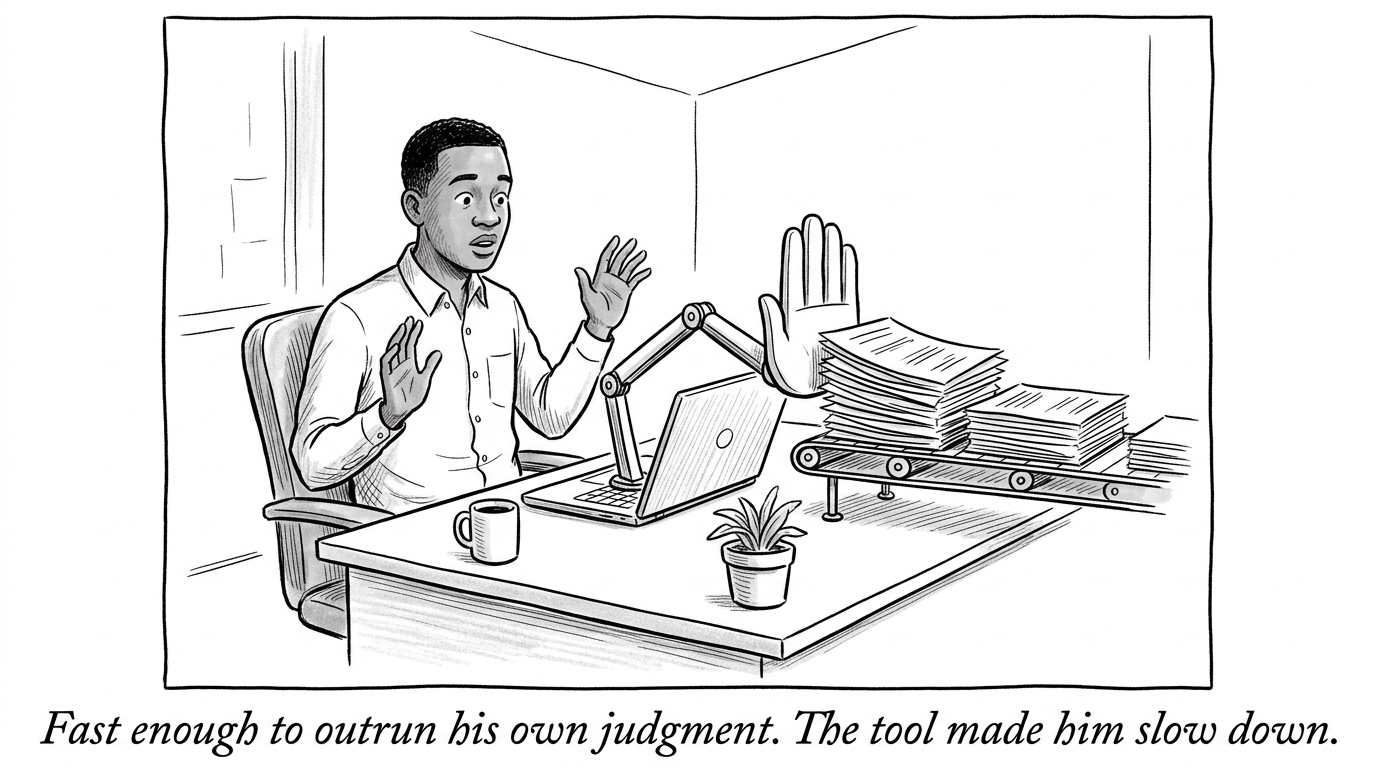
Tom Harpaz's problem wasn't that AI made him slow. It's that AI made him fast enough to outrun his own judgment. Twenty-three years old, no prior product management experience, he joined Section and started producing polished documents in an hour that used to take a junior PM most of a day. The work looked finished. Whether it was actually right was a separate question the speed wasn't answering.
A tool built to refuse him, not to help him
Section's founders, Greg and Taylor, built Tom a Claude-based tool they call PM Coach, and its first mode does something most AI tools are built specifically not to do: it says no. Coach Mode won't execute a task at all until Tom explains his own reasoning -- what problem he's actually solving, why his proposed answer is the right one -- and it was trained on roughly a hundred real management conversation transcripts specifically so it can push back the way an actual manager would, not the way a generic chatbot would. Only once that reasoning holds up does Peer Mode unlock, and Peer Mode is the fast one: drafting, specs, templates, execution at full AI speed, carrying forward whatever got worked out in the coaching conversation that came before it.[1]
Every other AI-productivity story this outlet has covered runs on the same premise: the tool's value is what it speeds up.[2] PM Coach's value is the opposite -- what it deliberately refuses to speed up. Over three months, Section's founders watched Tom's own behavior shift on its own: he started choosing to spend two or three hours in Coach Mode before ten hours of Peer Mode execution, not because the tool forced the ratio, but because the coaching sessions had become the part that actually made the execution worth doing. The tool's entire design bet is that a junior employee's real constraint was never output speed. It was judgment, and judgment doesn't get built by making the wrong answer arrive faster.
Worth naming plainly: this is one company's account of one employee, told by the people who built the tool and have every reason to want it to look like it worked. "Three years of experience in fourteen months" is Tom's own retrospective estimate, not a measured outcome with a control group. That doesn't make the mechanism described any less real or any less worth naming -- gating fast execution behind forced reasoning is a genuinely different design choice than anything else in this space -- but it's a case study with an obvious incentive behind it, not an independently audited result.
Why does this matter? This outlet published a piece hours ago about Anthropic researchers resigning over the odds that frontier AI kills everyone within a decade.[2] Both stories are true about AI in the same week, and they're not actually in conflict -- they're answers to two different questions. One is about what the most powerful models might eventually do at a civilizational scale. This one is about what a much smaller, deliberately constrained tool is doing right now to a twenty-three-year-old's actual career, on purpose, by refusing to let him move fast until he can explain why he should. Whether AI is a threat or a genuine accelerant depends entirely on which layer of the technology, and which use of it, is actually being asked about.
- Supercompanies (Section), AI is good for entry-level workers, actually
- DoAyni, A Researcher Who Helped Build GPT-4o Just Quit Anthropic...