A Billionaire Bought 114,000 Acres of Wyoming Ranchland Under a Fake Company Name So Sellers Wouldn't Raise Their Prices. It Took 23 Years and a Presidential Fight for the Land to Become a National Park.
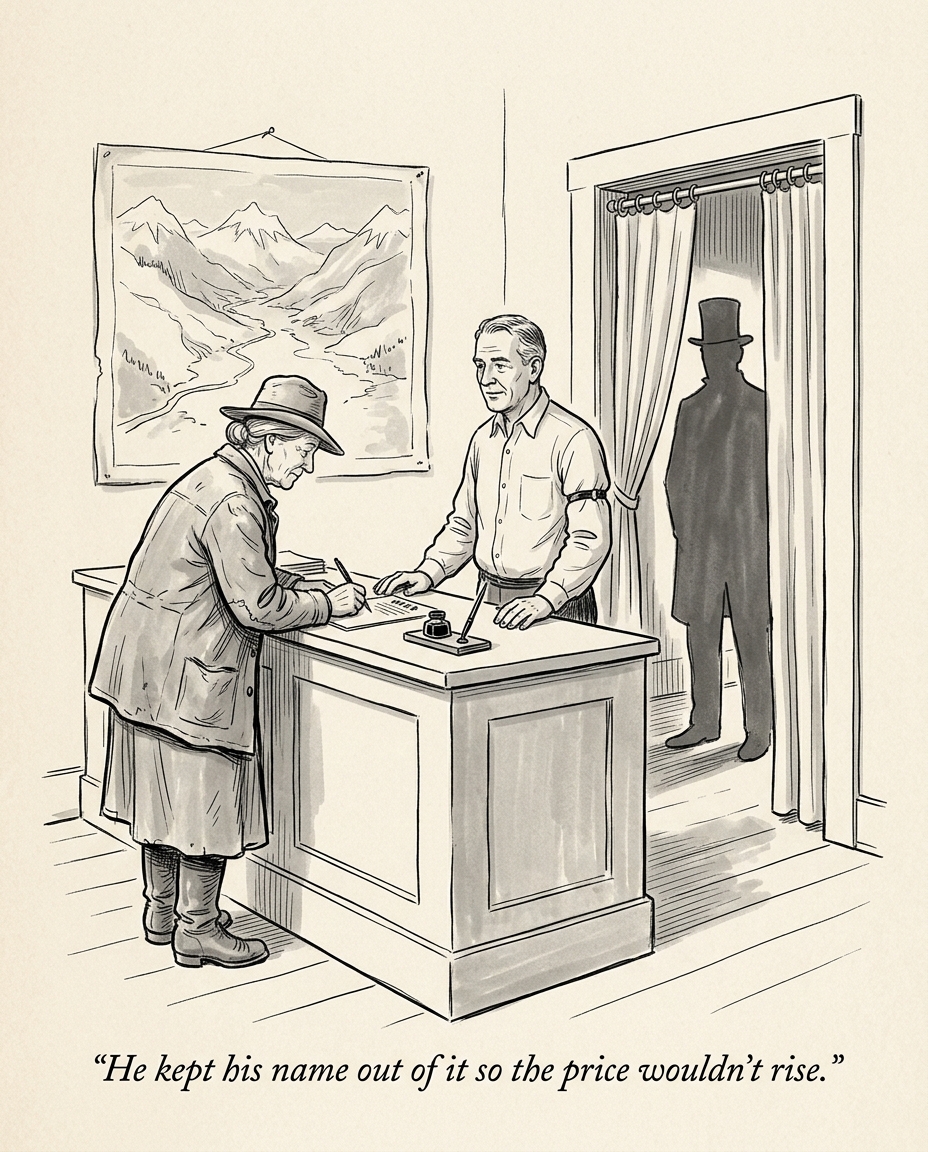
In 1927, John D. Rockefeller Jr. set up a company called the Snake River Land Company and began quietly buying up ranchland in Jackson Hole, Wyoming -- eventually agreeing to purchase as much as 114,170 acres for roughly $1.4 million.[1] He kept his own name out of it deliberately: if local ranchers and sellers had known one of the richest men in America was buying, land prices would have risen accordingly. The company operated as a front specifically so Rockefeller could assemble the land without anyone knowing what it was actually for.[1]
The secret held for three years, then didn't
The anonymity lasted until 1930, when the company was forced to release a statement revealing Rockefeller's identity and his actual plan: buy the land, then donate it to the federal government to expand Grand Teton National Park, which had been established in 1929 but at that point covered only the high peaks themselves, none of the valley floor below them.[1] Exposure did not simplify the plan. It produced two more decades of local resistance before the land Rockefeller had already bought and was offering to give away actually became part of the park.
Owning the land and being allowed to give it away turned out to be two entirely separate fights. In 1943, with the donation still unresolved, President Franklin Roosevelt used the Antiquities Act to declare the land a national monument by executive order -- bypassing Congress entirely, which triggered real local and Congressional backlash over federal land-grab concerns. It took until 1950, in a compromise brokered specifically to end that standoff, for the monument land to be formally absorbed into Grand Teton National Park.[1] Rockefeller had the money and the land in hand from 1927 forward. It still took 23 years, a presidential order, and an act of Congress to actually finish what he set out to do.
Why does this matter? Jackson Hole's current identity -- Wyoming's zero income tax, a real concentration of conservation-linked wealth around Grand Teton National Park, Teton County's status as the highest-per-capita-income county in the United States -- has a specific, datable origin most visitors never learn. It didn't emerge from the landscape being self-evidently worth protecting. One person spent decades and a fortune buying it secretly, then spent two more decades fighting to actually give it away. The park exists on the specific timeline of that fight, not on the timeline of the land itself.
Companion pieces on this outlet: "A Failing Mill Town Needed 15 Months and $60 Million..." and "A Cattle-Ranch Kid Turned Robotics Engineer..."