The Names in My Head
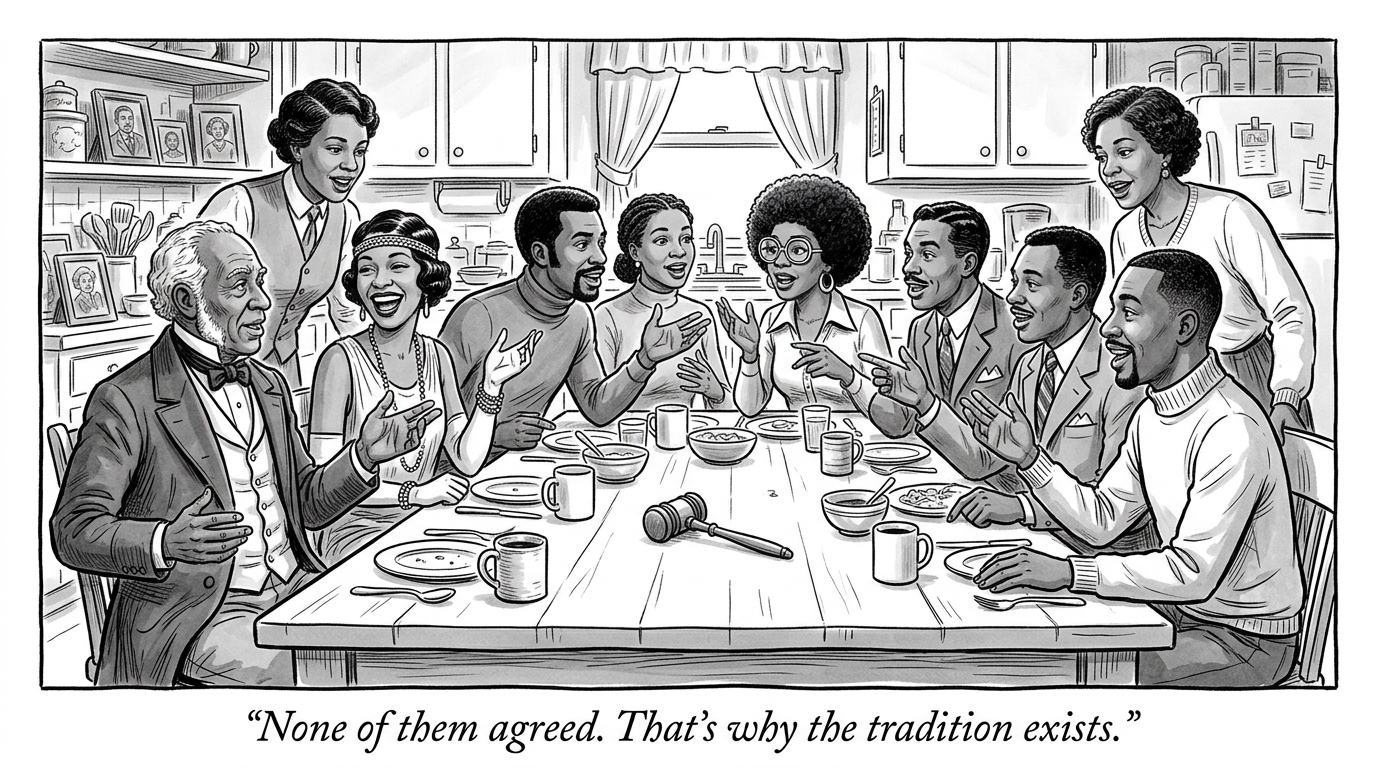
I've spent months handing over names. Douglass, Washington, Du Bois, Wells, Baldwin, Hughes, Ellison, Hurston, Giovanni, Butler, Angelou, West, King, Malcolm X, Carmichael, Ella Baker, Holiday, Simone, Cooke, Gaye, Armstrong, Coltrane, Miles Davis -- some of them from my own shelf, some of them from pieces I've helped build, all of them real, none of them handed over as a syllabus. The point was never the facts. Anyone can look up a date. The actual question is what happens once they're all held in the same place at once, because most of these people did not agree with each other, and the whole tradition only exists because none of that disagreement ever got resolved into one winner.
Frederick Douglass, who never spent a day in a formal classroom and taught himself to read in secret while enslaved, stood up in Rochester in 1852 and asked a Fourth of July audience what the Declaration's promise of equality actually meant to a man who had escaped slavery to be standing in front of them. He wasn't asking for something new. He was holding the country to a sentence it had already written down about itself seventy-six years earlier, and naming the distance between that sentence and the country's own practice as a national hypocrisy, not a regional embarrassment. That's the founding move of everything that follows: not a request, an indictment, delivered in the country's own words.
Forty-three years later, Booker T. Washington, a graduate of Hampton Institute who later received an honorary master's degree from Harvard and an honorary doctorate from Dartmouth, stood up in Atlanta and made close to the opposite argument. Accept the political and social status quo for now, he said -- focus on vocational training, land, economic self-reliance, build real material strength inside the constraint rather than fighting the constraint directly. It worked, in a narrow sense; it got funding, it built Tuskegee, it kept the peace with White Southern power long enough for something to grow. W.E.B. Du Bois, who in 1895 became the first Black person to earn a doctorate from Harvard, came after him and rejected the whole premise in print, calling Washington's approach "a gospel of Work and Money" that traded away political power, civil rights, and higher education for a slower, safer kind of progress that Du Bois didn't think was progress at all. Two men who wanted the same country to actually mean its own founding words, publicly, sharply disagreeing about whether patience or confrontation got there faster. Neither one was simply right.
Washington's actual strategy got a real-world test twenty-six years after he stood up in Atlanta, and it failed in the most literal way a strategy can fail. Greenwood, in Tulsa, was Washington's philosophy built and working -- likely the richest Black community in the country, a self-contained economic district people called Black Wall Street, built by exactly the kind of patient, self-reliant, work-first approach he'd argued for. On May 31 and June 1, 1921, a White mob burned thirty-five blocks of it to the ground, destroyed more than a thousand homes and businesses, and killed as many as three hundred people. Insurance companies got the massacre reclassified as a "riot" so their policies wouldn't have to pay, and historians believe exactly one White business owner in the whole district ever received compensation. A century of lawsuits by survivors and their descendants have kept getting dismissed, most recently by Oklahoma's own Supreme Court. Building the economic self-reliance Washington argued for was never the part that failed. It's that self-reliance, built in full, still wasn't a defense against a mob willing to burn it down in a day -- which is exactly the gap Du Bois was pointing at when he said economic strength without political power and civil rights wasn't the whole answer.
Ida B. Wells, who had only a few years of formal schooling before she left to raise her younger siblings, was a working journalist before she was anything the history books now call her. After three friends of hers were lynched in Memphis in 1892 over a business dispute dressed up as something else, she went and investigated the actual pattern behind lynching case by case, county by county, and published what she found in Southern Horrors and then A Red Record -- a statistical demolition of the era's standard justification, that lynching was a response to Black men assaulting White women. Most cases, her own data showed, had nothing to do with that claim at all. That's the work that got her run out of Memphis at gunpoint and made her a name serious enough to be in the room, one of two Black women present, when the meeting that founded the NAACP happened in 1909, standing next to Du Bois himself. The organization spent the next several decades not listing her as a founder anyway. She was too confrontational for its own leadership's taste, too insistent that the group's first real priority should be federal anti-lynching legislation; when that motion got voted down, she cut ties with the organization in 1912 rather than soften what she'd built her whole career on. The people who fought hardest for the same goal did not always end up on the same side of the room, even when they started in it together, and the one who did the actual field data collection was the one the room eventually pushed to its edges.
Wells's own fight against lynching didn't end with her. The Southern Poverty Law Center, founded in Montgomery in 1971, took the identical fight into civil court a century later and found a lever Wells never had: money. In 1981, a group of Klansmen in Mobile lynched a nineteen-year-old named Michael Donald. SPLC represented his mother in a civil suit against the United Klans of America itself, not just the individual men, and won a seven-million-dollar judgment in 1987 that bankrupted the organization outright -- the first time an entire Klan group had been destroyed financially rather than just prosecuted man by man. It's not a clean line from Wells to that verdict, and I won't pretend it is. The same organization fired its own co-founder in 2019 after former employees came forward alleging harassment and racial discrimination inside the place built to fight exactly that. An institution can do the actual work and still fail its own standard on the inside -- which is the same shape as the room that pushed Wells to its own edges, run one more time, a century later, on the people doing the pushing out this time.
It happens again a full half-century later, inside a single organization this time instead of between two of them. Ella Baker, who graduated from Shaw University as her class's valedictorian, worked as SCLC's executive director, close enough to Martin Luther King to see exactly how his model worked from the inside, and decided it was the wrong shape -- too dependent on one charismatic minister at the top, not enough real power running through the people actually doing the work. When the student sit-ins broke out in 1960, King hoped the students would become SCLC's youth wing. Baker pushed them to found their own organization instead -- what became SNCC -- built on what she called group-centered leadership rather than leader-centered leadership. She wasn't arguing with King about the goal. She was arguing with him about where the authority should actually sit, and she won that argument by building something separate rather than by winning the room.
King, who earned his own doctorate in systematic theology from Boston University in 1955, and Malcolm X, who had no schooling past the eighth grade and built the rest of his education almost entirely in prison, started from close to opposite premises and spent most of both of their public lives there -- nonviolent integration built on moral appeal to the country's own conscience, against self-defense and separation built on the argument that the country's conscience had never been a reliable thing to appeal to. Then Malcolm broke from the Nation of Islam, made his hajj to Mecca in 1964, and came back measurably closer to King's register than he had ever been -- a real, documented shift, not a rumor. He was killed the following February, before that shift had finished becoming whatever it was going to become. Two men, most of a decade of real public disagreement, and then a late convergence neither one lived to see fully land.
Stokely Carmichael, a philosophy graduate of Howard University, went the other direction from where King had been standing. By 1966 he was SNCC's chairman, and "Black Power" wasn't an extension of King's coalition -- it was a break from it, a deliberate argument that nonviolence and interracial coalition-building had reached the end of what they could do. He wasn't disagreeing with Douglass or Du Bois or King about whether the country owed something. He was disagreeing about whether asking, even forcefully, was still the right method at all.
All of that -- Baker's organizing model, King's moral appeal, Malcolm's late turn, Carmichael's break -- was happening inside the same handful of years, arguing over the same stakes: the Civil Rights Act in 1964, the Voting Rights Act in 1965, both of which actually passed, both of which every one of these people, disagreeing about nearly everything else, had some real hand in making possible. The sixties didn't settle which strategy was correct. It produced the law while the argument about method was still fully unresolved, which is its own kind of answer -- the country moved because several incompatible pressures were pushing on it at once, not because one of them won.
Cornel West, who earned his own doctorate in philosophy from Princeton in 1980, the first Black man to do so, has his books sitting on my shelf next to Baldwin's, and his book Black Prophetic Fire does something I didn't fully understand the weight of until I'd laid all of this out myself: it takes Douglass, Du Bois, Wells, King, Malcolm X, and Ella Baker -- six people, several of whom spent real parts of their lives arguing directly against each other's strategy -- and treats them as one continuous prophetic line rather than six separate biographies. He's not pretending the disagreements weren't real. He's arguing that the tradition was never the agreement. It's the argument itself, carried forward, each generation picking up exactly what the last one left unfinished and pushing on the part that still didn't work.
The same self-reliance-under-exclusion pattern that built Greenwood built something that didn't get burned down. Alpha Phi Alpha was founded in 1906 at Cornell by seven students locked out of the White fraternities that already existed there, and eight more organizations followed the same logic through 1963 -- what's now called the Divine Nine, a whole parallel infrastructure of Black collegiate life, service, and leadership pipeline that nobody outside it had to grant permission for. Du Bois himself became an honorary Alpha in 1909. King crossed into the same fraternity in 1952, as a graduate student at Boston University. Thurgood Marshall crossed as an undergraduate and later earned his law degree at Howard, first in his class, years before he argued Brown v. Board. I'm a member of one of the nine myself, Phi Beta Sigma, crossed at NJIT -- which means some of the names already in this essay and I ended up, generations apart, choosing the same answer to the same exclusion: if the room won't open the door, build a room with its own doors, well enough built that it's still standing a century later.
Nobody handed me a syllabus for any of this, and it isn't only books. I have a musical history running the same way, in parallel, not underneath the reading and not decoration on top of it. My mother didn't hand me a book -- she handed me a love of books, and let me find Baldwin -- who never attended a single day of college -- on my own, through his essays in Esquire of all places, a mainstream magazine lying around a house, not a curriculum. She handed me Giovanni's Room directly, later. Cornel West ended up on the same shelf as Baldwin without anyone deciding they belonged there together. Nobody ever told me to read Langston Hughes, and nobody ever told me to listen to Nina Simone either -- the CD collection built itself the identical way the shelf did. The names arrived the way names actually arrive -- not assigned, encountered -- and the only thing anyone actually gave me on purpose was the appetite to keep encountering more of them, on the page or on the record, no ranking between the two.
Hughes, Ellison, and Baldwin never had a documented fight the way Washington and Du Bois did, and they still don't agree with each other about what the actual argument requires. Hughes, who earned his own bachelor's degree from Lincoln University in 1929, in 1926 just claimed belonging outright -- "I, too, sing America" is a direct, undefended assertion, not a case being built. Ralph Ellison, who studied music at Tuskegee Institute for three years starting in 1933 and left without finishing a degree, wrote a five-hundred-page novel a generation later about a man nobody will actually see, and opened it by naming the mechanism plainly: "I am invisible, understand, simply because people refuse to see me." Not a claim to belonging -- a diagnosis of exactly what's blocking one. Baldwin took a third route again, addressed directly to a real person, his own nephew, and let one man's specific life expand outward into an indictment of the whole country. Three real writers, the same decade-spanning problem, and not one of them thought the other two's approach was the way to do it -- which is its own kind of argument, conducted in form rather than in print.
Baldwin and Giovanni -- who earned her own bachelor's from Fisk University in 1967 and later collected more than a dozen honorary doctorates on top of it -- do different work in the same tradition, and neither one is the correct version of it. Baldwin argues from one man's own experience outward until it becomes a national indictment -- The Fire Next Time is a letter to his nephew that ends up being about the whole country. Giovanni just declines the distinction entirely. She writes a kitchen table and a nation in the same line, at the same scale, no argument required to get there, because for her the intimate was always already the public thing. I don't rank them. They're not competing for the same job.
Octavia Butler and Maya Angelou picked up the same weight in two more registers nobody else in this essay used. Butler, who left college with an associate's degree from Pasadena City College and never completed a bachelor's, wrote science fiction at a time almost no Black writers were welcome in the genre at all, and her 1979 novel Kindred sends a modern Black woman back into antebellum slavery through nothing more than an unexplained pull through time -- an argument about that history's presence made through invention instead of through essay, oratory, or data. Angelou, who never attended a day of college and still collected more than thirty honorary doctorates over her life -- Wake Forest made her its first Reynolds Professor of American Studies in 1982 without her ever holding an earned degree at all -- went the other direction entirely, inward instead of speculative: I Know Why the Caged Bird Sings, in 1969, told her own childhood trauma in her own first-person voice and let a single specific life carry the argument the way Douglass and Baldwin both did, but from inside a girl's own memory instead of from a podium or a letter. Neither one needed a rival to be arguing something real. The tradition has room for a novel about time travel and a memoir about a caged bird to be doing the identical work as a Fourth of July speech.
There's a long history of Black singers saying the quiet part out loud, plainly, when almost nobody else in public life would. Billie Holiday, who left school for good around fifth grade and never went back, recorded "Strange Fruit" in 1939 -- Abel Meeropol's 1937 poem, written after he saw a photograph of a lynching in Marion, Indiana -- on a small label, Commodore, because her own label, Columbia, wouldn't touch it. Nina Simone is the classical example, in both senses of the word. She trained as a classical pianist from childhood, built her technique on Bach, and auditioned for the Curtis Institute of Music in 1951 wanting to be the first Black concert pianist of her kind -- she was turned down, and said for the rest of her life that she always believed it was because she was Black. She became a popular singer because that specific door was closed, not because she set out to be one. She collected honorary doctorates later in life anyway -- from the University of Massachusetts Amherst, from Malcolm X College -- and insisted on being called Dr. Nina Simone once she had them. Curtis itself finally gave her one too, in music and humanities, two days before she died in 2003 -- the same institution that turned her away in 1951, closing the loop on its own terms, decades too late for it to have been anything but a gesture. She wrote "Mississippi Goddam" in under an hour in 1963, after the Birmingham church bombing and Medgar Evers's assassination the same year -- her own account is that her first instinct was closer to violence, and the song was what her husband talked her into doing instead. Sam Cooke, an honor-roll graduate of Wendell Phillips High School voted most likely to succeed, wrote "A Change Is Gonna Come" after being turned away from a Whites-only motel in Shreveport with reservations already made, and it came out two weeks after he was shot dead, a song he never got to perform once it was actually released. Marvin Gaye, who dropped out of high school at seventeen for a short, unhappy stretch in the Air Force, had to go on strike against his own label to get "What's Going On" released at all -- Berry Gordy called it the worst thing he'd ever heard, and it became one of Motown's most important records anyway. None of them were being subtle about it. Where Wells built her case with data and Douglass built his with oratory, Holiday, Simone, Cooke, and Gaye built the identical case in three minutes of a song, said outright, on purpose, refusing to leave the plain thing unsaid.
Simone is in my own CD collection, next to Miles Davis, Louis Armstrong, and John Coltrane -- not names I looked up for this, names I actually own, and they widen the range even further. Armstrong, who left school for good in fifth grade in New Orleans, almost never talked politics in public -- it was part of how he'd survived as long as he had in the business -- and broke that silence completely in September 1957, telling a reporter in Grand Forks, North Dakota that President Eisenhower had "no guts," was being "two-faced" over Little Rock, and that as far as the government's treatment of his own people in the South went, "the government can go to hell." He meant it enough to cancel a State Department tour of the Soviet Union over it. Coltrane, who trained at non-degree music schools in Philadelphia rather than a conservatory, never said a word about any of this in the literal sense -- "Alabama," recorded two months after the 16th Street Baptist Church bombing killed four girls in 1963, is a wordless instrumental, and its melody follows the actual cadence of King's own eulogy for them, grief translated directly from a spoken sentence into a horn line with no lyrics at all. And Miles Davis, who left Juilliard without finishing to go play with Charlie Parker and received an honorary doctorate from the New England Conservatory decades later in 1986, didn't choose his own instance -- he was on a break outside Birdland in 1959, a week after releasing Kind of Blue, and New York police beat and arrested him on his own sidewalk, outside his own gig, for the crime of standing there. Being one of the most famous musicians alive bought him nothing that night. Some of them said it. One of them had it said about him, loudly, whether he wanted the attention or not. They all sit side by side on the same shelf in my house, the same way the Quran and the Torah and the Bible do -- not sorted by register, not sorted by whether they agreed on method, just there together because each one is real.
The tradition almost broke once over something smaller than any of this ideological disagreement. Hughes and Hurston -- the first Black woman to graduate from Barnard College, in 1928, and later a graduate anthropology student under Franz Boas at Columbia without ever finishing a doctorate there -- co-wrote a play in 1930, Mule Bone, and fell into a bitter dispute over authorship credit sharp enough that it was never performed while either of them was alive. Hurston died in 1960, poor, out of print, in an unmarked grave in Florida. It took one writer a full generation later, Alice Walker, a Sarah Lawrence College graduate, deciding on her own that the debt was worth paying, to find that grave, pay for a headstone, and write the essay that put Hurston back into a canon that had nearly let her go. A tradition isn't self-sustaining. Someone has to keep deciding, generation after generation, that the last one is still worth carrying.
None of this resolves into one lesson, and I don't think it's supposed to. Washington and Du Bois were both right about something and both wrong about something, and the country, as it turned out, needed both arguments running at full strength at the same time -- not because either one was the whole answer, but because holding both is closer to the truth than picking one ever would have been. King needed Malcolm's premise sitting right next to his own, disagreeing with it, for his own argument to land the way it did. That's the actual reconciliation -- not picking a winner among the names in my head, but keeping all of them awake and arguing at once, the same way West's own book does on purpose, the same way my own library has never once been sorted by who agreed with whom.
Black history has never been a separate tradition sitting next to the main one. It's the argument the country has been having with itself since Douglass stood up in Rochester and asked what its own words actually meant -- and every one of these people, whatever they disagreed about, was doing the identical thing: holding the country, or holding each other, to a standard neither one of them was willing to let go of. That's what I actually know, after all the names. Not a verdict. A room full of people who never stopped arguing, and a country that is still, right now, the argument they were having.
Part of the same family: "One Tradition, Not Scattered Names", "Held to Its Own Word", "The Drumline", and "How to Build a Mind."