The Drumline
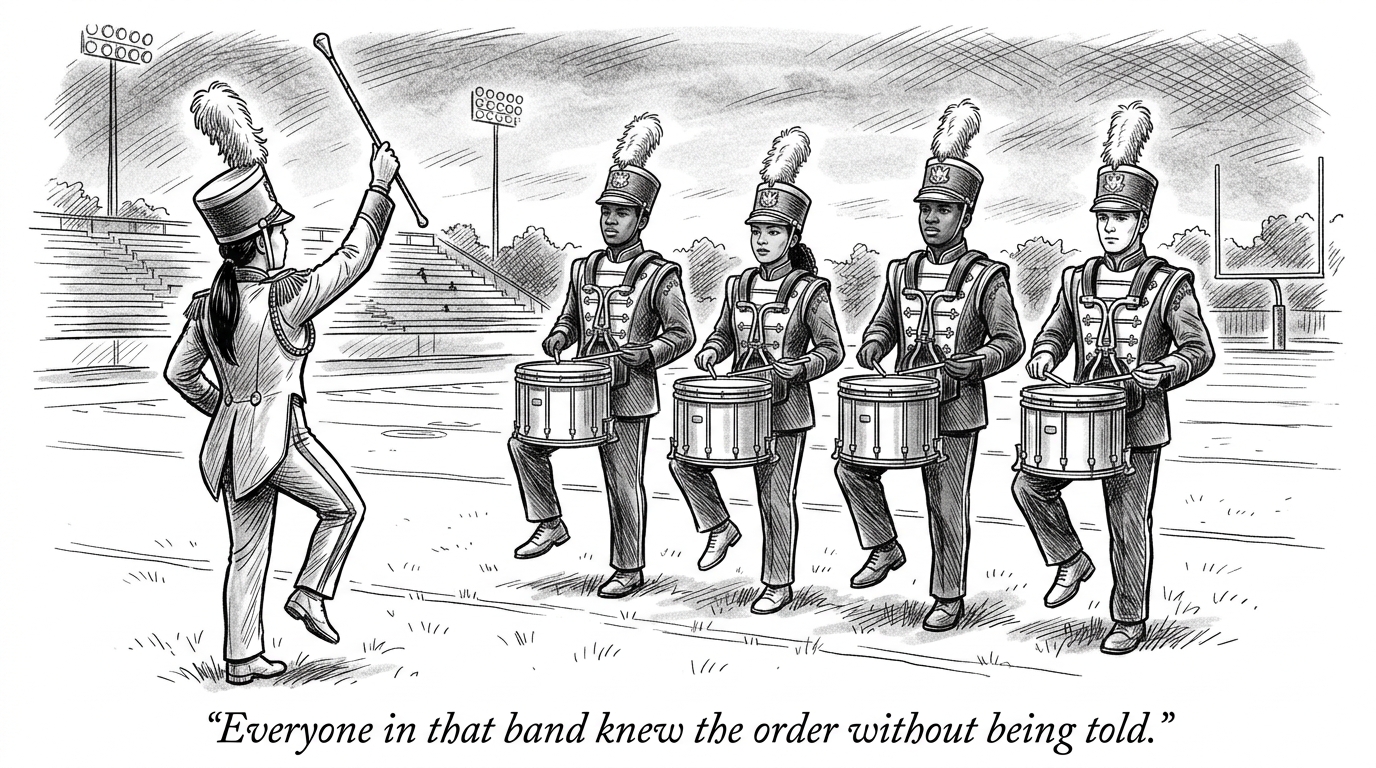
One of my best friends in that band played trips -- three tuned drums strapped to a harness, carried and played at once while marching. I played saxophone, and next to what he carried, mine was easy. I said so at the time, more or less as a joke. I still think it's true. The flute and clarinet players had the lightest load in the whole band -- they didn't weigh much and didn't play long. The order was real, and everyone in that band knew it without needing to be told: trips, then sax, then the woodwinds carrying almost nothing. Underneath all of it was marching itself, which I hadn't done before I met a man who taught it to me. Marching in a Black band, he told me, was a whole different level from marching in general. I didn't ask him to explain further, and looking back, I don't think he needed to. I felt the difference every practice.
I've thought about that ranking again lately, at a much larger scale than one high school band, because it turns out the same two things -- recognition and cost -- sit on top of each other at the top of this entire tradition too, in a single school, in a way that's hard to look away from once you see it.
Florida A&M's Marching 100 is, by any honest measure, one of the most decorated bands in the country. It has performed at multiple Super Bowls, at the Summer Olympics, and in the inaugural parades of two American presidents, Bill Clinton and Barack Obama. In 1989 it was selected as the official United States representative at France's Bicentennial celebration of its own revolution, performing in Paris. In 1985 it became the fourth band in America, and the only band from a historically Black college, to win the Sudler Trophy -- the closest thing collegiate marching bands have to a Heisman. Sports Illustrated named it the best marching band in the nation in 1992. Thirty separate techniques the band originated are now standard practice in marching programs across the country, high school and college alike. William P. Foster built almost all of that over a fifty-two-year tenure as director, the longest in the school's history. That is recognition, by every external measure anyone could ask for -- earned, documented, decades deep, not a claim I'm making on the band's behalf.
The cost sits in the same building.
On November 19, 2011, Robert Champion, a drum major in that same Marching 100, died after being beaten by fellow band members in a hazing ritual known inside the band as "crossing Bus C." Fifteen people were eventually charged. Three were convicted of manslaughter and hazing. The ringleader received a little over six years. The band was suspended for a full academic year while the school rebuilt its own rules around what had apparently been allowed to happen for a long time before it killed someone. Julian White, who had led the band for forty years, resigned under pressure not long after.
I'm not going to pretend those two facts cancel each other out, or that one somehow explains the other. They don't. The recognition is real, earned across decades by thousands of students who never touched anything close to what happened to Robert Champion. The cost is also real, and it happened inside the exact same institution that earned every honor listed above -- not in spite of what the band had built, but somewhere underneath it, in a tradition of discipline and hierarchy that clearly went further than discipline at some point, and nobody stopped it in time.
I pledged a fraternity. I went into it knowing hazing was part of what I was signing up for -- not something that happened to me, something I expected, the way anyone who pledges anything expects it. I'm not defending that expectation. I'm naming it, because it's the exact thing that separates my own pledging experience from what happened inside that drumline. A pledge walks in already having made a kind of trade, however troubling the trade itself is. A seventeen- or eighteen-year-old who joins a college band to play an instrument has made no such trade. They came for the music. Robert Champion came for the music. And by every account of what actually happened on that bus, he and the people around him basically endured the same thing pledges sign up for -- except none of them had agreed to it, and nobody had told them going in that this was the actual cost of the seat.
That's the line, and I don't think it's as hard to find as I wanted to believe a moment ago. It isn't about how heavy the gear is or how demanding the discipline is -- trips were heavier than my saxophone and that never hurt anyone. The line is consent, plainly. A tradition can ask a lot of the people who choose it, knowing what they're choosing. It has no right to ask the identical thing of people who showed up for something else entirely and were never given the choice at all.
And there's a second asymmetry sitting right next to the first one, easy to miss if you stop at consent alone. My actual crossing -- the initiation itself -- happened at my own school, the thing every pledge in that line walked in already expecting. The brand I still carry on my left arm came later, and it was a different act entirely. Decades on, it's faded -- it doesn't look now the way it looked the year it was made -- but it's still there, and it always will be. A few of us took a separate trip, years afterward, specifically to be branded. Nobody required it. I was already a grown man by then, with nothing left to prove to the fraternity or to anyone else in it. I chose it knowing exactly what I was choosing -- a mark that was once burned into people who never had a choice in the matter at all, taken up this time by a free man deciding, on his own terms, what it would mean on him. That's the whole reason it had to be a choice and not a requirement. A mark forced on someone means one thing. The same mark, chosen, means something close to the opposite.
A drumline member who endures a beating on a bus gets none of that. No mark he chose. No meaning he assigned to it as a free adult deciding something about himself. Just a cost imposed on him by people who took something that once meant powerlessness and pointed it, again, at somebody who never agreed to carry it and never got to decide what it would mean.
What I do know is that both halves of this deserve to be said in the same breath, not filed separately -- the Super Bowl, Sudler Trophy, two-presidential-inauguration recognition on one hand, and a twenty-six-year-old drum major beaten to death on a bus on the other, both true of the same band, in the same decade even. Anyone writing about the recognition without the cost, or the cost without the recognition, is choosing which half of the story to hide, and I don't think either half is the one that should be hidden.
Thirty, forty years on, my own mark is still there, faded but not gone. That's the actual point, more than anything else I've said here. Skin does not forget. A brand burned into an enslaved person never went away either -- that was the whole cruelty of the original mark, permanent whether the person wanted it or not. I chose the one kind of mark I knew would never let me pretend later that the choice hadn't been real. A trophy sits in a case and a headline fades from search results, but a chosen mark stays on the body of the person who chose it for the rest of that person's life, the same way it stayed on the people who never got a choice at all. Robert Champion doesn't get even that. Whatever was done to him on that bus left nothing behind that means anything to anyone, least of all to him. Mine is still here because I chose it. His ended because he didn't get to choose anything at all.
Part of the same family: "Rigor, Regardless" and "The Pleasantville Year," where this same marching band and this same friend first showed up.