Rigor, Regardless
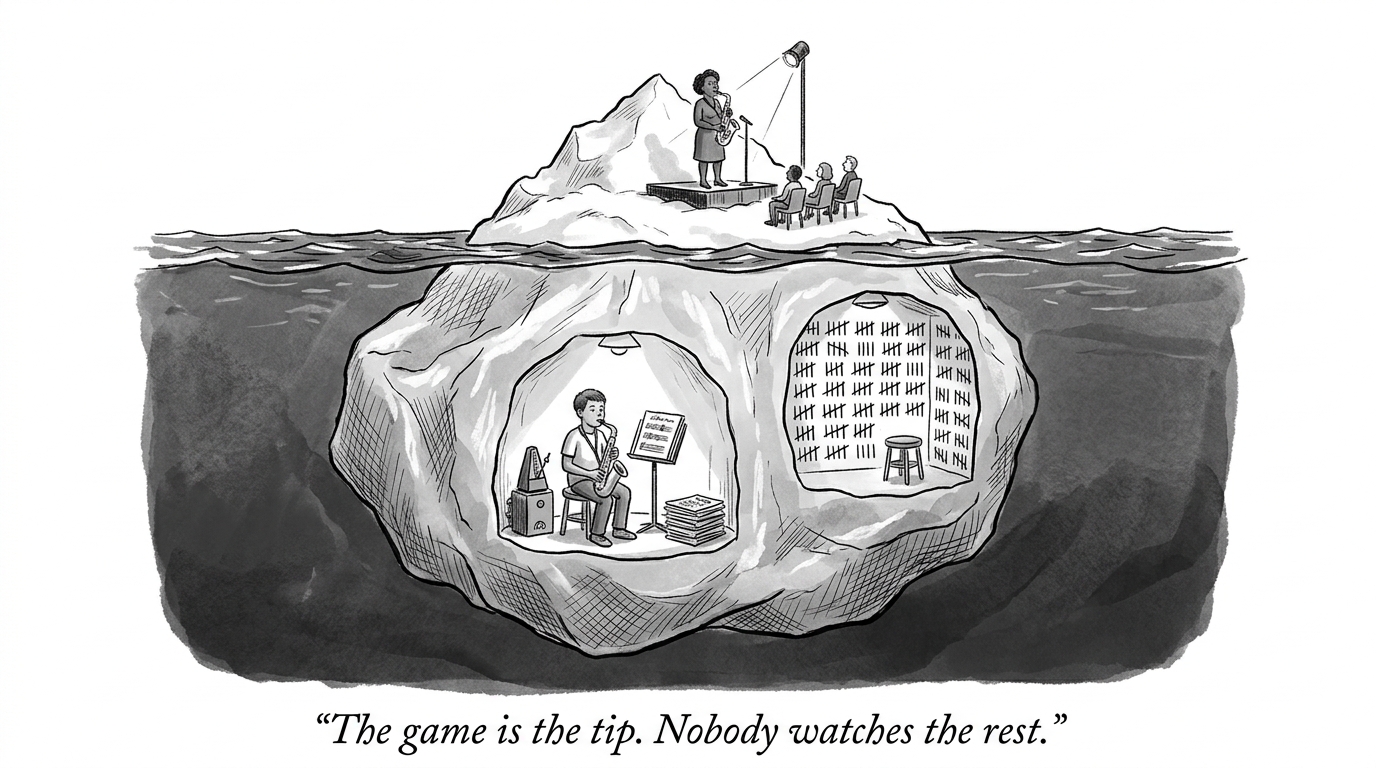
LeBron James has talked about this more plainly than almost anyone else who's ever been asked about it. What people watch is two and a half hours, a few nights a week, in season. What makes that look effortless is everything nobody watches: the recovery protocols, the film study, the conditioning work done alone in a gym at an hour nobody's filming. The game is the tip. Almost none of what actually produced it is visible at the moment it pays off, and most of it never gets watched by anyone at all.
I know this mechanism from the inside, on a much smaller stage, because I lived it before I had a name for it. I started playing saxophone in fourth grade. I did not get good until eighth. That's four years between picking up an instrument and actually being competent on it, and nobody watching me in fourth, fifth, sixth, or seventh grade would have seen much reason to expect eighth grade to be any different from the three years before it. I had a friend at the time who could play by ear before sixth grade, and read sheet music cold -- sight-read it, no rehearsal, no run-through. For me the saxophone was work, every year of it. For him it looked like it had never been anything else. I don't know what actually happened inside his head or his hands between his first lesson and sixth grade, and I'm not going to pretend I do just to make my own story cleaner. What I know is what happened inside mine: four years of unglamorous repetition before anything about it felt easy, and not one day of those four years where the payoff was guaranteed.
That's the part people leave out when they tell a story like this. It isn't just that the work is invisible. It's that the work happens without knowing it's going to pay off. You don't get to see eighth grade from fourth grade. You just do the next lesson.
So the real question was never talent versus effort. I know that argument, and I'm not interested in relitigating it -- some people clearly need less repetition than others to arrive at the same place, and pretending otherwise insults both what my friend had and what I built the harder way. The real question is what actually gets anyone, gifted or not, to keep doing the repetitions before there's any proof they'll matter. And I think the honest answer isn't willpower. Willpower is a story people tell afterward, once the thing has already worked out. The actual mechanism is closer to something with no patience for your convenience at all.
I own a dog named Hershey. Hershey does not care whether it's convenient for me to feed him. A farmer's cows don't care whether the farmer is tired, or has a headache, or would rather sleep in. The obligation doesn't negotiate. It doesn't know your mood exists. And I think that indifference is the actual instrument that builds discipline in a person -- not some internal reserve of grit you either have or don't, but a real thing outside you that keeps showing up regardless of whether you feel like it, until showing up regardless is just what you do. Somewhere inside those four years of saxophone lessons, something was playing the role of the cows. A lesson on the calendar whether or not I felt like practicing that week. A band that needed a saxophone part whether or not I'd earned it yet. I don't remember the exact shape of it well enough to swear to the details. But something was indifferent to my convenience long enough for the indifference itself to become the discipline.
I still own that saxophone -- a Selmer Omega. When I move, it moves, even in years I haven't touched it. I don't keep it because I still play it often. I keep it because of what four years of unglamorous, uncertain repetition built underneath it, and an object like that doesn't stop being true just because it's sitting in a case.
There's a rule I've held to for longer than I've had language for why: I did not wear a Harley-Davidson t-shirt until I actually had a motorcycle license. Buying the shirt earlier wouldn't have been factually wrong. It would have been claiming something I hadn't yet made true. That's a small, almost silly-sounding example next to a saxophone or a set of cows, but it's the same law, and the law is the point: you don't get to wear the identity before you've earned it, and earning it is never verified in advance. You do the work, and only afterward does anyone, including you, get to know whether it was going to be worth it.
I think that's actually the shape of every serious thing anyone's ever built, and it holds at a scale much larger than a saxophone or a t-shirt.
Thomas Edison ran through what his own notebooks describe as thousands of filament materials before he found one that would glow in a working bulb long enough to matter -- platinum, various carbonized woods, eventually carbonized bamboo. He is supposed to have said he hadn't failed, he'd just found thousands of ways that wouldn't work, and whatever the exact wording actually was, the notebooks back up the shape of the claim: methodical, exhausting, repeated trial with no promise any of it would land, for years, before it did.
John D. Rockefeller ran Standard Oil on the same law turned all the way down to the smallest possible detail. The story that gets told about him -- an engineer reducing the number of solder drops used to seal an oil can from forty to thirty-nine, because thirty-nine held just as well and cost less at the scale Standard Oil operated at -- sounds almost too small to matter next to Edison's filaments. It's the same discipline running at a completely different unit of measurement. Nobody outside that plant ever saw the drop of solder that got removed. It compounded into one of the largest fortunes in American history anyway, because rigor that only shows up where people are watching isn't actually rigor.
Albert Einstein spent the years that produced special relativity working as a patent clerk in Bern, examining other people's inventions during the day and doing the theoretical work that would eventually rewrite physics at night, with no laboratory, no institutional position, and no experimental confirmation waiting to tell him he was right. 1905 is called his miracle year now. It didn't feel like a miracle from inside a patent office in 1903, with no guarantee any of it would ever be more than a clerk's private obsession.
Nikola Tesla is the sharpest version of this, because his own story doesn't resolve into a clean moral the way the others do. He built the alternating-current system that still runs the actual electrical grid the world uses today -- genuinely foundational, genuinely his. And J.P. Morgan, who is on this same list for his own reasons, personally financed Tesla's Wardenclyffe Tower, meant to transmit power wirelessly across the world, before pulling the funding once he understood the scope of what Tesla actually intended. The tower was torn down for scrap in 1917. Tesla died in 1943, largely alone, largely forgotten by the public that now runs on his own invention every time a light switch gets flipped. The rigor was real. The payoff, for him personally, never came due. That's not a flaw in the argument this piece is making. It's the honest edge of it: the work has to happen without a guarantee, because if there were a guarantee, none of this would be rigor. It would just be patience.
Morgan's own version of the same law looks different from Tesla's, but it isn't smaller. In 1907, with no Federal Reserve yet in existence to do the job, a banking panic threatened to collapse the American financial system, and J.P. Morgan personally organized the private rescue -- locking the presidents of the major New York banks and trusts in his own library until, well past midnight, they'd agreed to underwrite the failing institutions with their own capital, his included. Nothing about that outcome was guaranteed walking in. He was an old man staking his own fortune and reputation on a plan that could have failed as easily as it worked. It worked. It is also, not incidentally, the direct reason the Federal Reserve exists at all -- the country built a permanent institution specifically so no single man's personal discipline would ever again be the only thing standing between the banking system and collapse.
Five completely different lives, five completely different scales, and not one of them is actually a story about talent. Edison's filaments, Rockefeller's solder, Einstein's nights in a patent office, Tesla's tower, Morgan's library at 2 a.m. -- none of it was owed a result. All of it happened anyway, the same way a saxophone lesson happens on a Tuesday whether or not eighth grade is anywhere in sight yet. That is the actual argument, and it is smaller and harder than either "practice makes perfect" or "genius will out." It is just this: rigor, regardless. Regardless of talent. Regardless of mood. Regardless of whether anyone is watching, and regardless -- this is the part that actually costs something -- of whether it ever pays off at all.
I didn't earn the right to say this by comparing myself to Edison or Morgan. I earned the right to recognize it by spending four years on an instrument that owed me nothing, next to a friend for whom it seemed to owe nothing back either, and by still owning the saxophone that came out of it, years after I stopped needing to prove anything with it to anyone. The court work looks effortless. The off-court work never does, to anyone who wasn't there for it, and the people who were there for it are usually the only ones who ever really know how close it came to not working out at all.
Part of the same family: "How to Build a Mind" and "The Pleasantville Year," and "The Drumline."