The Pleasantville Year
A note before this one starts. I don't do personal if a larger argument is possible. I default to class, to structure, to a wider lens, almost every time -- because it's the sharper tool, and because, if I'm honest, it's also the safer one. This is the piece where that exit wasn't available. I looked for a way to make this about something bigger than my own life, the way I usually would, and I couldn't find one that didn't falsify what actually happened. I wish there had been one. There wasn't.
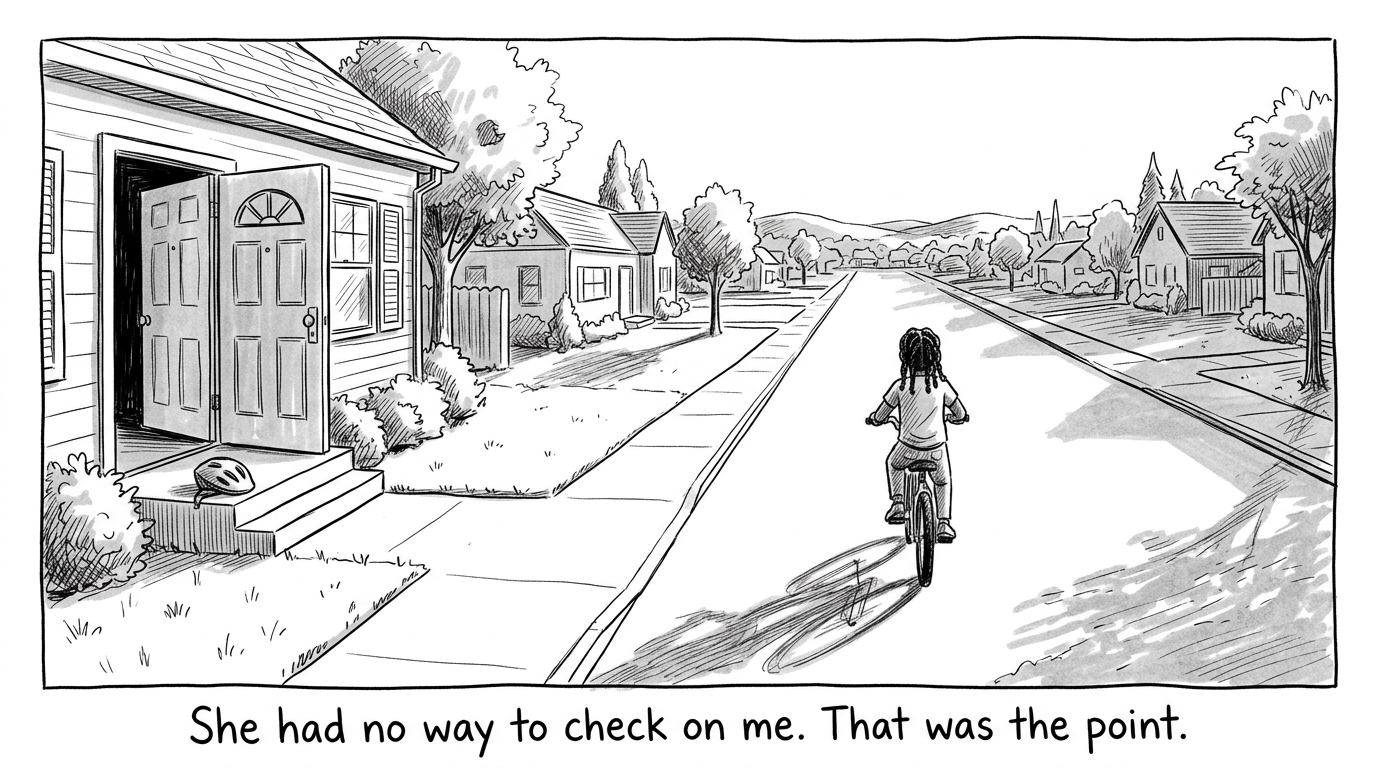
I got on a bicycle when I was eight years old and I went wherever I wanted. My mother put me out in the morning and told me to be back before it got dark. There were no cell phones. She had no way to check on me. I had no way to call her if something went wrong. That was not an oversight. She was a teacher. She understood child development for a living, and her answer to it was less structure, not more. I never went to a summer camp in my life. The whole apparatus that exists now to keep a childhood supervised, scheduled, and reachable -- none of it touched mine.
People hear that and assume the lesson is about freedom. It isn't, or it isn't only that. The actual lesson was narrower and harder than freedom: figure it out, and stupid should hurt. Not "explore and grow." Consequence. If I made a bad call, I found out why it was bad by living through what it cost me, not by being told in advance. That is a different mechanism than independence in the abstract. Independence is what people call it after the fact, when they want the warm version. What it actually felt like, from inside it, was closer to: nobody is coming, so get it right, or don't, and either way you'll know.
It wasn't one day that taught me that. That's the part people get wrong when they ask for the dramatic story, the one afternoon everything changed. It wasn't one afternoon. It was the same bike, the same freedom, repeated for years, until the repetition itself became the lesson. You don't learn where to go and where not to go by being told. You learn it by going, over and over, until a map exists in you that nobody drew on purpose.
And that map had a shape I didn't choose and didn't notice until much later. For most of my childhood, I believed Pleasantville was a Black town. Not mostly Black. Black, full stop, in the way an eight-year-old holds a fact without qualification. I didn't see the actual census numbers until I was an adult, and when I did, I was wrong, and I had been wrong with complete confidence for years. The reason I was wrong is the part worth sitting with. Nobody told me Pleasantville was Black. I built that belief myself, block by block, on a bicycle, because the places my own routes actually went were Black areas, and the places I never went were Northfield and Absecon. Nobody handed me that boundary. I built it with my own two feet and never once asked myself why I'd built it there and not somewhere else.
Here is the detail that complicates every easy explanation for why. On the surface, I had every reason not to be afraid of anything in that town. My father was a well-known local police officer. I personally knew the chief of police. I knew the mayor. I was my family's child in a small town, and that name meant something there. He wasn't only a badge people recognized from a distance, either. He ran the PAL program, the Police Athletic League, so half the kids in that town knew him as a coach before they ever knew him as a cop. He played adult baseball -- not rec-league, close enough to minor-league caliber that it showed -- and he was fast, genuinely fast, not fast for a man his age. I saw it with my own eyes more than once: teenagers who thought they had enough of a head start to get away, and didn't. A kid doesn't need to be told his father is untouchable once he's actually watched him run someone down. But that cover had a border, and I understood exactly where it sat long before I could have explained it in words. It covered Pleasantville. It covered Atlantic City, where enough people knew him too. It did not travel past those two places. In Mays Landing, or anywhere else my family's name meant nothing to the person standing in front of me, none of it applied. I would have been exactly what any other Black kid was to a stranger who'd never met my father: nothing. A kid with that kind of cover doesn't draw boundaries out of ordinary fear, inside the two towns where the cover actually worked, because on any given day, there was very little there to be afraid of. I drew one anyway. But my parents were not as unafraid as my own freedom might suggest, and I understand now that their fear was more informed than most parents', not less. My father wasn't just a cop. He was a juvenile detective. He arrested people I knew -- kids from my own world, not strangers from somewhere else. He had closer, more specific knowledge of exactly what could go wrong for a kid in that town than almost anyone else raising a child there. He let me roam anyway. That wasn't naivety about risk. It was a real risk, understood with unusual precision, accepted on purpose.
And he didn't leave it only to chance. At some point -- I don't remember exactly how old I was, only that I was old enough for it to imprint -- my father put me in an actual jail cell and walked away for hours. Nothing specific had happened. There was no incident, no warning I'd ignored. He wasn't punishing me for something. He was showing me something, on his own schedule, using the one tool he had access to that nobody else's father did. And here is the part that still sits with me: I knew every cop who walked past that cell. They knew me. My own name, the one that opened doors everywhere else in that town, meant nothing in that room. This was never a lesson about him, or what he could do to me. It was a lesson about what I actually was, the moment I stepped past the only two places where being my family's child meant anything at all. Everywhere else, I was just a Black kid, the same as any other Black kid a cop had never met -- and what happens to a Black kid who isn't compliant, somewhere his name buys him nothing, was the thing he couldn't teach me by telling me. So he gave me a few hours to feel that edge for real, on his own terms, before Mays Landing, or anywhere else past the line, ever got the chance to show me on its own. The point was never the cell. The point was to feel what trapped actually looked like, stripped of every piece of protection I normally carried around without noticing I was carrying it.
I should say plainly that I don't actually know that's what he intended. I know what it did to me. Whether he meant it exactly that way, whether it was as deliberate as it felt from inside a locked cell -- that I can't verify, because he and I have never once discussed it, in all the years since. I don't know if he remembers doing it at all. That's not a gap I'm rushing to close. Human memory is a mush, mine included. I know I sat back to back with my mother on a couch, both of us reading, for what must have been hundreds of afternoons -- I couldn't tell you when, or how old I was, or what book was in my hands. I know I listened to Earth, Wind & Fire before playing peewee football, and I couldn't tell you the exact song, or the season, or who else was in the car. Those things are real to me with total certainty and no precision at all, and the cell is the same kind of memory, just heavier. I carry what it did to me as fact. What he actually intended, sitting on the other side of it, is something I have never asked and, if I'm honest, am not sure I want to know.
What I don't have to wonder about is whether the lesson itself was true. About ten years ago, a Black police officer stopped me on a road in Arlington, Virginia. I was driving my Porsche, speeding, top down. He didn't write me a ticket. What he told me instead was that other officers would have taken a different approach -- his words, not mine -- to a Black man in a hundred-thousand-dollar car. I still have that car. Nobody put me in a cell that day. Nobody needed to. A grown man, decades removed from Pleasantville, on a road he'd never been stopped on before in his life, got the exact same lesson from a stranger who had no reason to invent it and nothing to gain by giving it to me instead of writing the ticket. That is the lesson we give our kids, still, because whatever my father actually intended in that cell, the thing he was warning me about never stopped being true.
Every Black family does some version of this with their own kids. That's not a guess. It's one of the most well-documented, quietly universal facts of raising a Black child in this country, whether or not it ever gets said out loud in those words. What made mine different wasn't the substance. It was the delivery. Ours was never subliminal, never something you were supposed to absorb sideways from tone, from a look, from what didn't get said. It was direct. It was put in front of you on purpose, in your face, unmistakable -- a jail cell, not a hint. Every one of us knew it was intentional, because it was.
So the freedom cuts more than two ways, it turns out. It builds you, and it sorts you, in the same motion. And underneath both of those, if you're lucky, is a parent who understands the actual shape of the risk well enough to hand you a controlled dose of the thing they're actually afraid of, on their own terms, before the world can hand it to you on its own -- or who at least felt like he did, from where I was standing, which may be its own kind of true even if the facts underneath it were never actually compared.
But the freedom, and that one afternoon in a cell, were still only part of what built me, and I didn't understand the rest of it until I went back through one specific school year and actually counted what happened in it.
I was fourteen, maybe fifteen. Tenth grade. I'd gone to St. Peter's, a private Catholic school, through eighth grade -- a nun's classroom, a different kind of formation entirely. Ninth grade was Holy Spirit, the Catholic high school. For tenth grade, my mother wanted me at a different church school. I refused it, and once that was off the table, public was the only option left -- Pleasantville High School. My parents were both worried about my safety there. What neither of them accounted for is that I already knew the actual gun runners and drug dealers in that world personally -- real relationships, not a rumor about who to avoid. My father's own professional knowledge of the danger was detailed and accurate. It just didn't include the one variable that actually determined whether any of it was a risk to me specifically, because that variable was my own standing in a world he could assess from the outside but never access the way I could from inside it. Public high school was not a risk in my mind. That gap isn't really about me, or about my own parents specifically. It's true of every kid and every parent. The lived life of a kid is never the same thing as the parent's view of it -- not because a parent isn't looking closely enough, but because at that age a kid doesn't talk much, and most of what would actually change the parent's own calculation never gets said out loud to the person doing the worrying. So for one year, and one year only, I left Holy Spirit for a public school my own parents were afraid of and I wasn't, before coming back for eleventh and twelfth. I've told the shorthand version of that path for years, Catholic school straight through, as if I'd never actually left it for a year in the middle. It skips the year that mattered most.
I dropped shop class that year and doubled up on math instead -- Algebra 2 and Geometry, at the same time, on the recommendation of a teacher who looked at what I was doing and decided, on my behalf, that I should be doing more of it. That single decision is the direct, traceable reason I was able to take calculus in high school. Calculus in high school is the direct, traceable reason engineering was easy for me later, when it was hard for almost everyone else in the room. I did not choose that. A teacher looked at me and redirected the whole trajectory, in one conversation I probably didn't think twice about at the time.
The same year, I "took" a computer science class, and I put that word in quotes on purpose, because I actually taught it. I knew more than the teacher did. Nobody arranged that either -- it was just already true by the time I sat down in that room, evidence of something that had been building since before anyone was watching, a VIC-20 and 6502 assembly and a self-taught fluency in Pascal that had nothing to do with any class I was ever enrolled in.
The same year, I met a man who taught marching band. I already played saxophone -- had since fourth grade -- so he wasn't the reason I picked up an instrument. He was the reason I learned to march, and marching in a Black band, in his own words to me at the time, was a whole different level from marching in general. I didn't ask for that education either. It was simply put in front of me, by a man who had it to give, in the same year everything else was happening.
And that same year, I sat in a public-school English classroom where the teacher kept a Bible on his desk -- not as scripture, not as an argument for God, but as a work of literature and as an explanation of Western civilization. He was careful about that distinction in a way I only came to appreciate as an adult. He wasn't proselytizing. He was teaching a text the way you'd teach any other foundational document, because you cannot actually understand the civilization you're standing in without it, whatever you personally believe about it. The year before, in ninth grade at Holy Spirit, a nun had already taught me real, unflinching evolutionary biology -- no hedging, no apology, inside an institution whose own religious education generally makes no room for it at all. That was also the year my mother made sure I met a Black engineer in person -- not as a slogan, a fact standing in a room, put in front of me specifically because I was good at math and she wanted that fact there before anyone could talk me out of it. Years later, in college, a chemistry professor who was also a monk handed our class the Desiderata on the first day, a secular poem about how to live, from a man of faith, in a science course. I still have that poem on my desk. Moral and science were never in tension for me, and now I know exactly why: I was educated, without asking for it, by people who refused to treat those things as enemies, starting before that one tenth-grade year and continuing for years after it, each instance arriving from somebody who decided, unprompted, that I should have it.
None of that was independence. It was the opposite. It was other people, watching closely enough to notice something in me before I could have named it myself, and acting on it without being asked. My mother handed me a love of books with no assigned titles. My father put me in a cell for a few hours to teach me something no lecture could have -- or so it felt to me, from inside it. And that stretch of ninth and tenth grade, it wasn't only my parents. It was a math teacher, a computer science class I was already ahead of, a bandleader, an English teacher, a nun, all stacked into two consecutive school years, each one opening a door I hadn't asked to have opened.
I think that's the actual argument, and it took me a long time working through it to find the honest shape of it. The bicycle built something real. Consequence, unsupervised, repeated for years, is a genuine mechanism, and I don't think you can manufacture an adult without some version of it. But it also built a blind spot I carried for a decade before anyone corrected it, and pretending the freedom only did the good half is a lie by omission. And freedom by itself was never the whole story anyway. The years that mattered most to me weren't years I built alone on a bicycle. They were years several adults, none of them coordinating with each other, looked at a fourteen-year-old and decided to act. Input at that age is a game changer in a way it simply isn't at twenty-five or thirty-five. You are still soft enough to be moved and old enough for the movement to hold its shape for the rest of your life. Miss that window, on either side of it, and the same conversation, the same recommendation, the same gesture, doesn't do the same work.
This is what adulting actually is, underneath the word people use for it half as a joke -- not a switch that flips at some birthday, but evolution, and evolution runs at wildly different speeds depending on what's evolving. I carried the belief that Pleasantville was Black, unquestioned, for decades, because nothing ever forced it into contact with the actual numbers -- that particular naivety took most of a lifetime to correct. Watching my own three kids, the gap between fifteen or sixteen and nineteen runs on a completely different clock: three or four years, and the difference in whether a kid can actually explain their own reasoning, not just have one, is stark. Some naivety takes thirty years to clear because nothing ever collides with it. Some clears in three, because growing up does the colliding on its own, whether anyone arranges it or not. And frankly it isn't only people. Societies evolve the same uneven way. It took ninety-nine years after the Fourteenth Amendment for the Supreme Court to strike down laws against interracial marriage, nine to zero, unanimous, on a question the amendment itself should have already settled the moment it was ratified -- a country's own naivety, sitting uncorrected for almost a century, because nothing forced it into contact with what the country had already promised itself on paper. A person and a country don't run on the same clock. But neither one gets to evolve on a schedule anyone sets from outside, and neither one is exempt from having to eventually collide with what it already claims to believe.
What we have built instead, for a lot of children now, is neither half of what I had. Not the consequence-bearing freedom -- supervised, tracked, reachable at every hour, with very little room left for stupid to actually hurt and teach something. And not, in most cases, the deliberate attention of adults willing to redirect a fourteen-year-old's whole trajectory in a single conversation, because there is less room in a scheduled, managed childhood for that kind of unscripted noticing to happen at all. You can end up with the worst of both: watched constantly, and still not actually seen. That is how you get a professional in their late twenties bringing a parent to a job interview. Not because they're lazy or weak. Because nobody ever handed them a bicycle and told them to be back before dark, nobody ever put them in a cell for an afternoon to make a real risk feel real, and nobody ever happened to be standing close enough, at fourteen, to notice what was already there and decide to act on it before they were old enough to ask for it themselves.
I got all of it, and I didn't earn any of it. A father who understood a real danger well enough to give me a controlled dose of it on his own terms, whatever he actually meant by it. A teacher who noticed. A bandleader who noticed. An English teacher, with a Bible on his desk in a public school, who decided a room full of teenagers needed to understand where their own civilization came from, whether or not they believed a word of it. I didn't leave it at gratitude. Both of my children took geometry over the summer, on purpose, specifically so calculus would be available to them in high school -- the exact same move a teacher made for me by chance, in a single conversation I didn't ask for, thirty-some years ago. I couldn't give them the bicycle, not the same way, not in the world we actually live in now, and I couldn't give them the cell either, not the way it was given to me. But the part underneath both of those -- someone who loves you understanding a real risk precisely enough to hand it to you deliberately, on their own terms, before the world hands it to you on its own -- that part I could still try to give them on purpose. I was built by people who noticed and acted. I grew up, and made sure some version of the same thing happened for mine, this time by design instead of luck.
I am writing this with a Montblanc that has a red crystal set into it, a pen I bought for exactly one purpose: marking up my own drafts, nothing else. It sits on a shelf next to fountain pens, next to a Serengeti pen that stands upright on its own, next to a quill. Thousands of dollars of pens, most of them used once or twice a year, kept for the specific feeling of doing this particular kind of work with something built for nothing but this. That is what the year helped build, as much as the calculus or the marching or the Bible on a desk did. Not the pen itself -- what the pen means. A tenth-grade year, and one unremembered afternoon in a cell before it, where several people I never asked for anything decided, on their own, to hand me a door or show me a wall, compounded for thirty years, into a life where I can afford to own an instrument for redlining my own sentences and let it sit idle most of the year, waiting. That is not a fact I am proud of or ashamed of. It is just the honest end of the sentence the whole year started, and I don't think you get to tell the story of the door opening without also telling the truth about the room they made sure you understood, first, so you'd know what it meant to walk through it instead -- even if some of what I remember about how I got there is mush now, and always will be.
This piece is the ground "How to Build a Mind" stands on -- not the mind itself, what has to exist before a mind is possible to build at all: "How to Build a Mind."
This piece's own "stupid should hurt" argument gets tested against its hardest limit elsewhere on this site -- what happens when the person paying the consequence never chose the risk: "Grace and the Vote."
The bandleader and the math teacher are the worked examples for a wider argument built later: "Recognizing the Shot."