Recognizing the Shot
Hamilton and Iron Man are running the same rhythm from opposite directions, and I noticed it tonight almost by accident -- a play on one side of my head, a movie on the other. Hamilton doesn't throw away his shot because he doesn't know how much time he has. An orphan, immigrant, no name, no money -- the urgency is built into the condition itself. Tony Stark wastes his for years. He had every shot anyone could ask for and spent it on parties and weapons contracts until he woke up in a cave with a car battery wired to his chest and finally saw, for the first time, what he'd actually been doing with it. Two men, opposite starting conditions -- nothing, versus everything -- and they arrive in the same place. Don't waste it.
I don't think that's actually the point, though. I think the point is one step earlier than that. Neither of them gets to "don't waste it" until they first recognize that there's an it to waste at all. Hamilton's recognition is almost involuntary -- scarcity makes the shot obvious, the way hunger makes food obvious. Stark's isn't. Stark has to be captured, nearly killed, and shown his own weapons in the hands of the people they were supposed to be used against before recognition even becomes possible for him. His whole arc isn't about taking the shot. It's about the cave doing, by force, what nothing else in his life had managed to do on its own.
The version I actually lived didn't come from scarcity or from a cave
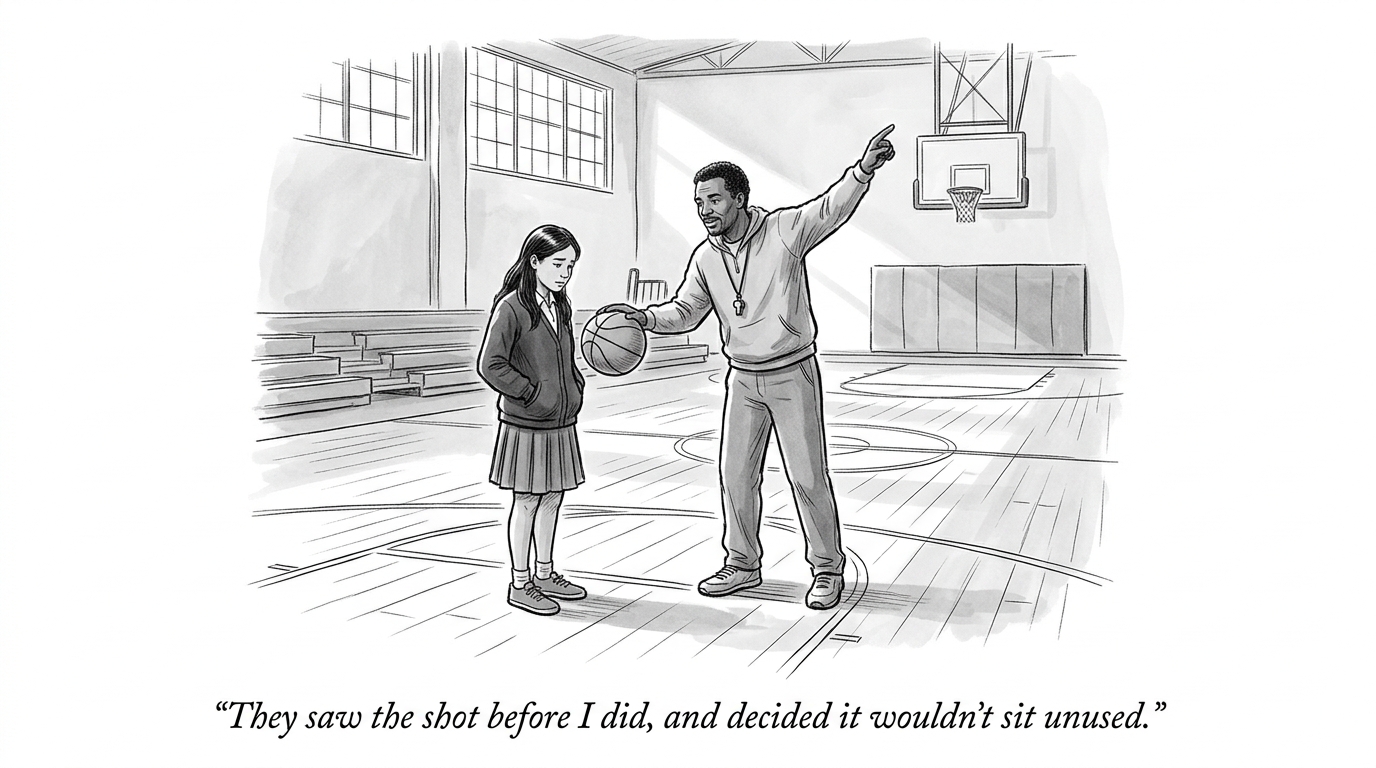
I didn't grow up with Hamilton's scarcity, and nobody had to nearly kill me in a basement to make me see anything. My version of recognizing the shot came from other people, and they didn't wait for me to see it myself. A nun at Holy Spirit, ninth grade, decided I was going to be taught real evolutionary biology, unhedged, inside a Catholic curriculum that had every reason to soften it and didn't. A year later, in the one public-school year sitting between two Catholic ones -- tenth grade, Pleasantville High School -- a math teacher moved me into Algebra 2 and Geometry at once after I dropped shop class -- not because I asked, because she looked at what I was doing and decided the shot was there whether I'd noticed it or not. A bandleader opened a door in a music room I hadn't gone looking for. None of them handed me a lesson about not wasting my life. They just quietly refused to let a shot sit there unused while they had the standing to do something about it.
That's a third mechanism neither Hamilton nor Stark has room for in their own stories, because both of those are, in the end, stories about one person and their own reckoning. Mine wasn't that. Recognition doesn't have to be self-generated, and it doesn't have to be forced by crisis. Sometimes it's just handed to you, by somebody who saw it before you had the vantage point to see it yourself, and decided on your behalf that it mattered.
The same mechanism, moved from a person to an institution
I watched a version of this happen at scale, years later, from the other side of it. In-Q-Tel measured its people on one question: did this move the mission forward. Not return on capital -- the thing every other fund on earth is measured against. That's not a small difference. It's the reason a technical staffer's own conviction about a piece of hardware could become a real position instead of a memo nobody acted on. One of the people on my own bench spent years there with a specific goal in the back of his head: find the investments that would make a real exoskeleton suit possible. Not because anyone ordered him to chase that. Because the institution's own freedom made it a shot worth taking, and he recognized it as one before he ever had to ask anyone's permission to go after it.
That's the same mechanism as the nun and the math teacher, just moved from a person recognizing a shot in another person to a person recognizing a shot inside an institution built to let him take it. The suit in the movie is fiction. The choice to point real capital at making it real wasn't.
The same discernment, pointed inward instead of out
Every version above is about recognizing a shot in front of someone else -- a nun, a math teacher, an institution's own freedom, aimed outward at a person or a possibility other than yourself. There's a mirror-image version of the identical mechanism that Stark's own story actually gets right, and it usually gets missed underneath the suit and the one-liners: he makes Pepper Potts CEO of his own company. Not a gesture, not a step back from ego -- a correct, specific read of his own limit. He knew running Stark Industries wasn't something he could do, and instead of holding the title anyway and running it badly, he handed it to the person who actually could. That's not humility for its own sake. It's the same discernment as everything above, turned on himself instead of on someone else: recognizing a shot he wasn't the right person to take, and refusing to sit on it out of ego the way he'd have refused to sit on it if he'd seen it in somebody else. It's also what grace actually looks like in practice, just fictional -- believing a position you don't occupy holds understanding you lack, the same claim this site has made in earnest about a much harder case, and acting on that belief instead of just stating it.
What's actually being asked, every time
I don't think "don't waste your shot" is really the instruction, in any of these versions. It's downstream of something harder: recognizing that the shot is there at all, before anyone can waste it or take it. Hamilton gets there by not having a choice. Stark gets there by being forced into a cave. I got there because other people -- a nun, a teacher, a bandleader, later an institution built on the same logic -- kept recognizing it before I could, and refused to sit on what they saw.
That's not a footnote to the real mechanism. It is the real mechanism. The arc doesn't bend because one person privately decides not to waste their own shot -- it bends because someone recognizes a shot in front of a person who can't yet see it themselves, and acts on what they saw instead of staying quiet about it. Every arc-bending moment I actually trust, looked at closely enough, has that same second person standing just outside the frame of the story: the one who saw it first and refused to sit on it. That's not a smaller claim than "seize your moment." It's the actual engine sitting underneath every version of that story anyone's ever told, including my own.
Part of the same family: "How to Build a Mind," "The Pleasantville Year," "How Things Actually Move" -- that piece's own mechanism, a person's decision about their own exposure, run one layer earlier: someone else's decision to recognize a shot before its owner could see it -- and "Grace and the Vote", the real, much harder version of the same belief Stark's fictional one is a small, low-stakes instance of.