How Things Actually Move
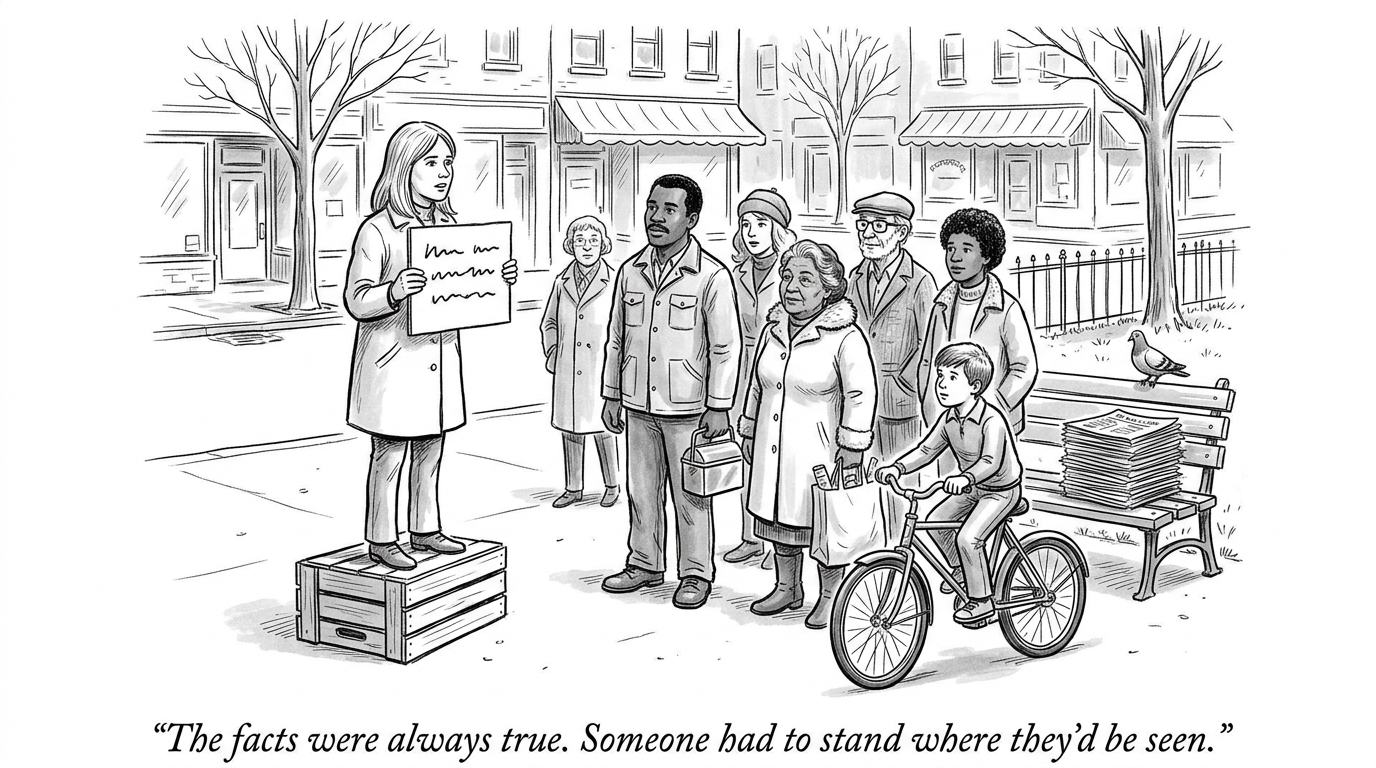
The easy story about historical change puts the truth at the center. Someone finds it, says it, and the world eventually catches up. I don't think that's how it actually works, and I want to lay out five cases that show the real mechanism instead -- a person's decision to be public, or in one case a president's decision not to be, and the arc bending because of that decision specifically, not because the underlying facts finally became undeniable on their own.
Susan B. Anthony didn't win women's suffrage by being right. Being right was available to plenty of people who said nothing. She was arrested for voting in 1872 and turned the trial itself into a public argument, at a moment when doing that carried real, specific legal and social risk. The arc of the suffrage movement bends around her decision to make her own case a public one, not around the fact of women's equality, which had been true the whole time and had convinced almost no one on its own.
Lois Gibbs is the case I find most useful precisely because she isn't famous the way the others are. In 1978 she was a twenty-seven-year-old housewife in Niagara Falls who discovered her son's elementary school sat on top of a twenty-thousand-ton toxic waste dump. She had no organizing background. She formed the Love Canal Homeowners Association, brought national attention to what had been a quiet, contained local scandal, and her decision to become the public face of that fight is the direct reason over eight hundred families got evacuated and the reason Superfund exists at all. The contamination had been sitting there for decades before she went public with it. The contamination alone never moved anything.
Martin Luther King and Malcolm X are the two most obvious instances of this same mechanism, and I'm naming them together on purpose rather than picking one, because they represent two different registers of the identical decision -- both men chose to be public, unmistakably, under their own names, knowing exactly what it would cost them, and both arcs bent because of that choice, not because either man's underlying argument was new.
Rosa Parks sharpens the mechanism past "decide to be public" into something harder to sit with. She was not the first person to refuse to give up a bus seat in Montgomery. Claudette Colvin did the same thing nine months earlier, in March of 1955, at fifteen years old. NAACP organizers chose Parks as the face of the boycott instead of Colvin -- an adult, married, employed, personally unimpeachable -- because they judged her more sympathetic to a broad public than a pregnant, unmarried teenager. Colvin's decision to go public was just as real and just as early. It simply wasn't consumable the way Parks's was, and the arc bent on the name the public could accept, not the name that acted first.
Franklin Roosevelt is the case that runs the whole argument in reverse, and I think it's the sharpest one here. He didn't bend the arc by deciding to be public. He bent it by deciding, with the full, willing cooperation of the American press corps, not to be. Roosevelt was paralyzed from the waist down by polio. In public he wore heavy iron leg braces hidden under specially cut suits, stood or sat rather than appear in his wheelchair, and the press -- not by government order, but by a widely honored, largely unwritten agreement -- simply declined to photograph him in it. Of roughly thirty-five thousand photographs in his own presidential library's collection, only a handful show the wheelchair at all. Journalists went along with it partly out of the norms of the time and partly because, between the Depression and the war, they believed the country needed to see strength.
That concealment is not a footnote to his presidency. It's arguably load-bearing for the whole thing. A shorter, less durable presidency plausibly doesn't get Social Security passed, and almost certainly doesn't get it entrenched deeply enough to survive the decades after him. I want to be precise here rather than let this get conflated the way it usually does in my own head, let alone anyone else's: Social Security is Roosevelt's own, direct creation, signed in 1935. Medicare and Medicaid are not his programs. Both were signed thirty years later, under Lyndon Johnson, long after Roosevelt was dead. What Roosevelt actually built was the durable political premise underneath all three -- that the federal government has a legitimate role insuring citizens against poverty, age, and illness. Medicare and Medicaid are what that premise became in other hands, a generation later, not things he personally built. The concealment bought him the years it took to plant that premise deep enough to survive him. It did not, by itself, build everything that grew from it.
The same precision applies to food assistance, and it cuts the same direction with an extra twist. The actual New Deal program is the 1939 Food Stamp Plan -- a Rochester, New York pilot, genuinely Roosevelt's, running two colors of stamps at once: orange for whatever food a family chose to buy, blue restricted to USDA-designated surplus commodities only. It ended in 1943. What eventually became the permanent program, and much later SNAP, is the Food Stamp Act of 1964 -- Lyndon Johnson's, building on pilot programs John Kennedy had started three years earlier, not Roosevelt's creation any more than Medicare and Medicaid were. The twist is that the live argument right now over whether SNAP dollars should buy anything or be restricted to what the government approves isn't a new fight imposed on an old program. Roosevelt's own original version already ran that exact split, in 1939, in the same wallet -- one stamp color free, the other one government-chosen, eighty-seven years before it became a soda-and-candy fight in state legislatures.
I picked five cases where the decision worked, and I want to be honest about what that leaves out. Far more people have made the same kind of decision -- to go public, or in a much smaller number of cases, to conceal -- and nothing bent. A whistleblower who told the truth and was fired, forgotten, and changed nothing. A local organizer who tried to become the next Lois Gibbs and never got past a city council meeting. I don't know how to weigh their decisions against the five above, or whether the decision still mattered to the person who made it even when the arc didn't move. I'm not going to resolve that here. I think a reader can sit with both -- that the mechanism is real, and that it doesn't guarantee anything -- without me telling them which one to weigh heavier.
Five cases, and I don't think any of them resolve into a tidy moral about honesty or courage. Anthony, Gibbs, King, and X paid a real cost by choosing exposure. Parks paid a smaller version of the same cost for a decision that, structurally, wasn't entirely hers to make alone. Roosevelt paid something too, in the opposite direction -- a country that voted for him four times without ever fully seeing who they were voting for, which is its own kind of cost, just aimed at the public instead of at him. What ties all five together isn't the truth winning out. It's a decision, made by someone, about what the public would or wouldn't see, and an arc that bent because of that decision specifically, and would not have bent the same way without it.
Part of the same family: "The Cost of Going Public," "Grace and the Vote," and "Recognizing the Shot" -- the same mechanism run one layer earlier: someone else's decision to recognize a shot before its owner could see it.