Grace and the Vote
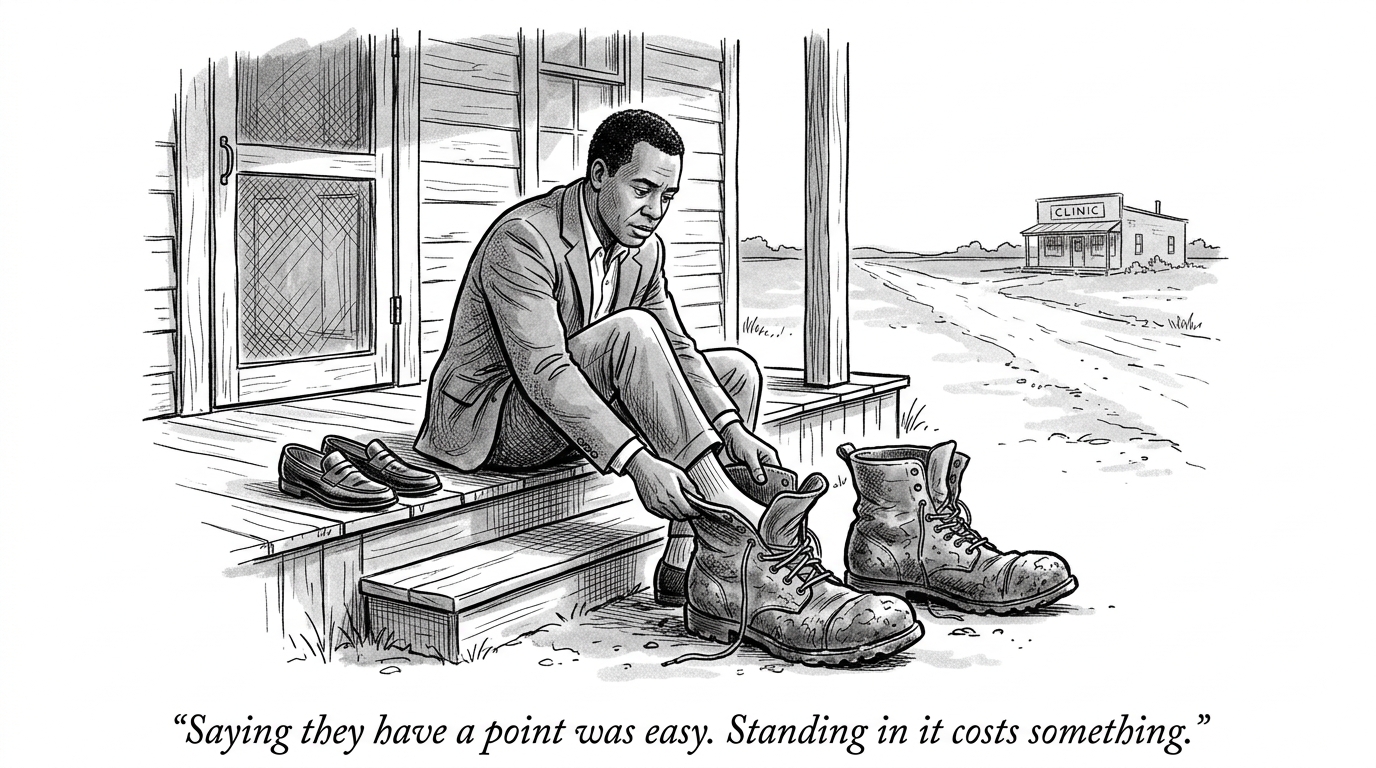
I don't live in Iowa, and I said once, out loud, that I believe people who do have a point of view I may not have sufficient understanding to consider. That was easy to say. It cost me nothing. Nobody asked me to actually go stand inside the view I was claiming to respect. This is me trying to do that, on the hardest version of it I currently have access to, and seeing how far grace actually travels before it runs out.
Here is the fact, plainly, before I try to explain around it. Roughly 700 rural hospitals in this country are now at risk of closing because of a specific federal Medicaid law. The five states with the most hospitals at risk delivered some of the largest election margins in the country for the party that passed it. More than a third of US counties are now maternity care deserts, and in six out of ten recent closures, the hospital that shut its doors was the only place in the entire county where a woman could give birth. The same year a Yale School of Public Health study said full federalization of healthcare would save a trillion dollars and a hundred and fourteen thousand lives a year, Congress cut nine hundred eleven billion dollars from Medicaid in the other direction, and subsidies expired that doubled premiums for twenty million people. Both directions are on the record now, from credible sources, in the same calendar year. The people whose hospitals are closing voted, in large numbers, for the law that is closing them.
The easy move here, and I want to name it before I try not to make it, is to treat that as a contradiction that proves something about the people who voted that way. Foolish. Uninformed. Voting against their own interest without knowing it. That is the ungracious read, and it is ungracious specifically because it assumes the vote can only be explained by a failure to understand the facts -- which quietly assumes that if they understood what I understand, they would think what I think. That is not belief in a position I don't occupy. That is belief in my own position, wearing a hat that says empathy.
So let me actually try to stand in it.
The most serious version of the case starts with distrust, and the distrust is not irrational on its face. A federal program, once it exists, tends not to shrink. It grows a permanent constituency, a permanent bureaucracy, and a set of incentives that don't answer to the person actually receiving care -- they answer to reimbursement codes, to insurers, to administrators three states away who will never meet the family whose hospital just closed. A voter who has watched this pattern play out across a lifetime of federal programs is not being stupid when they conclude that sending more money to Washington is not obviously the same thing as sending more care to their own county. That is a real, coherent, historically grounded political philosophy, not a talking point invented to excuse cruelty. It has a name -- federalism, subsidiarity, whatever word you want on it -- and serious people have held it for as long as this country has argued with itself about what the federal government owes anyone.
The second version is narrower and, I think, harder to sit with, because it isn't about Washington at all. It's about me.
I built the entire spine of another piece around a single idea: figure it out, and stupid should hurt. I got on a bicycle at eight years old with no way to call for help if something went wrong, because my mother believed -- correctly, I still believe -- that a childhood with the safety net removed is what actually builds an adult capable of judgment. Consequence, not cushioning, was the whole mechanism. I did not arrive at that belief abstractly. I lived inside it, and it worked, and I am who I am partly because nobody engineered the risk out of my own growing up.
A version of that same instinct, run at the scale of a country instead of a childhood, is not hard to find in the vote I am trying to understand. If a safety net that catches every fall also teaches a whole community that falling has no cost, then removing some of the net is not cruelty in this view -- it is the same lesson I was given on a bicycle, applied to people who never got to choose it the way I chose mine. Real consequence, not more cushioning, is what some of these voters believe actually rebuilds self-reliance, at the community level, the way it rebuilt one kid at the family level. I did not expect, going into this, to find my own parenting philosophy standing this close to the thing I was trying to hold with grace instead of contempt. It is closer than I want it to be.
Here is where I have to stop being generous, because the honest version of grace includes knowing exactly where it runs out, not pretending it doesn't.
I chose my own risk. I was the one on the bicycle, and I was the one who paid whatever price a scraped knee or a bad decision cost me, and I was old enough, eventually, to understand what I'd learned from paying it. A rural hospital closing is not that. The person who pays is not the voter who cast the ballot weighing a philosophy against a risk -- it is a woman in labor, sixty percent of the time in a county with nowhere else to go, who never got a vote in the household calculation that decided this was an acceptable cost for rebuilding self-reliance somewhere upstream of her. Consequence works as formation when the person bearing the pain is the one who gets to learn from it and grow past it. It becomes something else entirely when the person bearing it is a newborn whose mother had nowhere to deliver, and there is no version of "stupid should hurt" that was ever meant to apply to a person who did nothing more than happen to live in the wrong county in the wrong year.
There's a second thing I built this same week that this collides with directly, and I didn't see the collision coming until I was already inside it. I spent a long time arguing that an institution survives a crisis not by avoiding every mistake, but by having a culture -- temperament, hired for on purpose, run with grace -- that can absorb a mistake and recover from it. Fallibility was the given. Recovery was the point. A rural hospital does not get that. There is no grace-based recovery from a closed labor-and-delivery unit for the specific woman who needed it the week it closed. The thesis about institutions surviving works because a bad loan can be worked out, refinanced, forgiven, made whole again later. A shuttered hospital in a county with no other option is not a bad loan. It doesn't recover. It's just gone, and the community underneath it absorbs that permanently, the same way no amount of grace afterward gives a person back the version of the birth they should have had.
So where does that leave the actual belief I said I was testing.
I still believe the federalism argument is real, and coherent, and not evidence of anyone's stupidity -- I can stand inside that one and it holds. I still believe the "stupid should hurt" instinct, run at scale, is a real and serious political philosophy, not a cover story, even where I think it's being misapplied to people who never chose the risk it assumes they chose. What I don't believe anymore, having actually tried to stand inside this instead of gesturing at the idea of standing inside it, is that grace requires me to pretend the outcome is symmetrical. Grace is belief that a position I don't occupy contains understanding I lack. It has never been a requirement to believe that every outcome from every position is equally survivable, or that the person absorbing the cost consented to the experiment being run on them. I can hold the voter's reasoning as real and coherent, and hold, at the same time, that the specific place this reasoning lands -- a birthing unit with nowhere else in the county to go -- is not a place grace can follow all the way to the end without also naming what it costs.
That is as far as I got. I don't think the exercise failed just because it didn't resolve into either "they're right" or "they're wrong." I think that not resolving is the actual result -- that this is what grace looks like when it's doing real work instead of being a nice word said from a safe distance, and I would rather leave it exactly this unfinished than round it off into something cleaner than what I actually found when I went and looked.
This piece runs on ground built elsewhere on this site: "The Pleasantville Year" is where "figure it out, and stupid should hurt" first got argued. "700 Rural Hospitals Are Now at Risk of Closing...", "Rural Counties Rely on Public Assistance at a Higher Rate Than Cities Do...", "34.6% of US Counties Are Now Maternity Care Deserts...", and "A Yale Study Says Single-Payer Would Save $1 Trillion and 114,000 Lives a Year..." carry the sourced data this piece takes as given rather than re-arguing.
A small, low-stakes fictional version of the identical belief: "Recognizing the Shot."