The Wager and the Decision to Make It
I read Pascal in high school, at lunch, on my own time. Nobody assigned him, and nobody handed him to me directly either -- I found my way to him because I was already teaching myself to program -- 6502 assembly on a VIC-20 first, the computer that started all of it, and then Turbo Pascal, the Borland compiler that sold for fifty dollars and turned a whole generation of people with home computers into programmers almost by accident. I learned the syntax before I knew the first thing about the actual man it was named for, and once I noticed that, I went looking for him the same way anyone who wrote software on that thing eventually did. It wasn't a private habit. If you wrote code on Turbo Pascal in that era, you went looking for the person sooner or later. I was just one of a lot of people who ended up at the same shelf by the same door. I learned the man first. The wager came after, a separate thing I pieced together once I already knew who he was, not the reason I went looking for him in the first place. I skipped the cafeteria to sit with him alongside Socrates and Aristotle, Constantine, Freud, and Hume, and I didn't have a name yet for why he belonged on that particular shelf next to those particular people. I have one now. Everyone reaches for Pascal's Wager as a piece of borrowed logic -- believe in God, because the cost of belief is small and the cost of being wrong about unbelief is total. That's the version that survives as a phrase. It's not the version that actually explains why I kept him on the shelf for thirty years.
Pascal was one of the sharpest scientific minds of his century before he was anything else. He did real, foundational work in probability theory -- the actual mathematics that a wager like his depends on to make sense at all -- and ran real experiments on air pressure and vacuums that other scientists of his era doubted were even possible to measure. Then, in his early thirties, he had a religious experience so overwhelming he wrote an account of it on a scrap of parchment and sewed it into the lining of his coat, where it was found stitched into every coat he wore for the rest of his life, discovered only after his death. He didn't set the mathematics aside for the mysticism. He kept doing both. The Pensées, the notebook of fragments he left unfinished when he died at thirty-nine, aren't a tidy argument for faith. They're fragments -- doubts sitting next to convictions, unresolved, because he died before he ever got the chance to resolve them into a finished book, and I don't think he would have resolved them even if he'd lived. The mathematician and the mystic were never two different men taking turns. They were the same mind, working the same way, on two different kinds of uncertainty.
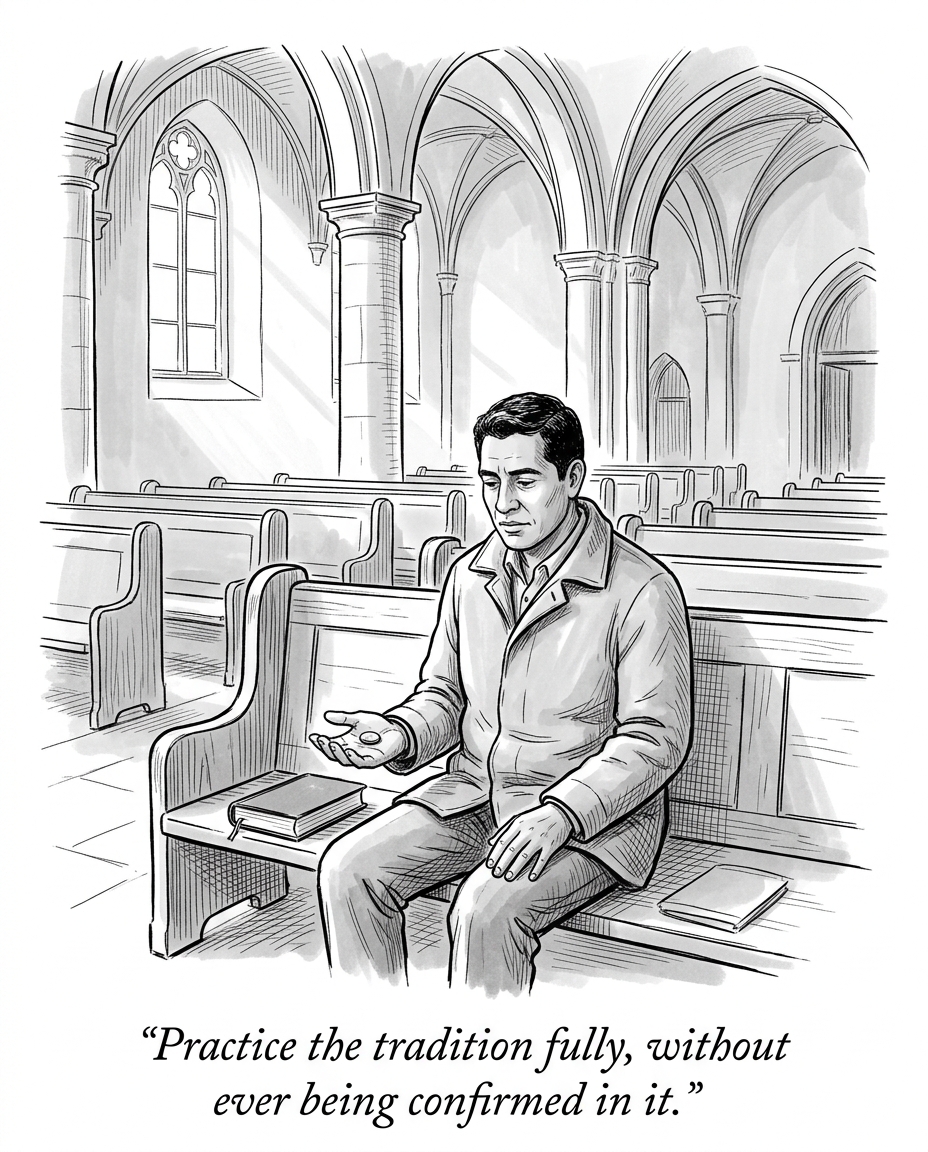
That's the actual thing I recognized at fourteen without being able to say it yet, and it's the thing I've been living out, one essay at a time, without naming it until tonight. I'm agnostic. I don't hold the theological claim underneath any tradition as settled fact. And I still go to Mass, and I want to be precise about what that actually means, because it isn't what it sounds like: I have never been confirmed. I'm not Catholic. I go to Catholic church, and I have for most of my life, and I love the tradition enough that I've sat through Mass in Latin and in Korean, understanding maybe a third of either service, and it never once felt like it mattered less for that. That's the actual beauty of the tradition, and it has nothing to do with the homily. You know when to stand. You know when to kneel. The body already has the choreography memorized before the mind has ever caught up to a single word being said, and the two were never waiting on each other to begin with. That is why Mass can matter to me at all. Mass was never about the doctrine landing. Mass is about the tradition. I have real problems with the Catholic Church itself, and I'm not going to soften them into something more comfortable to sit next to the rest of this: boys and girls raped by the men entrusted to carry that same tradition forward, for decades, covered up rather than confronted. That doesn't cancel out against anything else here. It sits right next to it, unresolved, exactly the way every other tension in this piece does. And the tradition still holds anyway. I've been to the Vatican. I've walked the tombs underneath it, the actual ground the whole structure is standing on. I watched my own son get confirmed, and he serves as an altar server now -- further into the tradition's own sacramental structure than I've ever gone myself, which is a different claim than saying he knows more about it than I do. I've studied religious history seriously, for years, on my own; the gap between us isn't knowledge. It's that he took the actual sacrament and I never have, and those turned out to be two completely separate things. I didn't push him there and I didn't hold him back from it. I just kept showing up next to him while he made a decision about the same tradition that isn't the decision I made. I still carry a Baptist Sunday service somewhere in me from a childhood that ran both traditions at once, still take the structure of belief seriously enough to let it shape how I live, without needing to resolve which tradition, if any, has the truth locked down. People hear "agnostic" and assume that means holding nothing seriously. Pascal is the proof that it can mean the opposite -- holding two things seriously at once, precisely because neither one has been proven wrong, and refusing to fake a certainty you don't actually have just to make the holding easier.
It didn't stop at two. Some of my closest friends are Mormon, a tradition with its own real theology, its own real claims, neither one identical to Catholic doctrine or Baptist practice and neither one requiring me to rank it against the other two. I didn't decide to collect traditions the way you'd collect stamps. I decided, without ever quite framing it this way until now, to let closeness with a person and closeness with a structure of belief be two different things that don't have to resolve into agreement before either one counts as real. I took my own kids to the Mormon temple in DC, the one with the white spires you can see from the Beltway, the same way I take them to Mass. Not because I wanted them to choose it. Because I wanted them to have the same thing I had -- more than one real structure to stand inside, before anyone asked them to pick. We've taken them to the major religious sites across the whole Abrahamic tradition, not just one branch of it. And in my own library, the Quran, the Torah, and the Bible sit on the same shelf, next to each other, the same way Baldwin sits next to writers who'd have argued with him. I didn't put them there to rank them. I put them there because a library that only holds the books that agree with each other isn't actually a library. It's an echo.
The wager itself gets misread, and the misreading is that it's only about your relationship with God. My own view of it is that it's as much about how you treat other people as it is about that. Strip the theology off and the argument still stands on its own: be better, because the cost is low and the upside is high. If there's some accountability waiting on the other side of a life, treating people well aligns with it and costs nothing extra. If there isn't, treating people well still costs nothing, and the people you treated well are still better off either way. That's the actual argument. God was never required to make it work. He was just the language available in the seventeenth century for talking about stakes that high, and the relationship with him and the way you treat the people around you were never two separate bets -- they were always the same one.
I've made this same move with the Bible itself, not just with Pascal. A public-school English teacher I had kept one on his desk, not as scripture and not as an argument for God, but as a work of literature and as an explanation of Western civilization -- because you cannot actually understand the civilization you're standing in without it, whatever you personally believe about it. That's not a hedge I invented to make the book comfortable for an agnostic to own. It's the honest description of what the text has actually done in the world, independent of whether its theological claims are true: it shaped the legal traditions I practice inside, the literature I've read my whole life, the language I'm writing this in right now. You can read it as scripture. You can also read it as one of the most consequential secular documents in the history of the civilization it produced, the same way you can strip the theology off Pascal and still find the actual argument standing underneath it.
The actual decision Pascal made, over and over, wasn't which side of a coin flip to bet on. It was a decision about how to live inside permanent uncertainty without either resolving it falsely or refusing to act at all -- take the structure seriously, do the work, hold the tension, and let whatever's actually true stay unproven rather than forcing a verdict you can't honestly reach. That's a harder, quieter decision than the famous wager makes it sound, and it's the one I actually recognize in my own life.
I've spent this whole night building essays that refuse to resolve into a clean lesson -- a Catholic kid on Sundays with a Baptist great-grandmother, a country whose founding language and founding slaveholding are both true at once, a reader who loves two authors' work and can't forgive their views, a hiring instrument that works and that I still hate. Every one of those pieces ends the same way Pascal's own notebook ends: not with an answer, with the tension left standing, on purpose, because forcing an answer would have been less honest than admitting I don't have one. I used to think that was a stylistic choice, a way of writing I'd developed on my own. It isn't. It's the same decision Pascal made three hundred and fifty years before I ever picked up his book at lunch, skipping a meal for a habit of mind I didn't know yet I was going to need for the rest of my life.
And I want to correct my own framing before I close this out, because it matters. It isn't one wager. That's the version that fits neatly into an essay, and it isn't the true one. Catholic Mass is its own wager, running on its own terms. Baptist Sunday service is a separate one, not a hedge against the first. Standing inside a Mormon temple with my own kids is a third, independent of the other two. The Quran and the Torah sitting on the shelf next to the Bible are more still, each one live, each one unresolved, none of them averaged together into a single position I could state in one sentence if you asked me what I actually believe. Pascal's own notebook was already like this before I ever thought to name it -- not one bet, a whole set of them, running at once, each one honest on its own terms.
And I want to be honest about where my own list actually stops, because pretending otherwise would undercut the whole point. I don't know the Eastern traditions' own version of this wager with anything like the depth I know the Abrahamic ones. I don't know the African traditional religions' version either. I don't think a naturalist or a secular humanist is exempt from having one, just because it doesn't get called a wager -- deciding there is no God and building a life and a meaning on top of that decision is its own bet, made with the same incomplete information as any of the others, and I don't think it gets to claim a neutrality none of the rest of us get to claim. Every belief system I know of is running some version of this, whether or not it uses Pascal's word for it. I just don't know most of them well enough yet to hold them the way I hold the ones on my own shelf, and saying so plainly seemed more honest than letting the list I do know stand in for a completeness I haven't actually earned.
I also want to be precise about why Pascal specifically, and not someone else, because I don't think it was luck and I don't think it was because he's objectively the best guide anyone could reach for. He was close at hand for me in the most literal way a name can be -- I was already typing his on a keyboard, compiling on Turbo Pascal, before I knew there was a man behind it worth reading. That's about as close to random proximity as a reach ever gets, and it's still what put him on the shelf in the first place, on a shelf I already had access to, in a canon I'd already been handed pieces of, at an age when I was reading whatever was near me rather than whatever was best in some abstract sense. Someone raised inside a different library, near a different shelf, would reach for someone else entirely and find the identical thing I found in Pascal, because the mechanism isn't about him being special. It's about proximity doing what proximity always does. I don't think that makes what I found in him less true. I think it means I should say plainly that it was found, not discovered as the one correct answer waiting to be uncovered by anyone who looked hard enough.
I went to Catholic school before any of this, and I can still cite Augustine without walking anywhere to get him. He isn't on a shelf I reach for. He's already in me, put there by years of instruction I didn't choose, the same way a language you're raised in doesn't feel like something you retrieve. Pascal started differently -- a book I picked up on my own, at lunch, a real reach the first time. But thirty years of going back to him did the same thing to him that Catholic school did to Augustine without my choosing it. He isn't a reach for me anymore either. He's in me now, every day, the same way Augustine is. It took me most of a lifetime to get there with Pascal, and it took no choice at all to get there with Augustine, and I don't think one route is more honest than the other. Both ended in the same place. Ulysses is not in that place. Neither is Plato. I know them. I've read them, closely, more than once. They're still a reach every time -- real, held, mine, but not yet integrated the way Pascal and Augustine are, and I don't know if that's a matter of time, or a matter of never having gone back to either one often enough for the return trip to stop being a trip at all.
I should say plainly that not everyone who looks at what Pascal did sees what I see in it, and the disagreement is old, specific, and philosophically serious -- not just a modern reader's discomfort. Nietzsche read the same man and came away with something close to the opposite reading -- to him, Pascal's faith wasn't two things held honestly at once, it was reason talking itself to death slowly, a mind that brilliant choosing to spend its own life dismantling itself for belief. Voltaire went a different direction entirely and objected to the wager on grounds of taste as much as logic -- he found the whole structure "indecent and childish," the gravity of a soul's fate reduced to a bet, and didn't think the reward on offer could ever produce more than a faint, unconvincing belief in anyone reasoning their way into it. William James took the opposite side, a century after Voltaire -- "The Will to Believe" defends the same basic move Pascal made, that it's sometimes rational to adopt a belief without full proof when the stakes and the uncertainty both demand it. But James added a condition Pascal's own wager doesn't obviously carry: the belief has to stay provisional forever, always answerable to new evidence, never permitted to harden into the kind of settled certainty a wager implies you'd stop questioning once you'd made your bet. Three real philosophers, three real readings of the identical decision -- suicide of reason, indecent bet, defensible risk on one condition -- and I don't think any of them is simply wrong. I think they're each describing the same evidence I am and naming it something different, which is exactly what a piece about holding contradiction should expect to happen to itself the moment it goes looking for other minds that looked at the same man. And I don't think that collision is a cost the piece has to absorb. Philosophy is in tension -- Nietzsche against Voltaire against James, none of them agreeing, all of them serious -- and tension is what actually builds a mind. Not the part where one of them wins. The part where all three stay standing at once.
The wager was never only about God, and it was never really singular either. It was as much about how you treat the people around you as it was about your relationship with him. I made that decision without knowing I was making it, the day I sat down with Pascal instead of eating lunch, and I've been making it every time I've written one of these pieces and let more than one tension stand instead of resolving any of them for you. That's the actual wager, or the actual wagers, mine and everyone else's, known and unknown to me. Not what you believe. Whether you're willing to keep several unresolved questions running at once, honestly, instead of forcing them into one.
Part of the same family: "No One Has to Lose" and "How to Build a Mind."