No One Has to Lose
I woke up not long ago with two songs on my mind, back to back, uninvited. Leonard Cohen's "Hallelujah." Kirk Franklin's "We Fall Down." I hadn't been listening to either one the night before. They just arrived, the way things do when a mind has been sitting on something longer than it realized. And once they were there, I understood why they'd shown up together. Both are about the same thing -- a person failing, plainly, and grace meeting them there instead of waiting for them to clean up first. Different voice. Same argument.
I didn't come to that argument abstractly. I lived inside two versions of it at once, as a kid, and neither one ever had to lose to the other. I spent my formative years at Mass -- St. Peter's through eighth grade, Holy Spirit for high school. And on Sundays, I went to Baptist church with my great-grandmother. Not one tradition followed by another. Both, running at the same time, in the same childhood. My great-grandmother is the reason I can hear Kirk Franklin as more than sound. Catholic school is the reason the structure of Mass still matters to me, still pulls me back, still feels like where I go when I go anywhere. My own personal position is agnostic. I don't hold the theological claim underneath either tradition. I play Pascal's game instead -- take the structure seriously, engage it fully, without needing to settle which one, if either, has the truth underneath it locked down.
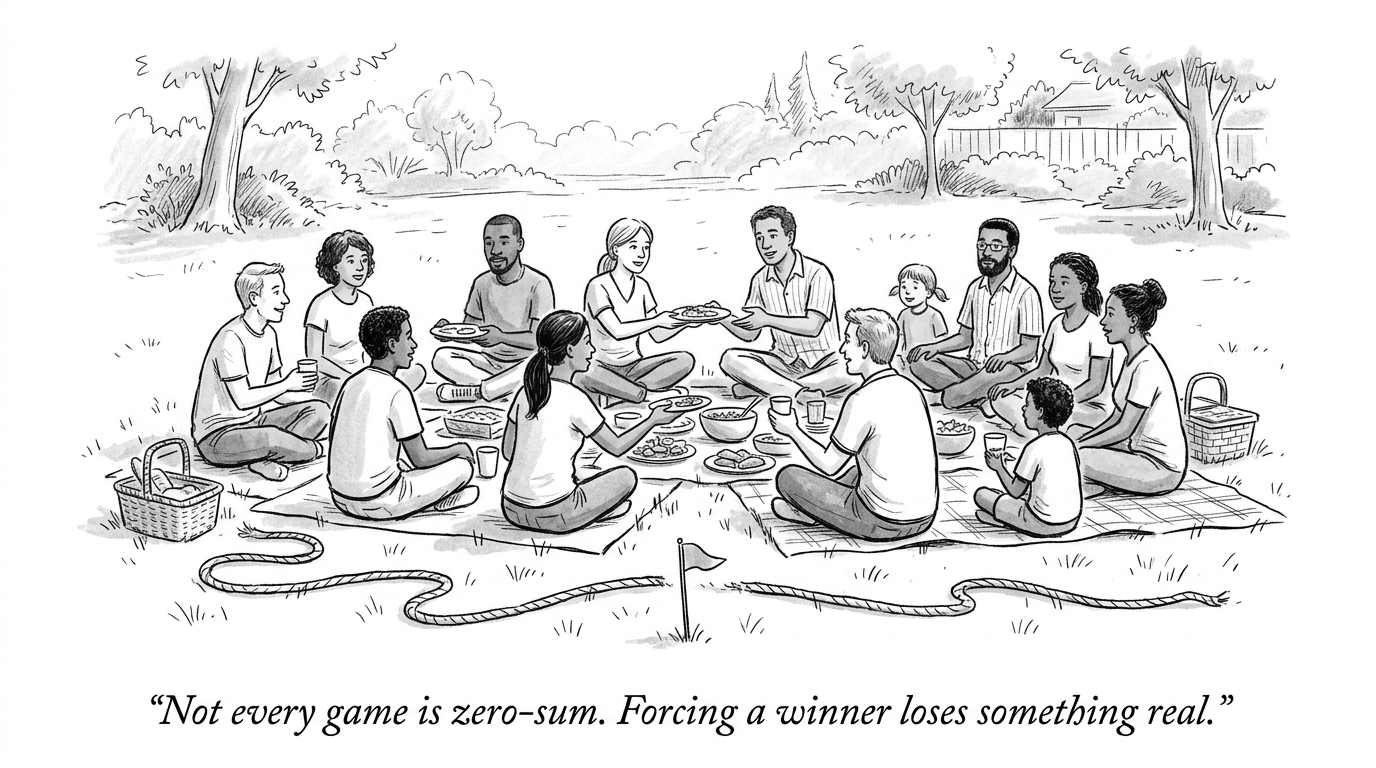
People hear "agnostic" and assume it means detached, picking and choosing, tourist in both houses and resident of neither. That's backwards. I was fully present in both rooms as a kid, at the same time, and I still am. What let that happen wasn't indifference. It was the thing I only had language for much later, when I actually read Robert Wright's Nonzero, and later still, Brian Clegg's Game Theory: not every game is zero-sum. Most of the ones that actually matter aren't. Two traditions can both be real, both be load-bearing, both shape a person all the way down, and neither one has to defeat the other for either to count.
I think this is the actual argument underneath a lot of what I've built out on this site without naming it directly. Grace toward Republican voters I don't understand didn't require deciding they were right and I was wrong, or the reverse. It required believing their position holds understanding I lack, full stop, no winner declared. Orson Scott Card and J.K. Rowling's work being genuinely beautiful and their personal views being genuinely hard to sit with -- that was never a contradiction I had to resolve into one verdict. Both are true, permanently, and I stopped waiting for one to cancel the other out. Even the country's own founding argument runs on this same shape: real, sincere language about equality, sitting right next to real, literal slaveholding, both true about the same people in the same document. None of these are close calls I finally settled. They're non-zero games, and the whole point of a non-zero game is that settling it -- forcing a winner -- is the move that actually loses something real.
Zero-sum thinking is comfortable because it tells you where to stand. Somebody's right, somebody's wrong, and once you know which, you're done. I understand the appeal. I just don't think it's usually true, and I think the places where I've lived two things at once without needing either to lose -- a Catholic kid on Sundays with a Baptist great-grandmother, an agnostic who still goes to Mass, a reader who can't fully forgive two authors he can't stop loving -- are the actual evidence, not just the argument. I didn't need Wright's book to prove non-zero games are the more honest read of most of what matters. I'd already been living inside one since before I could explain it. The book just gave it a name.
No one has to lose for this to work. That's not a compromise position, softened to avoid a fight. It's the more accurate description of how most of what actually shapes a person really operates -- My great-grandmother's pew on Sunday and St. Peter's classroom on Monday, both real, both mine, neither one waiting for the other to be wrong.
Part of the same family: "How to Build a Mind," "Grace and the Vote," and "The Cost of Going Public," where this same refusal to force a winner first showed up.