US Intelligence Agencies Named Six Chinese AI Companies in a Joint Advisory About Stealing US Models. China's Response: American Companies Do the Exact Same Thing.
On September 8, 2026, three US intelligence and security agencies published a joint advisory naming six Chinese AI companies and accusing them of a coordinated campaign to steal the capabilities of America's leading models. China's response, delivered within two days: American companies do the same thing, and the accusation is being used as a pretext.
The accusation, specifically
The NSA, CISA, and FBI jointly published "China-Based Artificial Intelligence Companies Conducting Industrial-Scale Distillation Campaigns Against U.S. AI Companies," naming DeepSeek, Moonshot AI, Alibaba, MiniMax, StepFun, and Z.ai directly. The advisory's claim: these firms are systematically extracting proprietary capabilities from US frontier models -- Claude, GPT, Gemini, and Grok -- at industrial scale.[1]
What "distillation" actually is, before either side's spin
Distillation is a real, ordinary, widely used machine-learning technique -- training a smaller, cheaper model to reproduce a larger model's outputs, which is how a lab turns an expensive frontier model into a fast, affordable product. It is not, by itself, theft; every major AI lab, American labs included, uses some version of it. The actual dispute is about scale, consent, and whether extracting a rival's outputs through its own public API crosses from ordinary technique into something closer to industrial espionage -- a line the US advisory says was crossed and China's government says was never real to begin with.
China's Commerce Ministry: baseless, and hypocritical
China's Ministry of Commerce called the US accusation baseless and without legal foundation, stating that Washington is politicizing a neutral, normal industry practice and applying double standards -- since American firms distill from Chinese models too. The ministry added a direct warning: if the US uses the distillation accusation as a pretext to suppress Chinese AI companies, China will take "resolute countermeasures."[2] The exchange is landing directly ahead of planned Trump-Xi talks, raising the stakes of what might otherwise read as a technical dispute between competitors.[3]
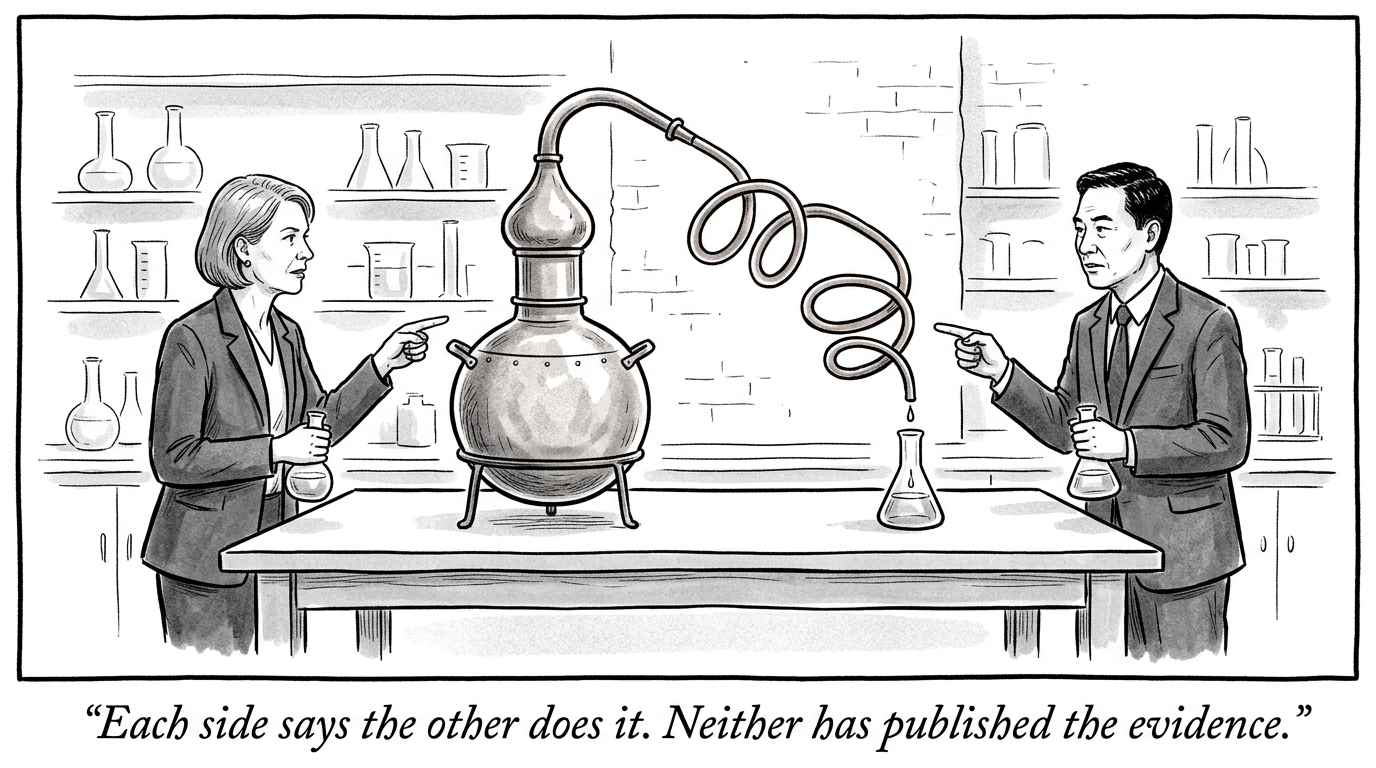
Neither side has published the actual technical evidence that would settle this in public. Detecting distillation is a real, if imperfect, technical field -- output-similarity analysis, watermarking, statistical fingerprinting of a model's training signatures. The US advisory asserts industrial-scale extraction happened; China's rebuttal asserts the practice is symmetric and the accusation is political theater timed to a trade negotiation. Both of those can be checked, in principle, against real data. As of this piece, what's public is two governments' competing assertions, not the underlying analysis either side is presumably relying on.
Why does this matter? This dispute is opening a third front in the same US-China AI competition this outlet has already covered from another angle -- China's own bet that grid access, not chip supply, is the real constraint on its AI buildout. Distillation adds a fight over the models themselves: not who can build the hardware or power the data center, but who gets to build on top of a rival's finished work at all, and what counts as ordinary competition versus theft when the thing being copied is software rather than a chip design. Like the chip and grid questions, this one is landing in public before either side has shown the evidence that would actually resolve it.
Companion piece on this outlet: "DeepSeek's Newest AI Data Center Generates Its Own Power..."
One of the six named firms just tripled its valuation, with the state as an investor
Moonshot AI -- one of the six companies named directly in the US joint advisory above -- closed a $3.5 billion funding round on July 29, 2026, more than double its original $1-2 billion target, at a $35 billion valuation that tripled its worth in six months.[4] The round was led in part by China's National Artificial Intelligence Industry Investment Fund -- the same state investment vehicle that also backs DeepSeek, another of the six firms named in the advisory.[5] The raise followed the open-source release of Kimi K3, a 2.8-trillion-parameter model Moonshot gave away for free days before the round closed, making it the largest open-weight model ever publicly released.[5]
That timing sharpens this piece's own argument rather than sitting beside it. The US advisory's underlying claim is that companies like Moonshot are extracting US frontier-model capability through public APIs at industrial scale; China's rebuttal is that the practice is symmetric and the accusation is political theater. Moonshot's response to the entire dispute was to give its newest, largest model away for free -- and get rewarded with a tripled valuation anyway, funded in part by the same state vehicle underwriting a second named company. Whatever the technical merits of the distillation claim, the dispute between the two governments is not slowing the capital or the model releases on the Chinese side; if anything, state money is moving toward the specific companies named in the US advisory, not away from them.
- National Law Review, China's Commerce Ministry Rejects U.S. Accusations of "Industrial-Scale" AI Distillation
- South China Morning Post, China rejects US claims of 'industrial scale' AI model distillation, warns of retaliation
- Washington Times, China hits back at U.S. claims of 'malicious' AI distillation ahead of planned Trump-Xi talks
- Bloomberg, Moonshot AI Surpasses Funding Goal to Hit $35 Billion Value
- Yahoo Finance / The Information, Moonshot AI's $3.5 Billion Round Tripled Its Valuation in Six Months -- and Beijing's Fingerprints Are All Over It