DeepSeek's Newest AI Data Center Generates Its Own Power and Skips the Grid Entirely. The Median Wait to Connect a New Data Center to the American Grid Is Now Five Years. China Didn't Solve the Chip Shortage. It Made the Chip Shortage Beside the Point.
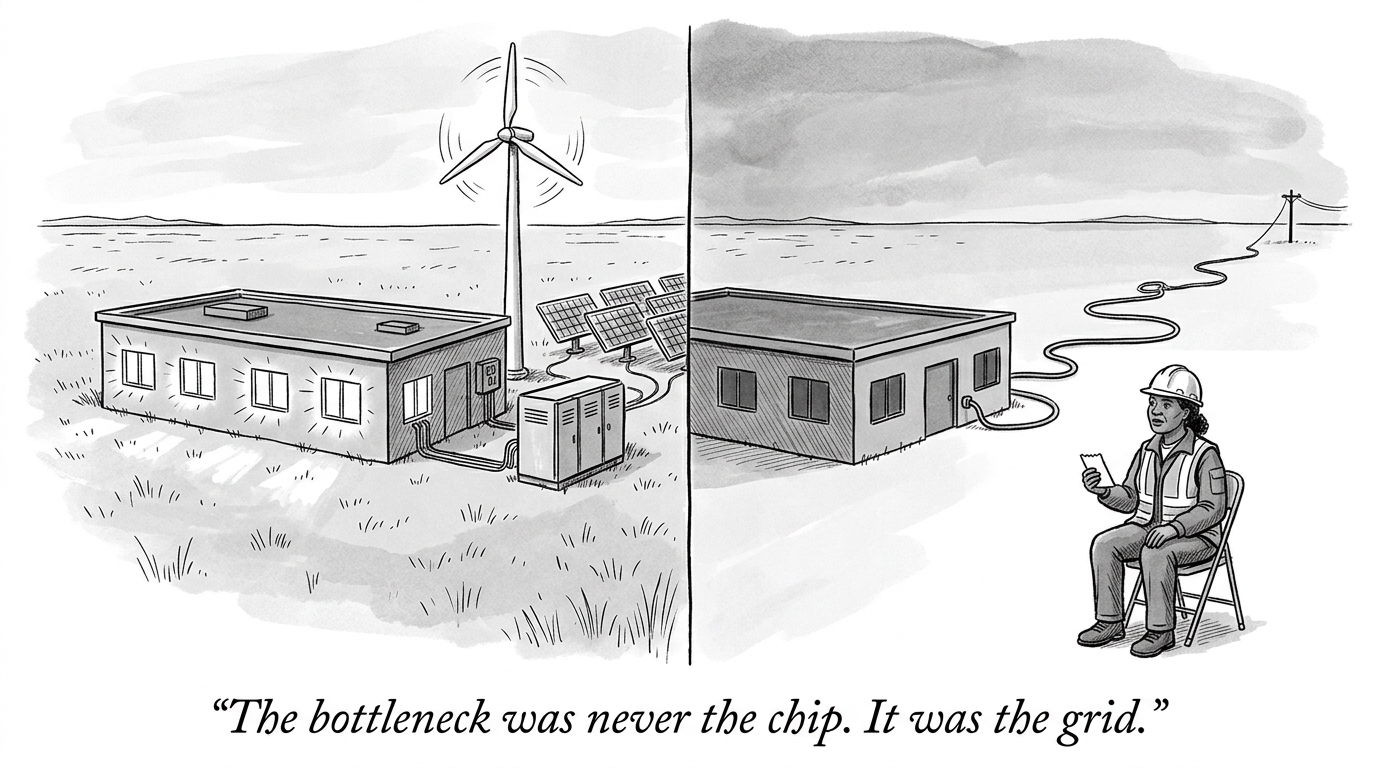
Every major AI infrastructure story this outlet has covered this year has treated chip supply as the binding constraint -- who owns the hardware, who rents it, whose chips run the benchmark faster. China's newest AI computing hub is built on a different bet entirely: that the real bottleneck was never the chip. It was the power grid.
Ulanqab, not Silicon Valley, is where the bet is being tested
Ulanqab, a prefecture in Inner Mongolia, now hosts more than fifty companies running fifty-six data centers with a combined 65,000 petaflops of computing power -- roughly nine percent of China's entire national computing capacity, concentrated in one region that had no comparable tech industry a decade ago.[1] DeepSeek is building a 1-gigawatt facility there. Z.AI is building its own 1-gigawatt campus nearby, engineered to run entirely on domestically produced chips. Both are part of Beijing's "East Data, West Compute" initiative, which deliberately routes compute-heavy workloads away from expensive, power-constrained coastal cities toward western provinces where land and energy are cheap and available.[2]
The actual engineering bet: don't wait for the grid, build around it
The detail that separates Ulanqab from an ordinary data-center buildout is what Centrin Data's facility there does with power specifically. It runs on a "source-grid-load-storage" model -- wind and solar generation, battery storage, and AI-managed power balancing, integrated directly into the campus and generating roughly 848 million kilowatt-hours of self-used green power a year.[3] The point isn't that it's renewable. The point is that it doesn't have to wait in line for anyone else's grid. A facility that generates and stores its own power can be built and switched on the moment construction finishes, with no dependency on a public utility's interconnection approval.
That last number is the actual American contrast, and it isn't close. As of the end of 2025, roughly 8,200 projects were sitting in US grid interconnection queues -- 1,312 gigawatts of generation and 749 gigawatts of storage, waiting on approval. The median time from application to commercial operation is now approaching five years nationally. In the PJM territory that serves the largest AI campus filings, the wait runs closer to seven. Google has publicly reported potential delays of up to twelve years for some proposed data centers.[4] Every dollar of chip spending this outlet has already covered -- OpenAI's owned Mac minis, its Jalapeño chip with Broadcom, Anthropic's $45 billion in rented Nvidia compute -- assumes the facility housing that hardware can actually get power turned on inside a competitive timeframe. Ulanqab's bet is that decoupling from the public grid removes that assumption entirely, on a timeline measured in months of construction rather than years of queue position.
The complication worth naming honestly: Ulanqab isn't clean proof that chips don't matter, because the chip question hasn't actually left the story. The Trump administration has alleged separately that DeepSeek obtained Nvidia Blackwell processors -- chips effectively banned from sale to China -- for its existing Inner Mongolia operations. DeepSeek has denied it, and Nvidia has stated it has seen no evidence of smuggled hardware reaching the site.[5] If that allegation is ever confirmed, Ulanqab isn't evidence the chip constraint was a myth. It's evidence China may be working to solve the power constraint and the chip constraint at the same time, rather than picking one.
Why does this matter? US chip export controls are built on the premise that restricting advanced silicon is the single lever that slows down a rival's AI buildout. Ulanqab doesn't disprove that premise -- it tests a second one alongside it: that even with every chip you could want, a data center sitting in a multi-year grid queue produces nothing. China's own AI companies are racing to build power generation directly into their compute campuses specifically so that question never has to be answered. Whether the constraint that actually slows down the next generation of AI infrastructure turns out to be the chip supply the US is restricting, or the grid capacity the US isn't building fast enough, is not a settled question. It's the one Ulanqab is betting on first.
Companion pieces on this outlet: "OpenAI Bought Its Own Mac Minis...", "Arm's CEO Says AI Will Cure Cancer...", and "Broadcom, AMD, Intel, and Micron Are All Posting Record AI Numbers..."
- Seoul Economic Daily, Inner Mongolia Emerges as China's AI Infrastructure Hub With World's Largest Facility
- Data Center Dynamics, DeepSeek planning 1GW data center in Inner Mongolia, China - report
- Global Neighbours, Cover Story: China's AI Boom Is Rewiring Its Power Grid
- Lawrence Berkeley National Laboratory, Queued Up: Characteristics of Power Plants Seeking Transmission Interconnection
- Yahoo Finance, DeepSeek's 1GW Ulanqab Pivot Signals China's Sovereign Compute Escalation