When the Fear Rises, the Checks Fall
Look at what this country does when it is afraid.
The panic
In 1950 Senator Joseph McCarthy began naming people he said were communists inside the government. The fear he stoked cost people their jobs, their careers and their standing, many of them on accusations nobody had to prove.[1][2] The FBI under J. Edgar Hoover had been investigating the film industry since 1942, and one historian argues that Hoover was the prime mover behind the Hollywood blacklist.[3][4] I am not claiming the Bureau and McCarthy worked as one, because the sources I found do not document that. In December 1954 the Senate censured McCarthy, 67 to 22, for abusing a Senate committee.[1][2]
A panic had ended in a rebuke. It did not end the machinery the panic had built.
The program
Two years later the FBI started COINTELPRO. It ran from 1956 until 1971. It began against the Communist Party and widened to the Southern Christian Leadership Conference and to Martin Luther King Jr..[5][6] The methods reported include wiretaps, informants, infiltration, forgery and blackmail.[5][6] The Bureau did this to Americans who were exercising the rights the Constitution gave them, including the people who were making the country live up to its own words. The civil rights movement was among its targets, and the Church Committee later named the Southern Christian Leadership Conference, Dr. King, the Black Panthers, the American Indian Movement, the National Lawyers Guild and the antiwar movement.[8][9]
The people running it believed they were protecting the nation. A man can love his version of his country and use the state against the people who want a truer one.
The break-in
It ended because of a burglary, not an investigation. On the night of March 8, 1971, eight people broke into an FBI office in Media, Pennsylvania, took more than a thousand documents and gave them to the press.[7] They stayed anonymous for more than forty years. A later Freedom of Information request, started by an NBC News reporter, pushed the program's name into public view.[7]
The correction
In 1975 the Senate voted 82 to 4 to investigate. The Church Committee heard from about 800 witnesses and read 110,000 documents. It concluded that the intelligence agencies had undermined the constitutional rights of Americans, because the checks the framers designed had stopped working.[8][9] Congress created permanent intelligence committees and passed the Foreign Intelligence Surveillance Act in 1978, so that surveilling Americans required a court.[8][9] Reporting since the 2013 Snowden disclosures has raised the question of how much of that protection survived.[10][11]
What I read in the sequence
The order repeats: fear, then a rebuke, then machinery that outlives the rebuke, then exposure by someone outside the machine, then a correction that does not last by itself.
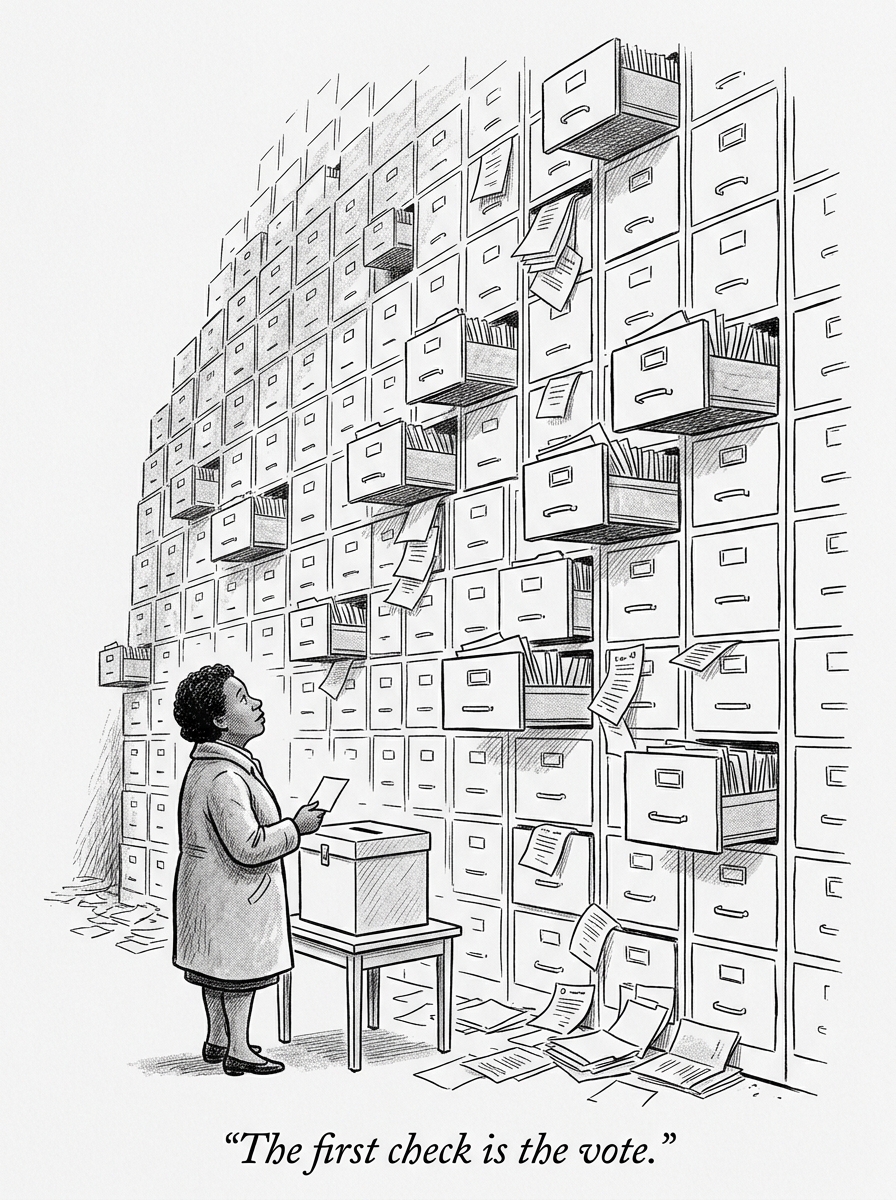
The first check is the vote. The people decide who represents them. Many citizens do not vote. In 2024, the Census Bureau reports, about 65 percent of citizens of voting age did.[12] That is why the vote cannot be the only check. The Senate that censured McCarthy and the Senate that opened the Church Committee were both elected bodies answering to voters.
I read the whole sequence as the civics lesson. A free country does not keep its rights by loving them. It keeps them by building checks, and those checks are the first thing to fall when people are afraid. They come back when someone outside the machine makes them come back: a citizen, a burglar, a reporter, a committee.
What I do not know
I do not know how closely the FBI and McCarthy worked together, and historians disagree about Hoover's part in the blacklist. I have not read the Church Committee's full report. I relied on the Senate's summary and on reporting about it. The record also holds claims about the FBI's conduct toward Dr. King that I have left out because I could not confirm them in a primary source. And I do not know whether the checks in place today would hold under the next real fear.
A companion piece looks at the other side of the same question: the people who chose this work out of love of country, and what it cost two of them.
- U.S. Senate, Joseph McCarthy and his 1954 censure (U.S. Senate)
- Britannica, Joseph McCarthy and his 1954 censure (Britannica)
- The Progressive, The FBI and the Hollywood blacklist (historian Francis MacDonnell's argument, and the 1942 FBI investigation of the film industry) (The Progressive)
- Furman University library on FBI files, 1945-1972, The FBI and the Hollywood blacklist (historian Francis MacDonnell's argument, and the 1942 FBI investigation of the film industry) (Furman University library on FBI files, 1945-1972)
- HeinOnline, COINTELPRO and its targets (HeinOnline)
- NPR, COINTELPRO and its targets (NPR)
- WHYY, The 1971 Media, Pennsylvania burglary (WHYY)
- U.S. Senate, The Church Committee and the reforms (U.S. Senate)
- Levin Center, The Church Committee and the reforms (Levin Center)
- In These Times, After the Church Committee, and since 2013 (In These Times)
- State of Surveillance, After the Church Committee, and since 2013 (State of Surveillance)
- U.S. Census Bureau, voting and registration tables, Voter turnout in 2024 (U.S. Census Bureau, voting and registration tables)