Centinel Said the Senate Would Quietly Run Everything No Matter What the Document Said. Madison Wrote Two Whole Essays Defending the Senate Specifically -- Essentially Answering Him by Name.
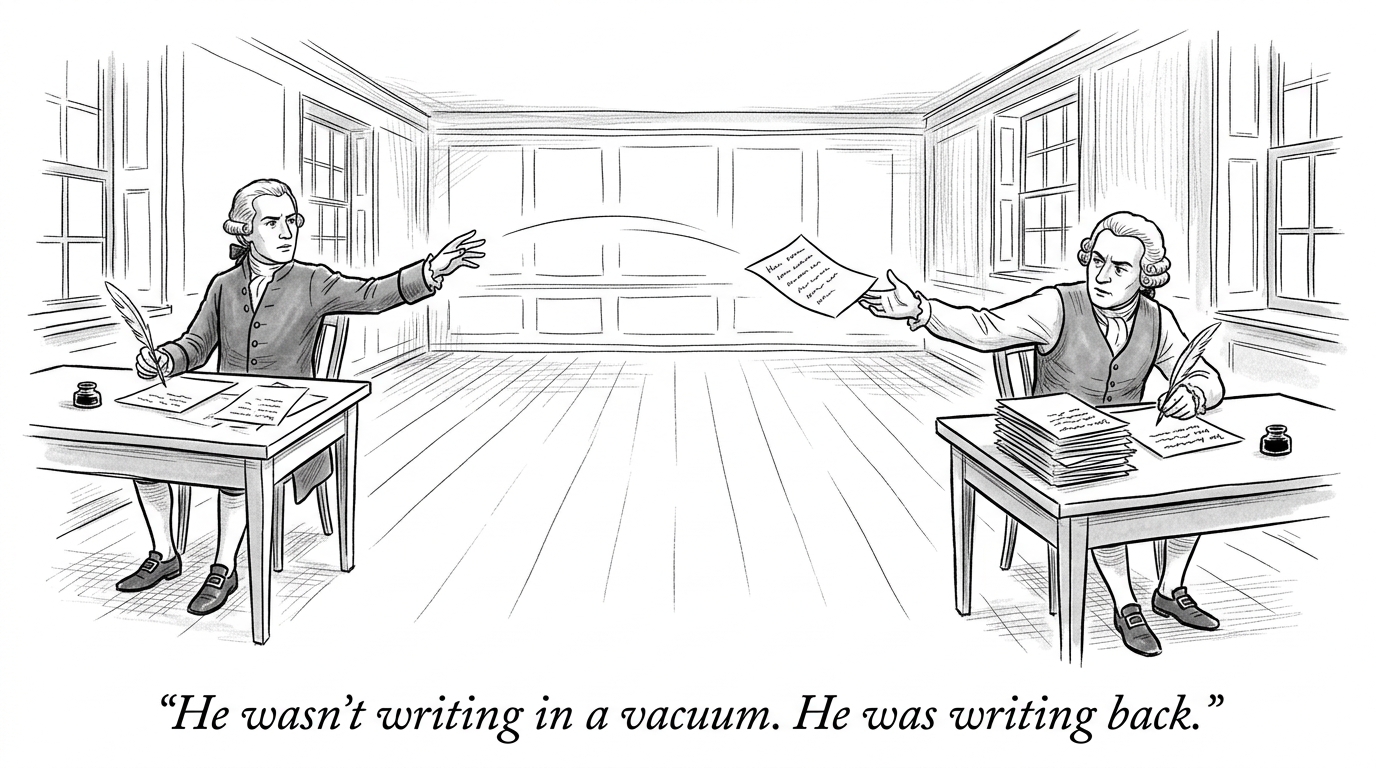
The Federalist Papers did not start in the middle of an argument. They opened it, on purpose, with the stakes stated as plainly as they would ever be stated again.
Federalist No. 1 (Hamilton) -- the opening bet, stated as a question the whole country was about to answer
Hamilton opened the entire 85-essay project with one question: can people actually build good government through "reflection and choice" -- real deliberation, real deciding -- or is every society, in the end, stuck depending on "accident and force" -- whoever happens to grab power, however they happen to grab it?[1] He was direct that getting this wrong would be, in his own words, "a general misfortune to mankind," not just an American problem. The other 84 essays are the actual attempt to answer the question Hamilton opened with.
That question was not new in 1787 -- the country had already made the identical move once, thirteen years earlier, in one crossed-out word. When Jefferson drafted the Declaration's most famous line, it originally read "We hold these truths to be sacred and undeniable." Benjamin Franklin crossed out "sacred and undeniable" by hand and wrote in "self-evident" -- swapping a claim grounded in religious faith for one grounded in reason, something any thinking person could work out for themselves, faith or no faith.[4] Hamilton's opening bet in Federalist No. 1 is the same move, aimed at government instead of a single sentence: can people actually reason their way to legitimate government ("reflection and choice"), or are they stuck with whatever they get by accident or force? Franklin's edit and Hamilton's opening question are the same Enlightenment wager, made twice, thirteen years apart, by two men working on two different founding documents.
Federalist No. 39 (Madison) -- answering "is this even really a republic?" with real precision
This directly answers a fear this outlet has already covered: Brutus and Cato both argued a republic can only survive at small scale, and the new government was simply too large to be a real one. Madison's reply was not "you're wrong, it's small enough." It was more precise than that. He argued the new government was not purely national and not purely federal (meaning a union of separate sovereign states) -- it was, in his own words, "in strictness, neither a national nor a federal Constitution, but a composition of both." Federal in its foundation. Partly federal and partly national in where its power actually comes from. National in how that power operates day to day. Federal again in how far that power actually extends. And neither purely one nor the other in how it gets amended.[2] Madison was not denying the scale problem Brutus and Cato raised. He was arguing the new government had been built as a genuinely new kind of thing, not a bigger version of the small republics either side was arguing about.
Federalist No. 62 and 63 (Madison) -- the direct reply to the exact attack on the Senate
This is the clearest essay-against-essay exchange in the whole ratification fight, and it is worth reading as exactly that. Centinel had argued that checks and balances would prove to be theater, and that the small, insulated Senate would end up running the government regardless of what the document said about three co-equal branches. Madison spent two entire essays -- 62 and 63 -- defending the Senate's specific design, almost point for point against exactly that fear.[3]
Madison's case: a smaller body, serving longer six-year terms, is less likely to be swept up in "the impulse of sudden and violent passions" and more likely to actually develop real, working expertise in what it is legislating on -- the opposite of Centinel's claim that insulation from ordinary voters was itself the danger. Madison flipped the argument directly: even the people themselves, he wrote, are "subject to the infection of violent passions" at times, and a body built to be more stable and more informed is a real check on that, not evidence of tyranny by design. He went further, noting "history informs us of no long-lived republic which had not a senate" -- a direct answer to the claim that a Senate was itself the danger, arguing instead that no republic had ever survived long without something structured very much like one. And on the core structural fear -- that concentrating real power in one body was risky no matter how it was elected -- Madison argued a second chamber "doubles the security to the people," because any real scheme of "usurpation or perfidy" would need both chambers to agree, not just one.[3]
Neither side actually won this specific argument outright, and that is the honest, useful takeaway rather than a disappointing one. Madison's design -- longer terms, smaller body, real expertise -- is a real, coherent case, and the Senate has, in fact, outlasted every fear that it would simply collapse into open tyranny. But Centinel's underlying claim -- that formal checks and balances do not automatically stop power from concentrating wherever one person or one office happens to be able to hold it -- is also the exact mechanism this outlet has already documented in a real, current case: a single Senate leader blocking, then rushing, Supreme Court confirmations using nothing but control of the calendar. Madison built a Senate designed to resist runaway passion and reward real expertise. He did not, and could not, build a Senate immune to one person deciding, on their own, when to let it vote at all.
Why does this matter? Reading the Federalist Papers as one long, uncontested argument misses the actual shape of the fight that produced them. Several of the most important essays were not written in a vacuum -- they were direct replies to specific, named fears, aimed at specific opponents, answering specific claims. Federalist 39 is Madison's precise answer to "this isn't really a republic." Federalist 62 and 63 are Madison's direct defense of the Senate against Centinel's specific attack. Reading only one side of that exchange means reading half an argument and mistaking it for the whole thing.
Companion pieces on this outlet: "Seven Documents Built America..." and "The Federalist Papers Ran 85 Essays. The Essays Written Against Them Also Ran 85..."
- Bill of Rights Institute, Federalist 1 Explained: Alexander Hamilton's Call for a Stronger U.S. Government
- Bill of Rights Institute, Federalist No. 39
- Constituting America, Federalist 62 and 63: Senate Powers for Soundness, Order, Stability of the Congress
- Crossway / PBS, The Most Significant Edit to the Declaration of Independence