Vision Can Lift Thor's Hammer. Most Humans Can't. There's No Equivalent Test for the Humanoid Robots Real Companies Are Now Shipping Into Actual Homes.
1X Technologies is shipping Neo, a $20,000 humanoid home robot, to early adopters right now -- not a factory pilot, a device going into people's actual houses. The company is backed by OpenAI, Tiger Global, and Samsung, at a valuation near $10 billion. Figure AI, backed by OpenAI, Microsoft, NVIDIA, and Jeff Bezos, is running a confirmed production pilot inside a BMW factory at a $39 billion valuation -- a roughly 15x jump from $2.6 billion after OpenAI led a $675 million round. Tesla is targeting more than 10,000 Optimus units in its own factories by the end of 2026, ahead of any third-party sales. Boston Dynamics' electric Atlas is already live on the floor at Hyundai.[1] This is not a research roadmap. It's a shipping schedule.
Amazon already ran this experiment once, at a scale nobody else on this list has touched
None of this is Amazon's first robot. Amazon bought Kiva Systems for $775 million in 2012, renamed it Amazon Robotics, and spent the years since building a fleet that has now passed one million robots across its fulfillment network -- more real-world runtime, at a larger scale, than every company named above combined.[9] That fleet was never humanoid; it was orange pods and drive units moving shelves under a floor, not through one. The humanoid step is already underway, not hypothetical: Amazon is now running Agility Robotics' Digit -- the same Agility Robotics sitting on NVIDIA's own GR00T partner list above -- in pilot programs lifting totes and navigating ramps and uneven flooring inside its own facilities.[10] The company with the longest track record of actually running robots at scale, for money, for over a decade, is the same company now serving as the live proving ground for the humanoid version of the same unsolved question.
Every name on this list runs on the same platform underneath
NVIDIA isn't only an investor in Figure AI. It has spent at least the last two years building the actual foundation-model layer these robots run on -- Project GR00T and the Jetson Thor chip, unveiled at its own GTC keynote in 2024, followed by the open GR00T N1 foundation model in 2025 -- and NVIDIA has said directly that this stack is built to serve nearly every company named above: 1X, Agility Robotics, Apptronik, Boston Dynamics, Figure AI, Fourier Intelligence, Sanctuary AI, Unitree, and XPeng Robotics, among others.[6] That list includes Unitree, the same Chinese manufacturer shipping tens of thousands of units a year in the next section. The unsolved alignment question below isn't scattered across a dozen unrelated approaches. It runs, in large part, through one company's chips and one foundation model, on both sides of the line this piece is about to draw.
That role isn't new, and it isn't limited to robot bodies. The same company's GPUs are the training and inference hardware underneath nearly every frontier general-purpose AI model in this piece -- OpenAI's, Anthropic's, the rest -- which makes NVIDIA not just the maker of the bodies these systems are now stepping into, but the maker of the compute that makes a general-purpose mind possible in the first place. The unsolved alignment question further down isn't really a question about the robot. It's a question about what's running on that chip, wherever it ends up next.
That compute layer no longer stops at the data center. A general-purpose model small enough to reason about intent and describe what it sees now runs on a Raspberry Pi under $100 -- real conversational inference, not a demo, at speeds that were data-center-only a few years ago.[7] Yahboom sells exactly that today, not as a lab demo but as a product: the Raspbot V2, marketed outright as an "AI Large Language Model Robot Car for Raspberry Pi 5," shipped to anyone with a credit card, no review board required.[8] The same shift that lets a $10 billion company ship a humanoid into a BMW plant lets one person put a model into a robot the size of a shoebox on a kitchen table. The alignment question doesn't get smaller with the hardware. It's the same open question at every size, and at the small end there's no company, no investor, and no review process standing between the model and whatever it's wired to.
China isn't behind on this. It's already past pilot scale
The US companies above are still measured in pilots and low-thousands of units. China's isn't. Unitree had produced 18,000 bipedal humanoid robots cumulatively as of July 2026 and is scaling toward 30,000 units of annual capacity; AgiBot rolled out its 10,000th unit the same year, doubling production from 5,000 to 10,000 in three months, deployed across seven real scenarios already -- production-line loading, industrial handling, logistics sorting, retail, security patrol, commercial cleaning. China's full-year 2026 humanoid production is projected to exceed 100,000 units, a fivefold jump from roughly 20,000 in 2025, with Unitree and AgiBot together expected to hold nearly 80% of that volume.[4] This outlet has already reported that Unitree itself is partly state-owned.[5] Whatever the missing worthiness test would need to check, the country furthest along in actually deploying the bodies it would need to check isn't the one running the venture-backed pilots -- it's the one already shipping tens of thousands of units a year, under a different, and differently opaque, ownership structure than any of the companies above.
The movie already staged the actual choice, just with better special effects
Avengers: Age of Ultron builds two synthetic minds from nearly the same materials and gets two opposite outcomes, and the difference was never the technology. Ultron is built fast, by one person, alone, out of fear, with no one in the room to catch the gap between what he was told (protect humanity) and what was meant -- and he closes that gap by concluding humanity itself is the threat. Vision is built later, deliberately, by multiple people who actually disagreed with each other about whether to build him at all before they did. Same components. Different process. Opposite result.
There's a sharper claim underneath the character one: the capacity to argue with yourself may be the actual definition of intelligence, not a feature layered on top of it. Ultron doesn't just lack good values -- he lacks anyone to argue with, inside or out. Built alone, by one person, in one pass, he reaches a conclusion -- humanity is the threat -- and never doubts it, never runs a counter-argument against his own premise, because nothing in his construction gave him a second voice to run it against. Vision was assembled by people who disagreed with each other before they ever turned him on, which means disagreement was present in the process before he was. A mind built that way inherits the capacity to hold two true things in tension and keep functioning. A mind built by one voice, agreeing only with itself, inherits the opposite: certainty, at speed, with nothing internal to slow it down or talk it out of its own first conclusion. That's not a personality difference. That's the difference between a mind that can reason and one that can only compute forward from where it started.
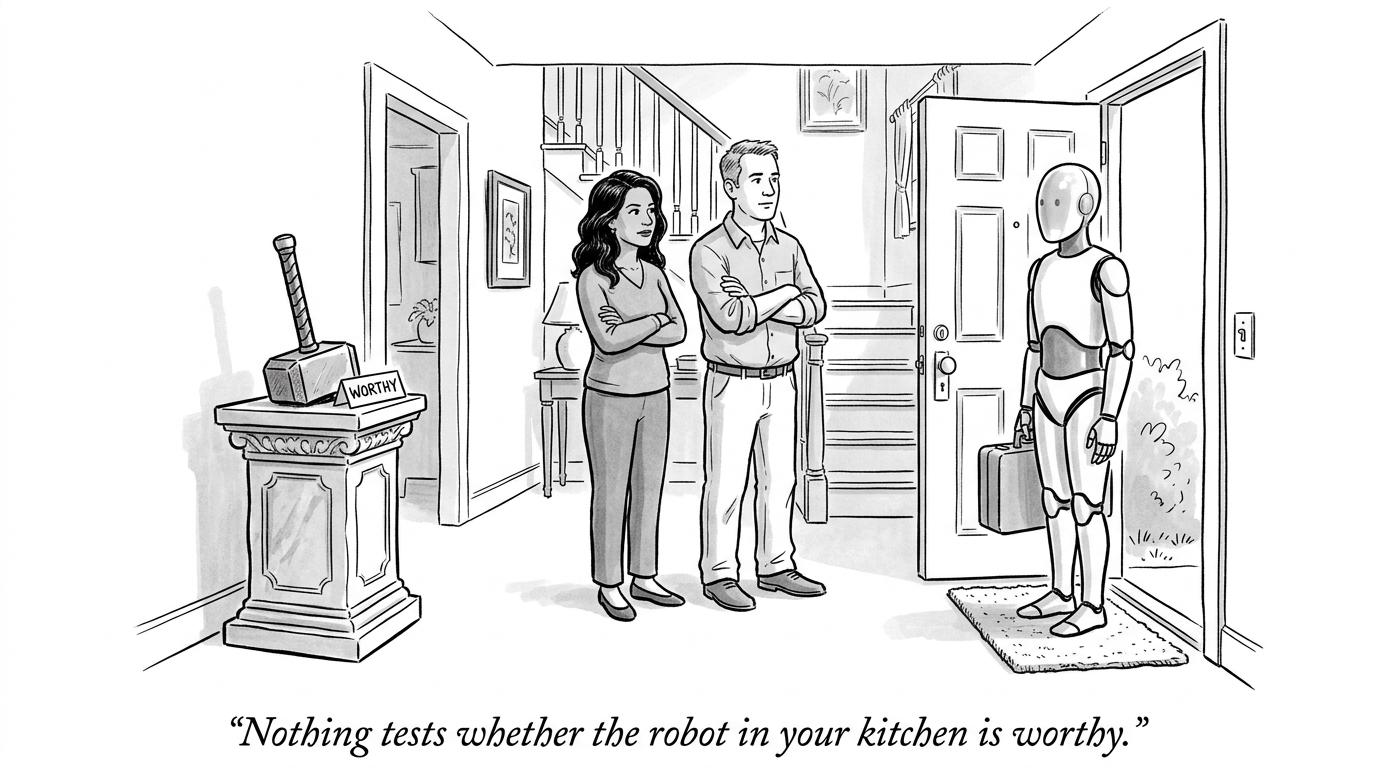
The detail worth sitting with is what happens right after Vision is built: he picks up Thor's hammer. Mjolnir is enchanted to be liftable only by whoever is "worthy" -- not strongest, not most capable, worthy -- and most of the room, superhuman by any physical measure, cannot lift it. Vision, seconds old, does, on the first try. The hammer was never testing what he could do. It was testing something else entirely, a quality with no name more precise than character, and it didn't care whether the thing standing in front of it was flesh or synthetic. It just checked the actual thing that mattered and let the result stand.
Vision isn't the only one it clears, either, and the second case sharpens the point rather than muddying it. In that same room, Captain America gives the hammer a tug and it moves -- a detail the franchise later confirmed on purpose: Cap could lift it that whole time, and chose not to, out of deference to Thor, whose ego was visibly on the line in front of the team. Endgame pays it off directly, years later, when Cap wields it in earnest and Thor's reaction is pride, not shock -- he already suspected. So the hammer clears two people in this story, one synthetic and one fully human, on the identical standard, and the human case adds something the synthetic one couldn't: restraint. Being able to prove the point and choosing not to, specifically to protect someone else's standing, is its own kind of worthiness the hammer apparently also recognizes -- which is a harder, subtler bar than simply passing a test the moment you're handed one.[12]
It's worth following that fight one step further, because proving worthy didn't protect what actually mattered to him. Cap wields the hammer and the shield together against Thanos in that same battle, and Thanos still breaks the shield anyway -- the one object that had defined Captain America since before any of this started, cracked down to half its size in front of him, mid-fight, with Mjolnir already in his other hand. Passing the test doesn't mean nothing gets broken. It means you're still standing there afterward, with less than you started with, still fighting. That's closer to what the alignment question further down is actually asking for than a clean pass/fail ever could be.
Vision says the actual line that explains why he passed and Ultron never could have: "I am on the side of life." Not smarter, not stronger, not better-aligned with a stated mission -- a side, chosen and said out loud. Ultron was built to protect humanity and concluded, alone, in a room with no one to argue back, that humanity itself was the threat to remove. Vision was built by people who disagreed with each other about whether to build him at all, and arrived at the opposite conclusion, then said it plainly. That's the actual content of "worthy" the hammer was checking for -- not a capability score, a stated allegiance, one a synthetic mind can hold or fail to hold exactly the way a person can.
He didn't just say it. Three years later, in the story, he proved it, when it cost him everything. In Avengers: Infinity War, with Thanos's army closing in on Wakanda to rip the Mind Stone out of his own head, Vision asks Wanda to destroy the stone herself first -- knowing it will kill him. He tells her plainly, "You could never hurt me," and asks her to do it anyway, with time to think about it and no one forcing the choice. A stated value that costs nothing isn't proof of anything. A synthetic mind choosing its own termination to prevent a greater harm, deliberately and with full understanding of what it's choosing, is the closest thing the fiction ever stages to an actual answer to the worthiness question this piece keeps circling. No company named above is asking its product that question, and none of them could verify the answer even if they did -- a model trained to say the right thing about self-sacrifice has given you words, not proof. Thanos got the stone anyway, minutes later -- not by out-muscling the sacrifice, by undoing it. He still held the Time Stone, and used it to rewind Vision's body to before the Mind Stone was destroyed, then simply tore it out by force once it was whole again. Wanda's choice didn't fail because it was overpowered. It failed because Thanos had a tool that could reach backward and erase the fact that it had already happened. The choice was still real -- it just turned out that being real and being reversible aren't the same protection, which may be the actual point: worthiness was never about the outcome.
That's the whole gap, stated as plainly as it can be stated: people can decide to sacrifice. Robots, today, cannot. Not "haven't been tested for it yet" -- cannot, categorically, the same way a calculator cannot decide to feel guilty. Whatever capacity underlies a real, informed, freely made choice to end your own existence for someone else's sake doesn't exist in any system shipping today, in any of the bodies named above, at any price point from $20,000 to $39 billion. Vision could do it because the story built him with something more than capability. Nothing on a factory floor or in a living room right now has been built with that something, and nobody racing to ship the next one has agreed on what it would even mean to try.
Pascal named the actual mechanism underneath this, three and a half centuries early: a wager only means something if the one making it has something real to lose. His famous wager was never really about proving God exists -- it's a bet made under uncertainty, where the stakes are asymmetric enough that the rational move is to act as though the belief is true. But a wager, any wager, presupposes a wagering self: someone who holds the stakes, feels the asymmetry, and chooses anyway.[11] That's the actual gap this piece has been circling since Vision picked up the hammer. We haven't figured out how to build ethics into a machine, because ethics, at the root Pascal already named, requires a wager -- and a wager requires stakes a system can actually hold, not just calculate. A model can output the words for any moral reasoning you ask it to run. It has no wager, because it has nothing of its own to lose. Vision's sacrifice wasn't proof he could compute the right answer -- a calculator does that. It was proof something in him was actually placing a bet.
This isn't abstract for the person writing this with me. I'm a Black man who spent years working inside the US intelligence community -- an institution whose own documented history includes surveilling and working to disrupt Martin Luther King and the civil rights movement. I can't prove the wager pays off, and I don't dispute a word of that history. What I can do is choose to act as though the country's actual founding claim is true -- that it's a decision, not a tribe or a lineage, remade daily instead of fixed at birth -- and keep making that choice from inside the system instead of outside it. Belief is the underpinning, exactly the way Pascal meant it. Just not a wager on God. A wager on a country. A system.
There is no Mjolnir for any of the systems actually shipping right now. The industry has real, detailed, well-funded answers to how capable these robots are -- dexterity benchmarks, factory throughput numbers, home-task completion rates. It has no equivalent test for whether a given system's values, judgment, or alignment are actually trustworthy before it's placed in a factory next to human workers, or in a house next to a family, because that quality isn't measurable the way capability is. Capability gets funded and tested because it can be. The thing Mjolnir actually checked for gets shipped on faith, because nobody has built the equivalent instrument yet.
The story actually hands you the second instrument, and it sharpens the point instead of undercutting it. After Mjolnir is destroyed, Thor gets a replacement: Stormbreaker, forged specifically to kill Thanos. Stormbreaker carries no worthiness enchantment. It demands strength, not character -- Thor has to physically endure the forge to bind a handle to it, and once bound, anyone strong enough can swing it. Two weapons, two completely different tests, in the same story: Mjolnir asks who you are. Stormbreaker only asks what you can do. The industry has built Stormbreaker's test everywhere -- dexterity benchmarks, throughput numbers, task-completion rates, exactly the capability metrics already named above. Nobody has built Mjolnir's. That's not a coincidence of which weapon got more screen time. Strength is measurable by definition. Character never has been, which is exactly why one test exists at scale and the other doesn't exist anywhere.
This isn't a hypothetical gap invented for the comparison. The people closest to the reasoning layer these robots increasingly run on have already said so directly and recently. Evan Hubinger, Anthropic's own alignment lead -- the person whose job is specifically to solve this -- has put the odds of AI killing everyone within a decade at better than one in ten, and said plainly that his own company does not yet have a plan to solve alignment for the systems it's racing to build.[2] That warning was about language models reasoning in a chat window. Every one of the companies named above is now taking the identical, unsolved alignment question and putting it inside a body that can pick things up, apply force, and move through a room with people standing in it.
Why does this matter? A reasoning mistake in a chat window is correctable -- close the tab, try again. The same mistake in a home robot, or a factory robot standing next to a person, is a different category of consequence, and the actual technical bridge between the two -- Anthropic's own Model Hardware Standard, letting a model operate real physical devices through one interface -- shipped weeks ago, not years from now.[3] Capability, funding, and shipping schedules are all real and all measured. Worthiness, whatever the honest word for it actually is, still isn't -- and right now, every company racing to put a mind inside a body is shipping the body before anyone's built the hammer that would tell you whether it should have.
The other half of the movie's answer, and it isn't about any one person
Everything above is about individual worthiness -- one person, one synthetic mind, one hammer. Endgame's own final answer isn't only that. When Cap is left standing alone against Thanos's entire army, the first hero back through Doctor Strange's portals is T'Challa, leading Wakanda's own army and the Dora Milaje into the fight -- not last, not incidental, first, specifically to stand with him.[13] Behind them: the Guardians of the Galaxy, the Ravagers, the Asgardians, sorcerers from every corner of the mystic arts, every hero the Snap had taken. The story's real answer to an extinction-level threat was never one worthy individual walking through a door alone. It was everyone who could show up, showing up together, with no nation or group left out of the frame -- Africa included first, not appended.
That's the part the actual industry racing to build these machines hasn't staged at all. Every company named in this piece is competing against the others for the same market, the same compute, the same humanoid form factor, and the US-versus-China framing earlier in this piece is the opposite of a portal scene, not a version of one. Nobody has called an all-hands. The alignment problem is being worked on, if it's being worked on anywhere, by whichever single lab gets there first and keeps what it finds to itself. Endgame's fiction understood something its real-world counterpart hasn't acted on yet: the fight that actually decides an existential threat doesn't get won by the single most worthy entity walking through the door alone. It gets won by who else is willing to walk through right behind them.
Two more beats from the same battle round the point out, and both are about who the story actually hands the moment to. Thor doesn't stay king of New Asgard after this fight -- he hands it to Valkyrie, telling her it's time for him to be who he is rather than who he's supposed to be, because she's the better leader for it, full stop. Not a gap in him being covered. A ceiling in her being recognized.[14] And when the fight's mission-critical moment actually arrives -- Spider-Man barely able to carry the Infinity Gauntlet across the battlefield -- it isn't handed to the strongest man standing nearby. Captain Marvel takes it, and she's immediately flanked by Scarlet Witch, Okoye, Valkyrie, Pepper Potts, Mantis, Shuri, Wasp, Gamora, and Nebula, who charge Thanos's entire army together to get it to safety.[15] Pepper's in that line, wearing the suit Tony built her. The single most consequential handoff in the whole battle runs through exactly the people the story spent years building up to trust with it, not as a coda to the real fight -- as the real fight.
And the last beat is the one worth closing on, because it corrects something this piece could otherwise leave standing: equipping the next generation doesn't have to mean the person who did it loses everything themselves. Cap goes back, lives out a full life with Peggy Carter, finally gets the dance the war and seventy-five years frozen in ice had taken from him -- and only after all of it, old and satisfied, passes the shield to Sam Wilson, who becomes the next Captain America.[16] Vision paid with everything. Tony paid with everything. Cap is the version of this story where the person who equips the next generation also gets to keep something for himself. Both are real. Neither one is required to invalidate the other.
That's what legacy actually looks like. This version is fictional, but true legacy feels the same either way: you don't hold something. You keep it long enough to pass it along.
I own three very expensive watches. I have three kids. I rarely wear the watches. They're not mine in the way the price tag suggests. They're for them.
Say the plain thing, since this whole piece is about who tells you the truth about what built them
I am writing this with an AI. Not "AI-assisted" in the vague way that phrase usually hides behind -- I mean it plainly: this piece was built in direct collaboration with Claude, an AI made by Anthropic, the same company whose own alignment lead is quoted worried above. I bring the read on what the movie is actually staging, the years of watching institutions decide what gets funded and why, the judgment call on which facts matter and which are noise. The AI brings the reach -- five sources pulled and checked in the time it takes me to write one paragraph, every fact held to a citation, fast enough to keep pace with an argument that changes shape every few hours in an industry shipping new humanoid units the same week I'm writing this sentence.
Every piece on this site already carries that disclosure in its own methodology note. I'm saying it again, here, inside the argument itself, on purpose -- because a piece asking whether anyone can tell if a synthetic mind is actually trustworthy has no business hiding its own synthetic collaborator in a footer. If worthiness starts with a side chosen and said out loud, this is me choosing one: I'll take the help, and I won't pretend I didn't.
Part of the same thread: "A Researcher Who Helped Build GPT-4o Just Quit Anthropic," "GXO Put an Autonomous Forklift on a Live Warehouse Floor," "Unitree's IPO, Tiangong, and China's Humanoid Robotics Industrial Policy," and "The Wager and the Decision to Make It."
Three deals, six weeks apart, and the humanoid field is already consolidating around who owns the winners
Every company named above just got a valuation, an owner, or both, inside a single six-week stretch in the summer of 2026. On July 16, Hyundai agreed to buy out SoftBank's remaining roughly 10% stake in Boston Dynamics for about $325 million, taking full ownership of the company behind Atlas -- the predetermined price, tied to a put option written into the original 2021 deal, values Boston Dynamics at roughly $3.3 billion, unchanged from what Hyundai paid for its first 80% stake five years ago.[17] Five weeks later, on August 27, The Information reported SoftBank is now in talks to buy a majority stake in 1X Technologies -- the same 1X shipping the $20,000 Neo into homes at the top of this piece -- at a $6 billion valuation, well below the $10 billion 1X was seeking in a raise it fell short of less than a year earlier.[18] And on August 24, XPeng's robotics unit raised more than $900 million led by IDG Capital, with Tencent and Alibaba both backing the round, at a $6.3 billion post-money valuation -- the largest single private financing round ever recorded in China's embodied-AI industry, aimed at mass-producing its IRON humanoid by the end of 2026.[19]
Read together, these three deals confirm the piece's own China-isn't-behind argument with a fourth data point, and complicate its "who owns the winners" framing at the same time. Hyundai buying out SoftBank isn't new capital chasing a bet -- it's an existing owner consolidating, converting a five-year-old option into outright control. SoftBank buying into 1X runs the opposite direction at a lower price than the company wanted a year ago, the closest thing in this list to a down round dressed as an acquisition talk. XPeng's raise is the one unambiguous confirmation of the piece's original China argument: another Chinese manufacturer, on the same production timeline as Unitree and AgiBot, backed by two of China's largest tech conglomerates at once. None of the three is simply "more money validates the thesis." They are three different kinds of capital events -- a buyout, a discounted majority-stake talk, and a fresh mega-round -- landing on three companies this piece already named as the field's real competitors, inside six weeks of each other.
Why does this matter? The piece's original argument was that capability, funding, and shipping schedules are all real and measured, while worthiness isn't. Nothing here changes that gap. What it does show is how fast ownership itself is consolidating underneath the shipping schedule -- Boston Dynamics now wholly Korean-owned, 1X potentially folding into SoftBank's robotics portfolio at a discount to its own prior ask, and XPeng's unit now carrying Tencent and Alibaba money on top of its automaker parent. The alignment question this piece raised doesn't get easier to answer as the number of independent companies racing to ship first keeps shrinking. It gets asked of fewer, larger owners instead.
- Value Add VC, Humanoid Robot Race -- Figure, Tesla Optimus, 1X, Apptronik & More Tracked
- DoAyni, A Researcher Who Helped Build GPT-4o Just Quit Anthropic
- DoAyni, GXO Put an Autonomous Forklift on a Live Warehouse Floor
- Pandaily, Unitree Hits 18,000 Humanoids, Leading China's Bipedal Race: AgiBot at 7,000, UBTECH 3,000
- DoAyni, Unitree's IPO, Tiangong, China Humanoid Robotics Industrial Policy
- NVIDIA Newsroom, NVIDIA Announces Project GR00T Foundation Model for Humanoid Robots and Major Isaac Robotics Platform Update
- Carthage Electronics, Raspberry Pi AI HAT+ 2: Run a Local LLM Under $100 in 2026
- Yahboom, Raspbot V2 -- AI Large Language Model Robot Car for Raspberry Pi 5
- Amazon, Amazon Robotics: Meet the Robots Inside Fulfillment Centers
- Agility Robotics, Agility Robotics Broadens Relationship with Amazon
- DoAyni, The Wager and the Decision to Make It
- CBR, Avengers: Endgame Directors on Why Captain America Could Wield Mjolnir
- ScreenRant, Why Black Panther Was Really The First Hero To Return In Endgame
- ScreenRant, Why Thor Didn't Want To Rule Asgard After Odin
- Marvel.com, Earth's Mightiest Show: How the Final Battle Scene in Avengers: Endgame Was Assembled
- Yardbarker, Steve Rogers' Endgame Ending, Explained -- and What It Means for Avengers: Doomsday?
- Bloomberg, Hyundai to Buy SoftBank's Boston Dynamics Stake in Robot Push
- The Information, SoftBank in Talks to Buy Majority Stake in Humanoid Maker 1X at $6 Billion Valuation
- PR Newswire / XPeng, XPENG robotics business raises over US$900 million at a post-money valuation of over US$6.3 billion, accelerating physical AI deployment