Leonardo Didn't Fail to Protect His Notebooks. He Built a Filter for the Right Reader -- and Then Nobody Pointed Anyone Toward the Gate for 370 Years.
Something true, once it exists, has exactly three ways to survive its own exposure -- and only one of them costs nothing to the person who made it, because it also transmits nothing. The first: pay the cost directly, in full, and let the world do what it does with it. Galileo published his Dialogue Concerning the Two Chief World Systems in February 1632, a full year before the Roman Inquisition tried him for it -- the book was already loose in hundreds of readers' hands by the time he was ordered to recant.[1] Socrates paid a version of the same cost at his own trial in 399 BC, choosing execution over exile specifically to keep practicing self-examination -- and his argument survived only because Plato, a student who outlived him, wrote it down afterward.[2] Different mechanisms, identical shape: full exposure, paid by someone, before or after the fact.
The second way costs nothing and produces nothing -- the void with no witness. Something true that is never recorded, never spoken, never given a form able to outlive the person who found it, simply ends when they do. No trial, no press, no risk, and no result either.
Leonardo took a third path, and it wasn't a failure to choose one of the first two
Leonardo da Vinci recorded a real, correct scientific finding -- that vortices of blood behind the aortic valve help snap it shut after each heartbeat, worked out between 1508 and 1513 through direct experiment with a glass model and water mixed with grass seed.[3] He wrote it down. He did not publish it, and he did not write it in plain script either -- he used mirror writing, right to left, legible only by holding it to a mirror or reading it with a practiced eye.
The common explanation is that Leonardo was left-handed and mirror writing kept his hand from smearing wet ink as it crossed the page -- a real, practical convenience. But a second, documented theory holds that he was also keeping his ideas away from casual readers in an era when the Catholic Church treated blasphemy as a crime punishable by torture, and his own anatomical dissections were exactly the kind of work that could draw that scrutiny -- a 1513 papal decree did, in fact, end his dissection work outright, ostensibly because he was not a licensed physician.[4] Historians reasonably debate how much protection mirror writing actually offered, since it is not real encryption -- anyone with a mirror, or a steady eye, can read it, and Leonardo's own contemporaries did.[4]
That weakness is not evidence the strategy failed. It is evidence of what the strategy actually was. Mirror writing was never meant to be a lock. A lock keeps everyone out equally. What Leonardo built was a filter -- something that costs a careless or hostile reader nothing to be stopped by, and costs a genuinely interested one only the trouble of holding a page to a mirror. It didn't protect the ideas from ever being read. It protected them from being read casually -- selecting, by the small amount of real effort required, for a reader willing to invest in the work before receiving anything from it. That is not the compromise position between full exposure and total silence. It is a third, real design, with its own logic: expose the work, but gate it behind a cost small enough for genuine interest to clear and large enough to filter out everyone else.
The same design is still in active use today, in a different medium entirely. Software engineers write code deliberately structured to distract -- control flow arranged so the program runs correctly, does its real work exactly as intended, and still takes real, sustained effort for a human reader to understand why it works. It is not broken code disguised as working code. It is fully functional code, gated the identical way Leonardo's notebooks were: a machine does not care how the logic is arranged, but a person trying to actually understand it has to earn that understanding, the same as anyone reaching for a mirror. The one place it sharpens past Leonardo's case rather than just repeating it: distracting code usually has a specific adversary in mind -- someone actively trying to reverse-engineer or steal it -- where Leonardo's filter was built more against casual exposure than a targeted attacker. Different threat model, identical mechanism: work that runs, gated behind effort, understood by very few of the people it runs in front of.
Packet analysis runs the same shape again, with one real difference worth naming rather than flattening away: nobody designed this filter on purpose. Raw network traffic hides nothing -- every packet is fully present, sitting there in full for anyone capturing it. But finding the truth inside it -- which of thousands of packets actually matters, what a specific sequence of timings and headers is actually doing -- takes real, earned skill, not because anyone built a mirror-writing-style gate deliberately, but because that is simply what raw, high-volume data looks like before someone with the training to read it looks at it. Leonardo's notebooks and distracting code are gated by design. Packet analysis is gated by nothing but scale and complexity, and produces the identical result anyway: the truth is completely exposed and still effectively invisible to anyone who has not paid the cost of learning to see it.
Both of the live examples above come from the same domain for a reason: computer security is one of the clearest places this whole mechanism runs in the open, and most people never see it, because most people underestimate how difficult the work actually is. A firewall rule that holds, a system that wasn't breached, code that resisted a specific attack -- the entire discipline's successes are, by design, invisible to the people they protect. Nothing dramatic happens when it works. The difficulty is not a story anyone outside the field gets told, which means the field's own version of Leonardo's problem is exactly backwards: the skill is real and the stakes are real, but almost nobody watching from outside has any way to see how hard the thing actually is that just quietly didn't fail.
Nuclear plant piping runs the identical inversion, with even higher stakes attached to the same invisibility. Flow-accelerated corrosion thins a pipe's wall over years of normal operation, and every pipe has a calculated minimum safe wall thickness -- T-min -- below which a breach becomes a real risk. A plant's FAC engineer has to track that thinning and get a pipe repaired or replaced before it crosses the line. When that work is done correctly, absolutely nothing happens: no incident, no headline, no visible proof that anything dangerous was ever close. The only evidence the danger was real at all is the calculation itself, which almost nobody outside the discipline ever sees or would know how to read if they did.
Intelligence work is the purest version of the same fact, because its entire measure of success is an absence. When the work is done correctly -- a plot disrupted before it becomes an attack, a threat assessed accurately and acted on in time -- the outcome is something that never happens at all. No event, no headline, no public record that there was ever anything to prevent. What reaches the public almost exclusively is the failure case: the plot that wasn't caught, the assessment that was wrong. A field can be doing its job correctly nearly every time and still be known to the outside world almost entirely through the rare cases where it didn't.
Security, packet analysis, distracting code, intelligence work, and a nuclear plant's own piping are five different fields running the same fact: competent, correct, high-stakes work is often invisible by definition, precisely because succeeding at it means nothing observable occurs at all.
Which means the real claim isn't just that success is invisible. It's that we don't understand failure, because failure is almost the only version of these fields we ever actually see. A breach makes the news. A pipe that never crossed T-min doesn't. A plane crash gets investigated in public for months. A following sea that a sailor correctly read and never broached in doesn't generate a single data point anyone else will ever encounter. This is real, documented psychology, not just an intuition: people judge how common or how dangerous something is by how easily examples of it come to mind, and disasters are always more memorable than the far more numerous, uneventful successes sitting right next to them.[7] The result is a permanent, structural distortion in both directions at once -- the public understanding of a field's actual danger comes almost entirely from its rare failures, and the public understanding of the skill required to prevent one comes from nowhere at all, because the evidence for that skill is, by its own definition, the absence of an event.
The filter worked. What never happened was pointing anyone toward the gate.
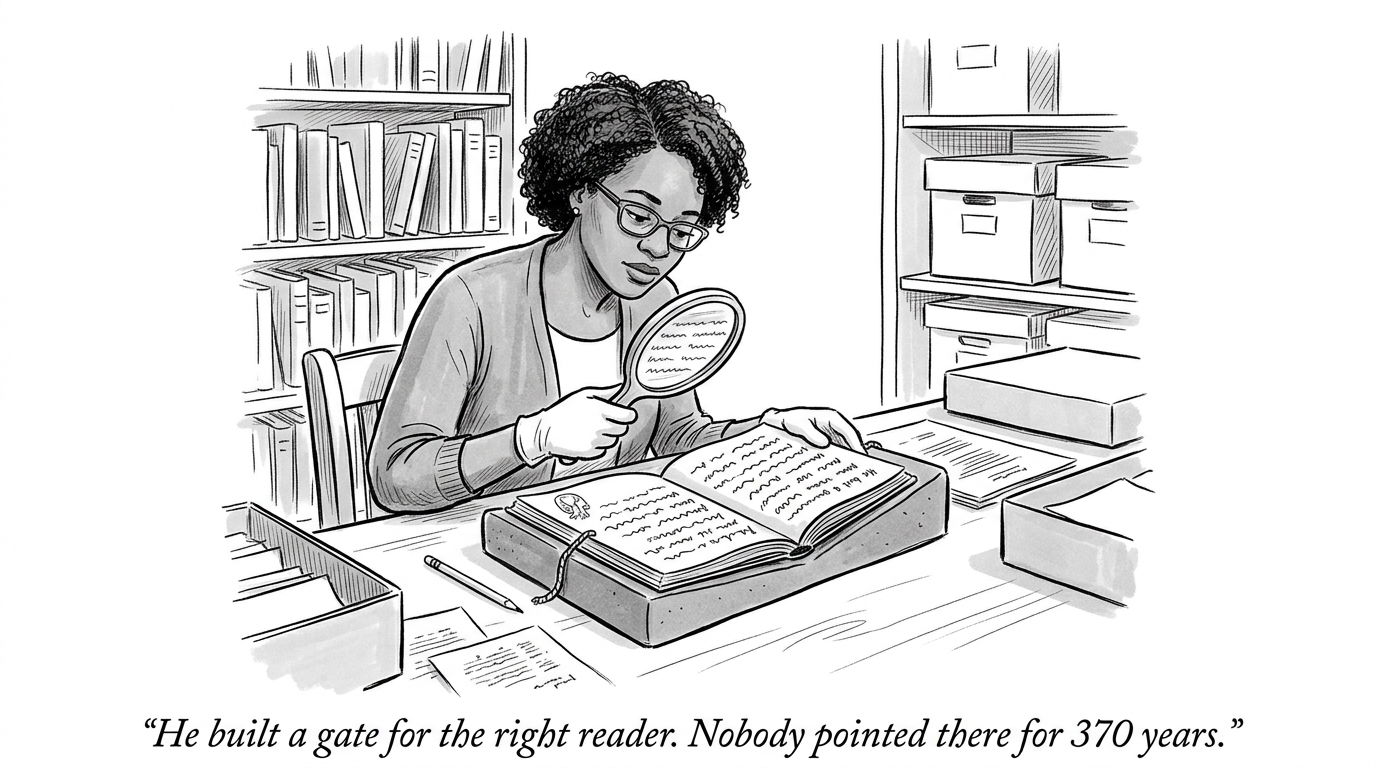
Leonardo's notebooks scattered after his death in 1519, passing through a chain of private owners across three centuries, in Milan, Paris, London, and Windsor.[5] The mirror-script filter did exactly what it was built to do the entire time -- a genuinely interested, sufficiently careful reader really could have decoded any given page. But almost none of them were ever given the chance to try, because almost none of them knew the notebooks existed, or where. It was not until 1883 that art historian Jean Paul Richter compiled, transcribed, and published The Literary Works of Leonardo da Vinci, organizing more than 1,500 passages from across the scattered manuscripts into a systematic edition and finally bringing them to a wide audience for the first time.[5] That is 370 years between the decree that ended Leonardo's dissection work and the moment a genuinely interested reader could find the gate at all -- not 370 years of the filter failing, 370 years of nobody being told it existed. Actual scientific confirmation of the specific aortic-valve claim came another 86 years after that, in 1969, once cardiology had the instruments to test it directly.[3]
This is the piece of the argument most accounts of "the cost of honesty" skip entirely. Full exposure and true silence get treated as the only two real options -- brave publication or safe erasure -- and everything in between reads as a failure to choose. Leonardo's case shows a real third option, sound in its own mechanism, with its own distinct failure mode that has nothing to do with courage. A filter that selects for the right reader still needs a second, separate thing to actually work: some way for the right reader to learn the gate is there at all. Leonardo solved the first problem completely. He never touched the second one, and the second one is what actually cost him three and a half centuries.
Even full exposure isn't one cost -- Claude Shannon shows the two halves can be paid separately
Information theorist Claude Shannon's 1948 paper was the opposite of gated -- published immediately, fully, and it reshaped every field it touched from the moment it appeared, with no analog to Leonardo's three-century wait. But Shannon still had a second, separate cost available to him, and he deliberately declined to pay it: after a brief taste of national fame following the paper's publication, he wrote asking the public to leave him alone and largely withdrew from public life, choosing career-long personal obscurity even as his technical work became foundational to modern computing and communication.[6] Inside his own field, this cost him nothing -- when he made a surprise appearance at a 1985 information theory conference, the reaction was "as if Newton had showed up at a physics conference." What he opted out of was the separate, public-facing cost of being a household name for it.[6]
The lesson this adds: "the cost of exposure" is not one bill. Exposing the work and being personally known for it are two different transactions, and Shannon's case proves they can be paid, or declined, independently. He fully paid the cost that let the theorem propagate. He never paid, on purpose, the separate cost of celebrity that would have come with it.
Why does this matter? The honest choice was never a straight line between silence and full public exposure, with courage as the only variable that moves you along it. Leonardo shows a real, legitimate third design -- gate the work behind genuine effort, filter for the reader who'll actually invest in it -- that is not cowardice and not failure, provided the second, separate problem gets solved too: making sure someone who would clear that filter ever learns there's a gate to try. Shannon shows the cost itself isn't indivisible -- exposing an idea and being known for it are two different prices, payable on two different schedules, or not at all. Knowing the actual menu of real options, and their real, distinct failure modes, is the difference between choosing deliberately and just hoping the version you happened to pick turns out to have been the safe one.
Companion pieces on this outlet: "Socrates Chose Death to Keep Examining. Galileo Recanted to Keep Living. Leonardo da Vinci Just Stopped Publishing...", "Bell Labs Built a 700-Foot Hallway on Purpose in 1941...", "Give grace", and "How to Build a Mind."
- Wikipedia, Dialogue Concerning the Two Chief World Systems
- Plato, Apology of Socrates (38a) -- via Center for Hellenic Studies
- Circulation Research (American Heart Association), Cardiovascular Research by Leonardo da Vinci (1452-1519)
- British Journal of General Practice (PMC/NIH), Leonardo da Vinci: anatomist
- Discovering da Vinci / Wikipedia, Jean Paul Richter and The Literary Works of Leonardo da Vinci (1883)
- IEEE Spectrum, Claude Shannon: Tinkerer, Prankster, and Father of Information Theory
- Tversky, A. & Kahneman, D., Availability: A Heuristic for Judging Frequency and Probability, Cognitive Psychology (1973)