The Hiring Decision Is the Filter
My family did not know what I actually did for a living for multiple decades. Not because I was hiding it out of some personal habit, though I probably was that too. The intelligence community hires for people who don't talk, and it doesn't stop selecting for that once you're inside. It runs the filter again, silently, on how you live at home. I've written elsewhere about where that instinct came from in me personally. What I want to write about here is the institution's side of it -- the fact that an organization can select so precisely for one trait that the trait outlives the job itself and reshapes a person's whole life, including the parts that were never supposed to be classified.
The nuclear industry does a version of the same thing, more visibly. It recruits heavily from the submarine service, and not because a submarine and a reactor control room look alike on a resume. It's because someone who has served on a submarine has already lived inside catastrophic, enclosed-system risk -- the kind where a mistake doesn't get walked back, it gets absorbed by everyone in the room at once. You cannot train that understanding into someone with a manual. You can only hire someone who already has it, formed somewhere else, under conditions nobody would volunteer to recreate just for the sake of the résumé line.
Apple says what it selects for out loud, which makes it the easiest case to check. Tim Cook has told students directly that Apple looks for people who want to change the world, who want to enrich people's lives, who are willing to work for a reason bigger than themselves. That's not a vague values statement pulled from a careers page. It's consistent enough, across enough of his own public remarks, that I think it's real. And it shows up again, unmistakably, in how the company just handled its own succession. John Ternus, a twenty-five-year Apple engineer, becomes only the third CEO this company has had this century -- Jobs, then Cook, then Ternus. Cook's own letter announcing the change echoes, almost word for word in spirit, the letter he sent fifteen years earlier when he took over from Jobs. Both times, the message wasn't about credentials or a search process. It was about continuity -- the same culture, the same DNA, carried forward by someone who had already spent decades inside it. Apple isn't hiring smart people at the top. It's hiring its own culture back into itself, generation after generation, on purpose.
Meta and Google, as far as I can tell, run a different filter -- one that reads to me as selecting hard for raw intelligence without the same visible weight on ethics. I want to be honest that this is my own read, not something I've verified with the same rigor as Cook's own public statements. But if it's even partly right, it's the sharpest possible contrast to Apple sitting right next to it: two companies competing in the same industry, for a lot of the same kind of talent, filtering for almost opposite things at the door.
None of these are the same trait, and that's the actual point, not an exception to it. The IC filters for silence. The nuclear industry filters for lived risk-tolerance. Apple filters for a specific kind of mission-driven care, entrenched enough to survive a founder's death and a second full CEO transition without losing its shape. Whatever Meta and Google are actually filtering for, it isn't the same thing as any of the other three. Each institution is selecting for exactly what it needs to survive its own particular kind of failure, not for some shared, portable definition of talent.
A handful of American companies built cultures durable enough to run for a century or more on the strength of what they selected for -- IBM's own training and culture discipline, General Electric's internal management pipeline, DuPont's safety-first industrial culture, forged over generations of running high-consequence chemical and manufacturing sites. Each one is proof that a hiring filter, sustained long enough, becomes something closer to an institution's actual immune system.
Sears is the proof that runs the other way, and I think it's the case that actually completes the argument rather than just adding another name to the list. Sears was every bit as durable as IBM or GE for most of the twentieth century. Then, starting in the 2000s under Eddie Lampert, the company restructured itself into dozens of internal business units, each one run like its own separate company, forced to compete with the others for capital and resources instead of cooperating toward the same goal. That wasn't a strategic misstep sitting on top of an intact culture. It was a change to the filter itself -- a deliberate decision about what kind of behavior would now get rewarded inside the company -- and the culture that grew out of it was internal competition, not the cooperation that had carried Sears for a hundred years. The company didn't just fail to survive its crisis. It built, on purpose, the exact culture least equipped to survive one.
I keep coming back to a smaller company for the clearest version of why this matters. A man I know ran an independent mortgage lender through 2008 and then again through the very different collapse of 2022 and 2023, and he didn't hire for skill at underwriting. He hired for temperament, using an actual behavioral instrument, because skill is trainable and temperament isn't, and what he was really trying to buy was a culture that could absorb a mistake and recover from it rather than one bad year ending the company.
He wasn't ahead of his time by accident. Close to two-thirds of employers now use some version of the same instrument for entry-level hiring, according to NACE's own surveys -- not because they went looking for Eric's method, but because they lost the signal they'd been using instead. A resume used to be legible enough to sort candidates by. It stopped being one once a language model could write a plausible one for anyone claiming to know anything, and skills-based assessment is what's left standing once the easier signal breaks. Eric didn't need AI to break the resume for him. He already knew it was never the thing worth reading closely.
I have to hold a real tension here rather than smooth past it, because I've taken that same test myself, not as a job applicant, and I hated it. My own view is that caring is something a conversation can find room for and a scored instrument cannot -- it takes an actual back-and-forth to sit inside the ambiguity of a person who might be exactly the right hire and might not, in a way a fixed set of questions doesn't leave space for. I don't think that makes the test worthless. I think it means the test worked well enough, often enough, across enough hires, to build the culture it was aiming for, while still being a real, informed critique of what any such instrument necessarily flattens about the people it's scoring. Both of those are true at once, and I'd rather leave them both standing than resolve it into a cleaner story than the one I actually believe.
People are fallible. Every institution on this list already knows that, whether or not it says so out loud. The ones that survive aren't the ones that filtered out fallibility. They're the ones whose hiring decision quietly built a culture with room to recover from it.
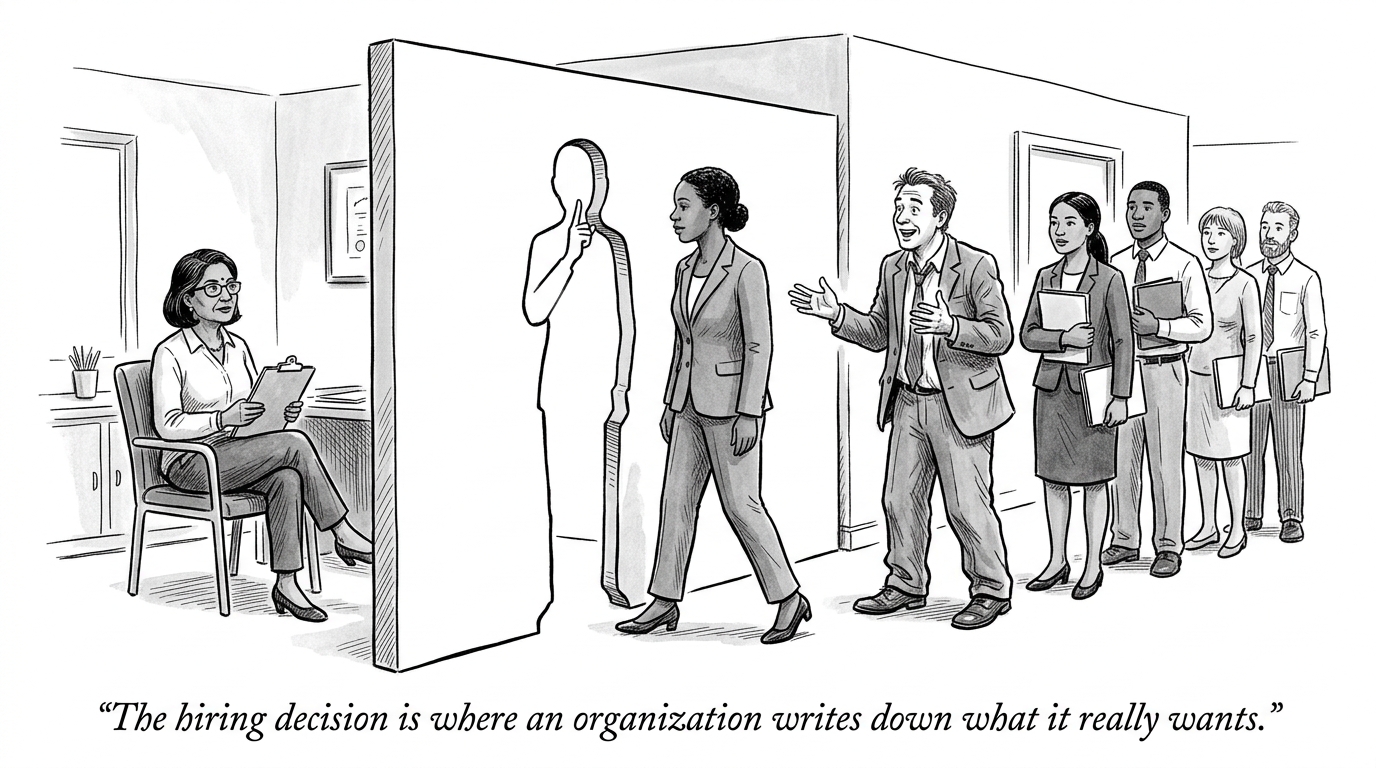
That's the actual mechanism, I think, underneath every case here. The hiring decision is the filter. It's where an organization's real priorities get encoded, honestly, whether or not anyone ever writes them down as a mission statement. And when the crisis eventually comes -- a market collapse, a founder's death, a reactor alarm nobody wants to hear -- it isn't the org chart or the strategy deck that determines what happens next. It's whoever the filter let through the door, years before anyone knew a crisis was coming at all. Culture always wins, because culture was never really a separate thing from who got hired in the first place.
Part of the same family: "How Things Actually Move" and "The Cost of Going Public."