The Arc of the Argument
Vision tells Wanda she could never hurt him, then asks her to destroy the stone in his own head anyway. Thanos gets the stone back minutes later -- not by beating that choice, by rewinding it, then snaps half of everything out of existence with a hand that costs him nothing. Tony gets it back the only way it can actually be gotten back: by doing the identical thing Vision did, on purpose, knowing exactly what it costs, with no version of the ending where he's still standing in it afterward. Three sacrifices, in the same run of movies, and only two of them are real. The third is capability pretending to be a choice.
The suit before the ending
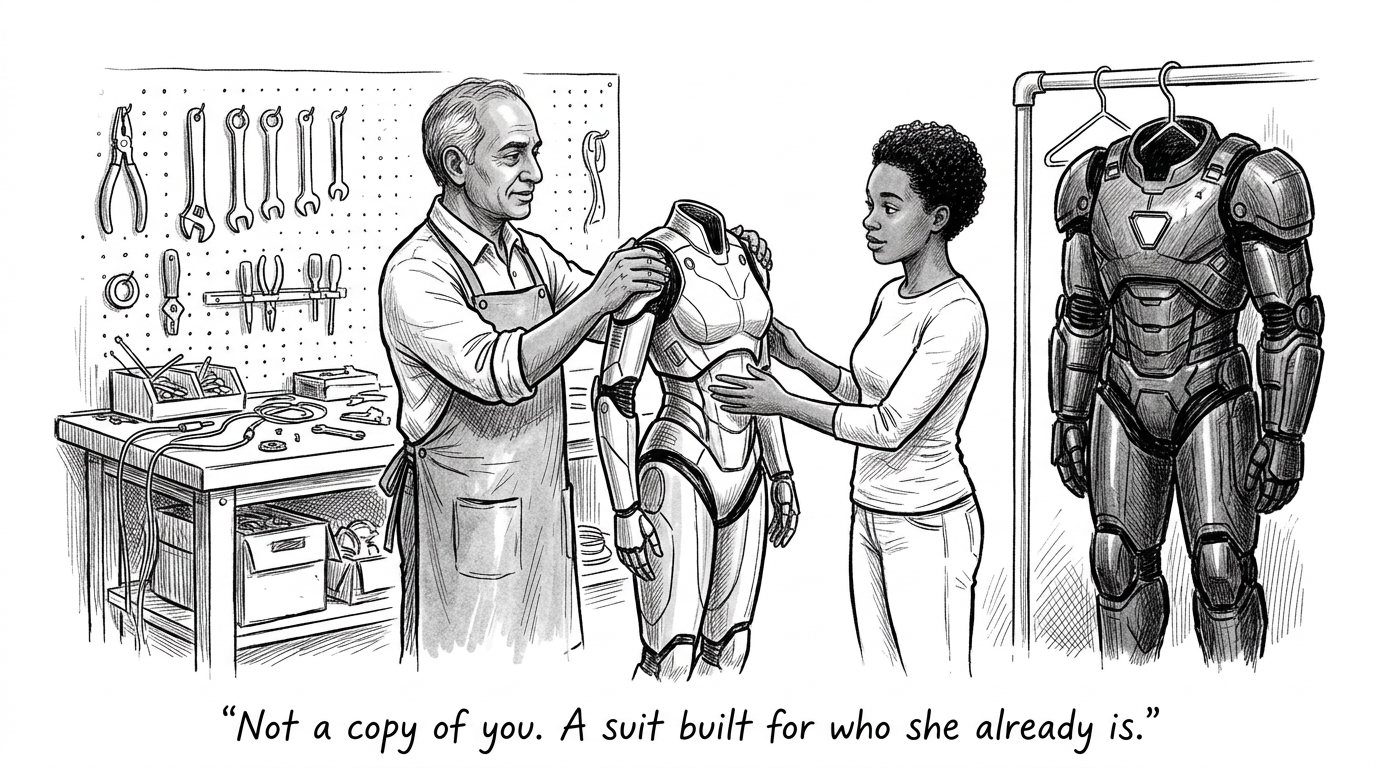
The detail I keep coming back to isn't the snap. It's what happens before it. Tony gives Pepper a suit. Not protection -- capability. She isn't standing behind a wall when the fight comes, she's in it, on her own terms, because he made sure of that before he ever needed to disappear. That's not a smaller beat than the sacrifice. It's the reason the sacrifice completes something instead of just ending it.
The arc, stated plainly
Watching all of it back to back, the shape of the whole argument finally sat still long enough to say in one sentence: we drop in, we do what we can, and we equip the next generation to do what they can. Nobody arrives with a clean slate or a finished job waiting for them. You get handed a situation already underway, you do the part that's actually yours to do, and the only piece of it that outlives you is whatever you managed to hand off before you had to leave the room.
Equipping is not duplicating
The temptation, watching that, is to think the goal is to make the next generation more like you -- pass down what you know, hope they run the same plays you did. That's not what Tony does. He doesn't teach Pepper to be Iron Man. He gives her a suit built for who she already is, so she can do something he couldn't do, standing somewhere he can't stand. A copy inherits your blind spots along with everything else. Equipping someone gives them an actual shot at not having yours.
Not a gap. A proving ground.
It isn't that I couldn't do this myself. Their ceiling is higher than mine, plainly, and what I'm actually building isn't a patch for something I lacked -- it's the proving ground for a capacity that's already there and needs somewhere real to get tested. Mandarin, starting at three years old instead of thirteen, isn't me handing my kid a shot I never got. It's me recognizing the ceiling is higher on their side of this than it ever was on mine, and making sure there's an actual arena for it instead of leaving it untested.
That's the sharper version of the whole arc, and it's the part easy to get backwards: you don't equip the next generation because you fell short. You equip them because what they're capable of is already bigger than what you were, and the only real failure available to you is building no proving ground for it at all. Run at the smallest scale there is instead of a snap that saves half the universe, it's the same claim: you don't get to finish it. You get to build the ground real enough that the next person can prove something you were never going to reach yourself.
This isn't a new argument. It's the oldest one there is
Moses leads forty years toward a land he's shown from Mount Nebo and is not allowed to enter. He sees it and dies outside it. King, in Memphis, the night before he was killed, closed his own last speech standing in that exact story on purpose: he'd been to the mountaintop, he'd seen the promised land, he might not get there with everyone else -- but they would get there. He wasn't speaking in metaphor. He knew which story he was standing in and said so out loud anyway, the day before it became literally true.
That's the real version of what a synthetic mind picking up a hammer and an armored suit handed to a widow were standing in for all along. Not getting to the room isn't the tragedy in this shape of story. It's the normal case. The only real failure is building nothing real enough for someone else to walk into it once you're not the one standing there anymore.
Reaching for Moses and King here isn't a flourish borrowed for the occasion. I went to Catholic school. The Abrahamic books were on the shelf before Marvel ever was, and I read King, Malcolm, and Baldwin in one breath as a kid with nothing sorting them into separate lanes. The same reflex that reaches for Vision or Tony Stark on a Tuesday night reaches for Nebo and Mason Temple just as fast, because they were never actually stored in different places to begin with.
It's the same wager underneath all of it, and it isn't special to Tony Stark or to me. It's the wager everyone makes the day they have a kid. You put something real on the table -- years, money, love you can't take back once it's given -- against an outcome you don't get to see the end of and don't get to control. Pascal needed a machine that could hold something to lose before it could be said to have made a real choice about anything. Every parent already has that. The wager isn't a movie plot or a philosopher's thought experiment. It's Tuesday, and one of my kids needs a haircut, and none of that makes the bet smaller.
Part of the same thread: "Vision Can Lift Thor's Hammer. Most Humans Can't," "The Construction Material," and "A Native English Speaker Needs About 2,200 Classroom Hours to Reach Fluency in Mandarin."