The Construction Material
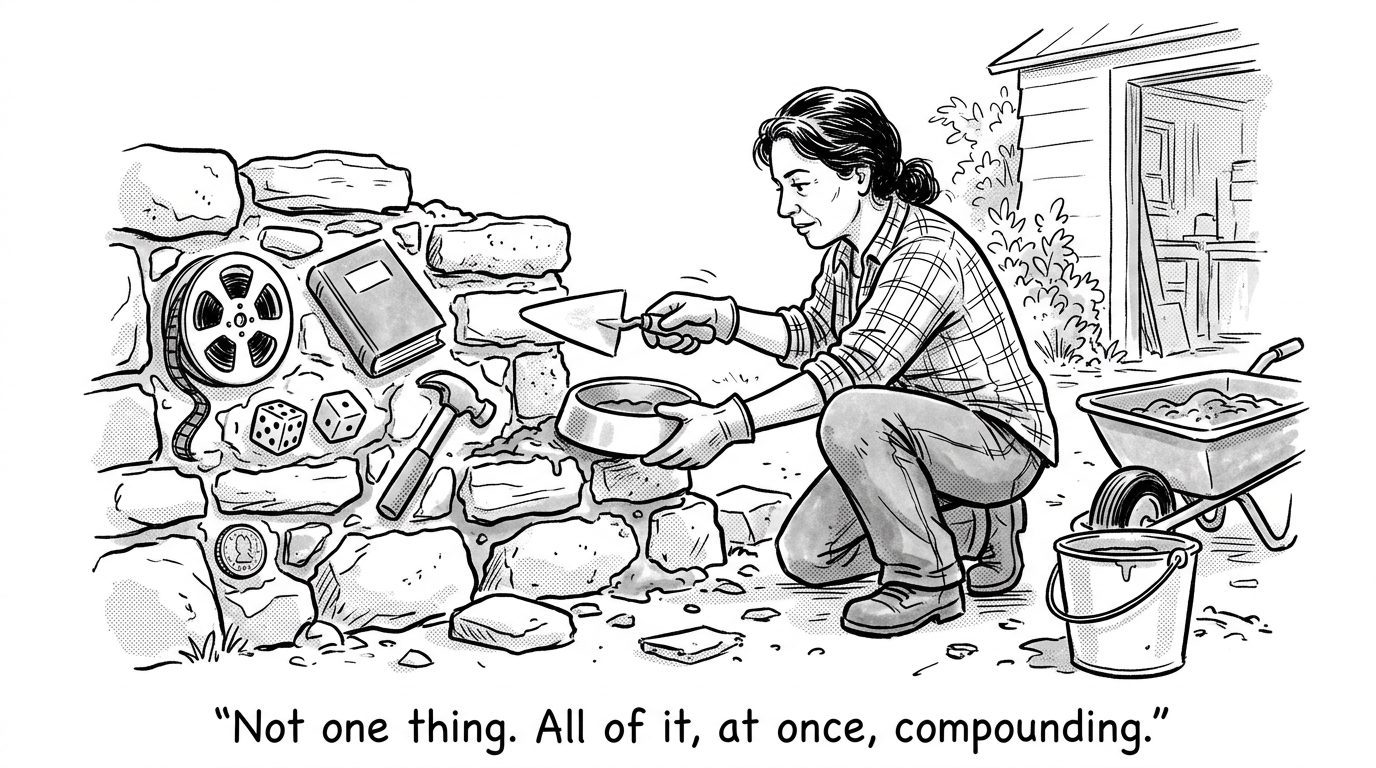
Hershey doesn't care what's happening in Wakanda. He got fed the same way he gets fed every night, on his own schedule, in the middle of a viewing marathon -- all three Iron Man movies, three Avengers movies -- that also turned out to be, without my planning it that way, two days of real work. Somewhere around Vision picking up a hammer nobody else in the room could lift, I had to go feed a dog. Neither of those things was an interruption of the other. They were both just happening, at the same time, the way everything actually happens.
No single thing produced the idea
I ended up, two days later, with a sentence I'm fairly proud of: the machine has no wager. Pascal's whole argument only works if the person making the bet has something real to lose -- and nothing shipping today, in any robot at any price, has that yet. If you ask me where that sentence came from, I can't point to one place. Not the movie, though Vision's actual death is in there -- asking Wanda to destroy the stone in his own head, knowing it would kill him, telling her plainly she could never hurt him. Not Pascal, though the wager itself is in there too, three hundred and fifty years old and still doing real work. Not the two days themselves, though the idea clearly needed all of them and wasn't going to arrive in one sitting. It's not one thing. It's all of it, at once, compounding.
That's not a special case. That's just how it works
I said it plainly once I noticed it myself: it is the construction material, not one thing. For humans, everything just compounds. Nothing I actually think gets produced by one input in isolation -- not a movie, not a conversation, not a fact I looked up an hour before. It's the accumulation, running continuously, whether or not I'm paying attention to it running. Iron Man on its own gave me nothing. Neither did Age of Ultron, or Infinity War, or Pascal, or a dog's feeding schedule. Together, on a two-day clock I didn't control the pace of, they gave me a sentence. That's not a metaphor for how thinking works. That is how it works, for me and for everyone I've ever actually watched think something true.
Which is exactly where I think the AI's actual job is, and isn't
I've been careful, in the pieces I've built this year, to say plainly when AI wrote alongside me, instead of leaving it in a footer nobody reads. That instinct isn't modesty. It's precision about which half of the work belongs to whom. The compounding above -- the movies, the two days, the feeding schedule that doesn't pause for any of it, the decades of formation sitting underneath tonight before tonight ever started -- that's mine. It ran on its own clock, unassisted, the way it's run my whole life. What the AI actually did was narrower than "help me think," and I think more honest: it turned an idea that had already finished compounding into something sourced, checked, and built fast enough to keep pace with how fast the compounding was actually moving. It didn't have the idea. It didn't watch the movies. It didn't feed the dog. It caught up to what had already happened in me, and made the catching-up nearly frictionless.
The point was never to think faster
I don't want a tool that thinks for me, and I don't think that's actually available at any price, whatever anyone is currently claiming about their model. What I want, and what I think I actually have now, is closer to this: the compounding still takes what it takes -- two days, six movies, a dog, whatever the real number turns out to be on any given idea -- but the distance between the moment it finishes compounding and the moment it exists somewhere real, sourced and checked and published, has gotten short enough that the idea doesn't sit around losing shape while I find time to build it. That's the whole claim. Not smarter. Not faster thinking. Less friction between what I already know, once I actually know it, and what gets said.
The compounding has a blind spot too, and it's mine
Einstein defined relativity -- held results as strange as time bending and simultaneity breaking down against everything Newton had settled -- and still could not accept quantum mechanics. Decades of arguing against it, and he never got there. Not because he stopped being smart. Smart and blind aren't opposites. They run at the same time, in the same mind, on different subjects.
I read King, Card, and Baldwin in one breath as a kid -- no sort between them, no shelf that said this one is for understanding race and that one is for understanding economics. Holy Spirit High School put a real cross-section of South Jersey in one room, and I got to sit in it. That's real, and it's most of why I can hold two true things at once instead of picking a side. But it was one cross-section. Not every one. Being unsorted inside the room I was actually in was never the same claim as having been in every room there is.
Which means the writing that comes out of all this compounding -- the pieces on this site, tonight's included -- has the same shape. Smart in the places the compounding actually reached. Blind in the places it never got exposure to, and I won't always know which is which from the inside, the same way Einstein couldn't see his own blind spot on indeterminism from inside a mind that had just finished redefining physics. If I'm going to say that plainly about myself, it should be said here, in the piece, not held somewhere only I can see it.
Part of the same thread: "Vision Can Lift Thor's Hammer. Most Humans Can't," "The Wager and the Decision to Make It," and "Recognizing the Shot."