Reading the Trend Line
Between 1963 and 1973, this country shot six of its own major political figures. Medgar Evers, shot in his own driveway in June of 1963. John Kennedy, that November. Malcolm X, February of 1965. Martin Luther King, April of 1968. Robert Kennedy, that June, the day after he won California. George Wallace, 1972, survived, paralyzed for the rest of his life. A civil rights field secretary, a sitting president, a revolutionary, an icon, a candidate, and a segregationist candidate -- the entire spectrum of American political conviction, all shot at, within one decade, for reasons that were never all the same reason. You don't need every one of those cases to trace back to a single tidy motive to see the actual pattern. The pattern is that for about ten years, this country kept answering political disagreement with a gun, no matter which side of the disagreement was doing the answering.
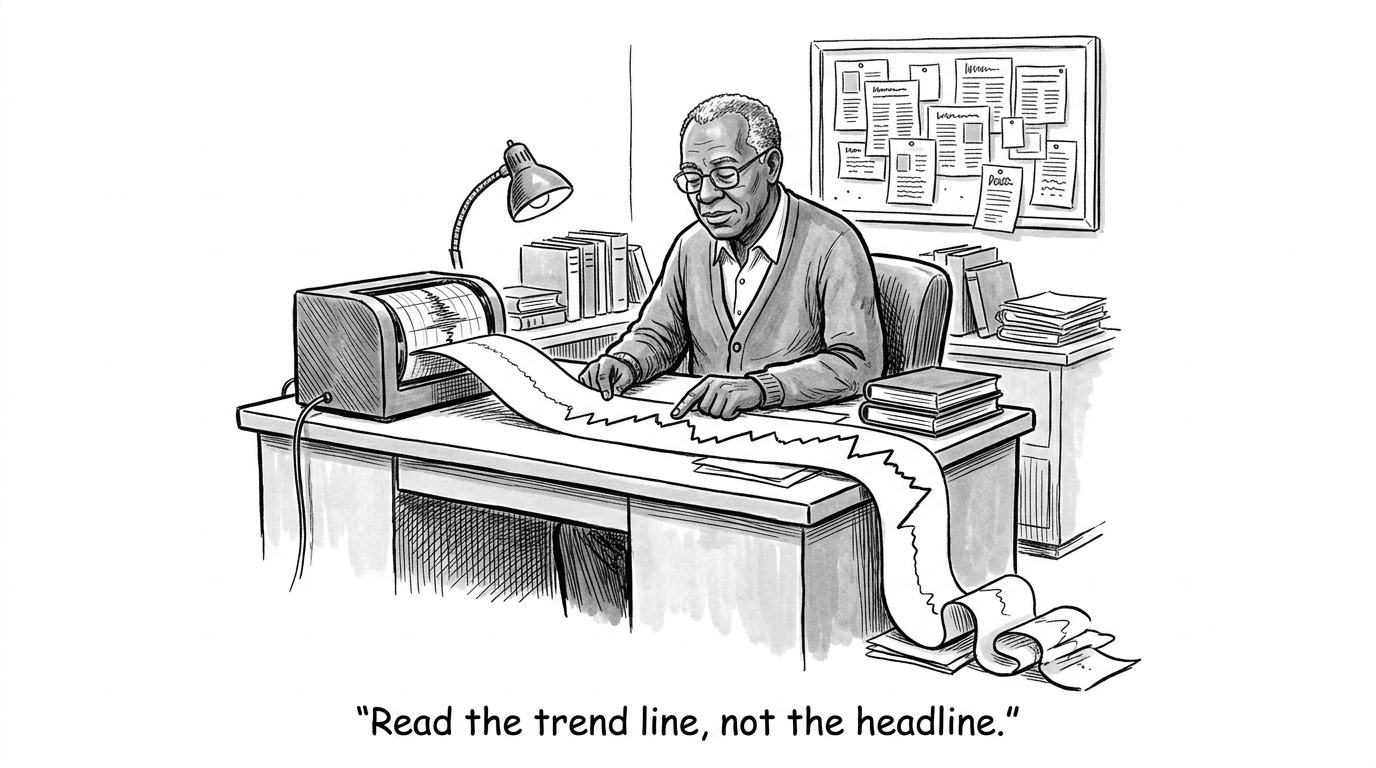
I've spent decades adjacent to how this country actually governs itself -- not as a casual observer of the news, but from inside rooms where the machinery of national security and public trust gets built, funded, and argued over. I'm not going to describe what I saw there beyond that. Politics in Washington is a contact sport, and it always has been -- sharp elbows, real rivalries, people who will use every legitimate tool available to end a career or kill a bill. That part is normal. That part is not what worries me, and I want to be precise about the line, because blurring it is exactly how a real warning gets dismissed as just more noise about how nasty politics has always been. What that time taught me, if it taught me anything durable, is how to read a trend line instead of a headline -- and the trend line I'm actually describing here is not contact-sport politics turning up the volume. It's contact-sport politics being replaced by an actual gun.
This isn't a concern I've had since this morning. I said the same thing to two of my own fraternity brothers more than a year ago -- before I had a single one of the numbers below in front of me, just from reading the temperature of the rooms I'd spent decades in. I'm not writing this because a headline scared me recently. I'm writing it because the thing I said out loud to people who know me well over a year ago now has numbers attached to it, and the numbers say I wasn't wrong to say it.
Capitol Police are on track to investigate over 14,000 threats against members of Congress in 2025, up from roughly 9,500 the year before -- a 58 percent jump in a single year, and a 50 percent increase since 2018. Threats against federal judges doubled between 2021 and 2023. The Supreme Court's own police force is planning for a 38 percent increase in violent threats in 2026, on top of a 28 percent increase the year before. Threats against local officials -- mayors, city council members, election workers -- rose 74 percent from 2022 to 2024. The University of Maryland has tracked politically motivated violence in this country since the 1970s, which means they were counting during the last decade this happened too, and they recorded 150 politically motivated attacks in just the first six months of 2025 -- almost double the same period the year before.
And the actual incidents, not just the threat counts, already span the whole spectrum the way the 1960s and 70s did. Steve Scalise, shot at a congressional baseball practice in 2017. Two separate assassination attempts on Donald Trump in 2024, one close enough to draw blood. Minnesota state representative Melissa Hortman and her husband, killed in 2025. An arson attack, with Molotov cocktails, at Governor Josh Shapiro's home. Charlie Kirk, shot and killed by a sniper at a public event. I am naming these together on purpose, the same way I named the six names from the 1960s and 70s together on purpose. This isn't a story about one side of American politics turning violent while the other side stays civil. It's a story about the temperature of the whole country rising at once, the identical shape as the last time this happened, with different names attached to it.
Here is where I have to be honest about what I don't know, because a concern this serious deserves more care than a clean, satisfying narrative. I don't know if this becomes 1963 to 1973 again. Trend lines can flatten. A country can notice itself doing this and pull back, the way it eventually did the first time, through mechanisms that took years to build and longer to trust -- more distributed security, more public revulsion, exhaustion with the cost of it. I also know that every one of the numbers above was measured before whatever happens next, which is the nature of a trend line -- it tells you the direction, not the destination, and it has been wrong about destinations before.
What I do know, from decades spent reading exactly this kind of signal for a living in rooms I'm not going to describe further, is that the instinct to wait for a single dramatic event before calling something a pattern is usually the instinct that gets the pattern wrong. Patterns don't announce themselves with one unmistakable moment. They show up first as a threat count nobody outside a few offices is reading, rising every year, across every kind of official, for half a decade, until one day the six names are already a list before anyone agreed to start counting.
I'm not writing this to tell anyone which side is right. I'm writing it because I've spent enough of my life around how this country actually holds itself together to know what it looks like when the numbers start telling you something before the headlines do, and I would rather be wrong about naming it too early than right about staying quiet until it was too late to matter -- and I already was too early once, more than a year ago, to two people I trust enough to have said it to before I had a single number to back it up.
Part of the same family: "How to Build a Mind," "The Pleasantville Year," "Proximity to Power Is Not Access," "Grace and the Vote," "Rigor, Regardless," and "The Cost of Going Public."